
Introduction
In retail chains and clothing and accessories brands, a single product can exist in dozens of variants — size, colour, design and batch — each with its own SKU. Counting that stock by hand is slow, and variants are easily miscounted or missed. Scan based inventory verification for retail replaces manual tallying with item-by-item barcode or QR scanning on a mobile application, matched against the book stock.
At TagMyAssets, we carry out scan-based inventory counts for retail chains and apparel brands using our own inventory verification applications, and reconcile the results against the ERP stock.
This article explains why apparel stock is hard to count, how a scan-based count runs, and what the output looks like. It is part of our wider inventory verification services in India.
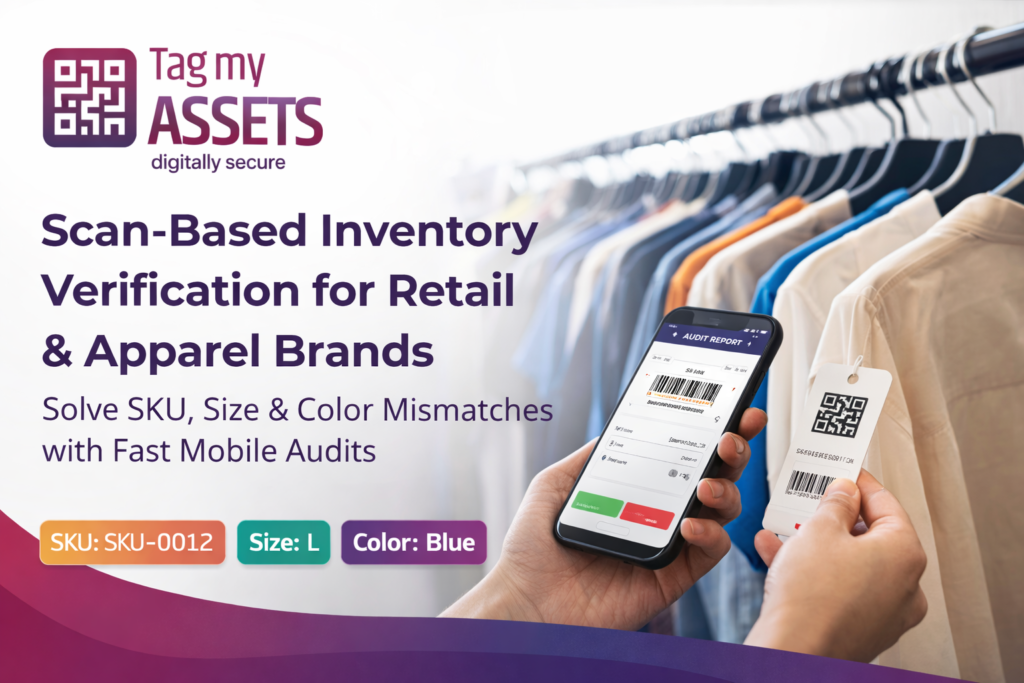
What Is Scan-Based Inventory Verification in Retail?
Scan-based inventory verification is a count in which each product’s barcode or QR code is scanned with a mobile application. Each scan captures:
- SKU code
- Product name
- Size
- Colour
- Style / design
- MRP
- Location (store, warehouse, bin)
- Quantity
The scanned data is synced to the cloud and matched against the company’s ERP or inventory records. Because each unit is read from its label rather than written down, the transcription errors of manual counting largely drop away.
Why Inventory Verification Is Complex in Apparel & Accessories
Unlike FMCG or electronics, fashion inventory has multiple variations of a single product. For example, one T-shirt may come in:
- 5 colours
- 6 sizes
- 3 designs
That is 90 SKUs for one item. Counting these by eye, a size or colour is easily logged against the wrong SKU.
Key Challenges Faced by Retail Chains
1. High SKU Complexity
Each size and colour has a different SKU. Manual verification often leads to:
- Wrong entries
- Missing variants
- Duplicate counting
2. Frequent Stock Movement
Retail stores experience:
- Daily sales
- Inter-store transfers
- Returns
- Exchanges
- Damaged goods
This creates continuous mismatches between system and physical stock, which is why a count needs a firm cut-off.
3. Poor Barcode Quality
Many brands face:
- Faded labels
- Torn tags
- Wrong barcode printing
Unreadable labels slow the count and have to be resolved by SKU lookup.
4. Time Constraints
Because stock moves every trading hour, retail counts are usually run overnight or on a closed day, so the count reconciles against a fixed book position. The window is short, and manual counting struggles to finish inside it.
5. Shrinkage & Pilferage
Without regular verification, losses from theft, misplacement and misbilling stay hidden in the book stock until someone counts it.
Our Scan-Based Inventory Audit Methodology
At TagMyAssets, a retail count follows six steps.
Step 1: Pre-Audit Data Mapping
Before the count, we map:
- Master SKU list
- ERP stock extract as at the cut-off
- Store codes
- Category structure
This makes reconciliation straightforward once the count is done.
Step 2: Application Set-Up
Our inventory application is configured with:
- The brand’s SKU format
- Size and colour mapping
- Store hierarchy
- Validation rules
Validation rules flag scans that do not match the SKU master at the point of capture.
Step 3: Physical Scan-Based Count
Our audit team scans:
- Hanging garments
- Folded stock
- Accessories
- Backroom inventory
- Display units
Each item is scanned individually. Photos and location data are captured where required.
Step 4: Cloud-Based Data Sync
Scanned data is uploaded to our cloud platform as the count proceeds, so coverage and quality can be monitored during the night rather than after it.
Step 5: Reconciliation & Variance Analysis
Scanned data is matched with the ERP stock to identify:
- Shortages
- Excess stock
- Wrong SKUs
- Missing variants
- Non-moving items
Step 6: Management Reporting
We provide:
- Store-wise reports
- Category-wise reports
- SKU-wise variance
- Ageing analysis
- Shrinkage summary
These reports support statutory audit, internal audit and management decisions.
What It Looks Like in Practice
In one retail engagement, 50 auditors counted more than 100,000 SKUs in a single overnight window, from 8 PM to 10 AM, and the count was reconciled against the ERP before the store reopened. The full account is in our mobile inventory verification case study.
Benefits of Scan-Based Inventory Verification for Retail Brands
1. Fewer Recording Errors
Each unit is read from its label, so SKU, size and colour are captured as printed rather than written down. Most retail brands follow GS1 barcode standards, which keeps SKU identification uniform across stores.
2. Counts That Fit the Window
Parallel teams scanning into one dataset can complete a large store within an overnight or closed-day window, which avoids trading disruption.
3. Better Stock Visibility
Management sees, by SKU and location:
- Fast-moving SKUs
- Dead stock
- Excess inventory
- Missing variants
4. Earlier Detection of Losses
Regular counts bring shrinkage to light sooner, which is what makes pilferage and leakage controllable.
5. Better Replenishment Planning
Accurate stock data supports procurement decisions and helps avoid overstocking.
6. Audit Evidence
A documented, reconciled count supports statutory audit, internal audit and investor reviews. For the audit side of stock counts, see our guide to physical verification of inventory.
Why TagMyAssets for Retail Inventory Verification?
- Trained audit teams for overnight and closed-day counts
- Our own inventory verification applications
- Cloud-based reporting
- Pan-India execution
- Variance output in a structured format your ERP team can use
- Experience of multi-store retail counts
Frequently Asked Questions (FAQs)
Q1. Can scan-based audits work if barcodes are damaged?
Yes. Damaged or unreadable labels are resolved by SKU lookup against the master list, with manual validation where required.
Q2. Can you audit stores overnight?
Yes. Inventory counts are usually run after store closure or on a closed day, so the count reconciles against a fixed book position without disrupting trade.
Q3. Can the results be matched to our ERP?
Yes. The count is reconciled against an ERP or POS stock extract taken at the cut-off, and the variance output is shared in a structured format your ERP team can use.
Q4. How often should retail inventory be verified?
It depends on stock value and movement. Many large chains count quarterly; others count half-yearly, with cycle counts in between.
Q5. Do you operate outside Delhi NCR?
Yes. TagMyAssets carries out inventory verification across India.
Q6. Why is scan based inventory verification for retail better than manual counting?
Each unit is read from its label rather than written down, which reduces recording errors and lets parallel teams finish inside a short count window.
Conclusion
For retail and apparel brands, thousands of size and colour variants make manual counting slow and error-prone. Scan-based counts bring each unit’s identity straight from its label into a reconciled dataset, with variance reporting by store, category and SKU.
To plan a count, write to connect@tagmyassets.com or call 9650003293.