
Asset tagging for facility management companies supports tracking corporate office infrastructure, IT equipment, and furniture across multiple buildings and client locations.
These organizations are responsible for maintaining thousands of physical assets such as workstations, meeting room equipment, IT infrastructure, HVAC systems, and security devices.
Without a structured system, tracking these assets across multiple floors, buildings, and client locations can become difficult.
This is where asset tagging comes in.
Modern facility management companies are increasingly adopting QR code, barcode, and RFID asset tagging solutions to maintain accurate asset records and improve operational efficiency.
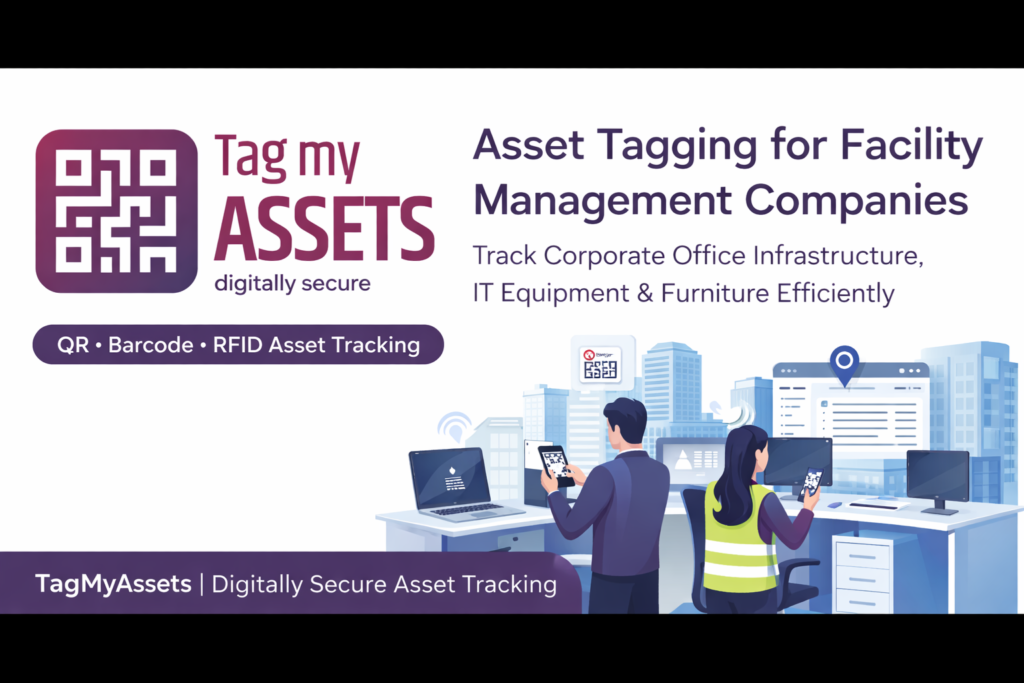
Asset tagging for facility management companies helps track corporate office infrastructure and IT equipment.
Challenges Faced by Facility Management Companies
Facility management teams often handle assets across multiple client offices and locations, making asset tracking a complex task.
Common challenges include:
1. Assets Spread Across Multiple Locations
Large corporate offices may span several floors or buildings.
Assets such as chairs, monitors, printers, and networking equipment are often moved between departments.
2. Shared Infrastructure
In managed office environments, some assets belong to the facility operator while others belong to individual clients.
Examples include:
- Conference room displays
- Access control systems
- Printers and networking devices
- Pantry appliances
Maintaining clarity on asset ownership is critical.
3. Frequent Asset Movement
Office furniture and IT equipment are regularly relocated due to:
- New employee onboarding
- Office reconfiguration
- Client expansions or reductions
Without proper tagging, assets can easily become untraceable or misallocated.
4. Manual Asset Registers
Many organizations still maintain asset records in Excel sheets, which often become outdated quickly. Manual tracking results in:
- Missing assets
- Incorrect asset locations
- Inaccurate depreciation records
Why Asset Tagging Matters for Facility Management Companies
Asset tagging provides each asset with a unique identification number, which can be scanned using mobile devices.
Common tagging technologies include:
- QR Code Tags
- Barcode Labels
- RFID Tags
- Metal Asset Tags
Each asset is linked to a digital database containing:
- Asset ID
- Location
- Department or client
- Purchase details
- Maintenance history
This gives facility teams a single asset register to verify against. To understand asset tagging in detail, read our complete guide on asset tagging.
Typical Assets Managed by Facility Management Companies
Facility managers handle a wide range of infrastructure assets.
| Asset Category | Examples |
|---|---|
| Office Furniture | Workstations, chairs, meeting tables |
| IT Equipment | Laptops, monitors, docking stations |
| Networking Devices | Routers, switches, WiFi access points |
| Security Equipment | CCTV cameras, biometric systems |
| HVAC Systems | Air conditioners, ventilation units |
| Pantry Equipment | Coffee machines, refrigerators |
| AV Equipment | Projectors, video conferencing systems |
Proper tagging helps maintain accurate records of these assets.
Benefits of Asset Tagging for Facility Management Companies
1. Faster Asset Audits
Scanning tagged assets is substantially faster than matching register descriptions to items by hand.
2. Accurate Asset Database
Each asset carries a unique ID linked to its record, so differences between the register and the floor can be identified.
3. Clear Ownership Tracking
Facility managers can easily distinguish between:
- Operator-owned assets
- Client-owned assets
4. Improved Maintenance Planning
Tagged assets can be linked to service records in the client’s own maintenance system.
5. Reduced Asset Loss
Tagging makes misplacement and unrecorded movement visible at the next verification.
Asset tagging for facility management companies helps maintain accurate asset records across corporate offices and managed workspaces.
A professional asset tagging project usually includes the following steps:
1️⃣ Physical Verification of Assets
Teams identify and document all assets across the facility.
2️⃣ Asset Data Collection
Important information such as asset type, location, and department is recorded.
3️⃣ QR / Barcode Tagging
Durable tags are attached to each asset.
4️⃣ Mobile App Scanning
Assets are scanned using handheld devices or mobile apps.
5️⃣ Reconciled Asset RegisterFindings are reconciled against the Fixed Asset Register and delivered as an Excel register for later verification cycles.
How TagMyAssets Supports Facility Management Companies
TagMyAssets carries out asset tagging, physical verification and FAR reconciliation as a field service for large corporate offices and commercial facilities.
Services include:
- Physical verification of assets
- QR code and barcode asset tagging
- RFID tagging for high-value assets
- Mobile-based data capture during tagging and verification
FAR reconciliation and variance reporting
The output is a reconciled asset register covering every client location and building in scope.
Learn more about our Fixed Asset Management Services:
https://tagmyassets.com/fixed-asset-management/
How Asset Tagging for Facility Management Companies Improves Asset Visibility
Asset tagging for facility management companies improves asset visibility across corporate offices, commercial buildings, and managed workspaces.
By assigning a unique QR code, barcode, or RFID tag to each asset, facility managers can quickly identify and locate assets using mobile scanning devices.
In large corporate environments where assets are spread across multiple floors, departments, and client areas, maintaining visibility over equipment and infrastructure becomes challenging.
Asset tagging provides a centralized system that records important asset details such as asset ID, location, department, purchase information, and maintenance history.
When facility teams conduct periodic audits, tagged assets are identified by scan rather than by description, so it is clear whether an asset is present, relocated, or missing.
Verification results can be shared with clients as an asset-wise report by location.
Final Thoughts on Asset Tagging for Facility Management Companies
Facility management companies operate in environments where thousands of assets are constantly being used, moved, and maintained.
Without proper asset tracking systems, maintaining accurate asset records becomes difficult.
Many facility management companies use asset tagging systems to maintain accurate asset records across corporate offices and managed workspaces.
Why Digital Asset Tracking Matters
Implementing asset tagging helps facility managers identify, track, and manage office infrastructure more efficiently.
QR codes, barcodes, and RFID tags allow assets to be verified quickly during audits.
Frequently Asked Questions
What is asset tagging in facility management?
Asset tagging in facility management is the process of assigning unique identification labels such as QR codes, barcodes, or RFID tags to office infrastructure, furniture, and equipment so that facility managers can track and manage assets efficiently.
Why do facility management companies need asset tagging?
Facility management companies manage thousands of assets across corporate offices, commercial buildings, and managed workspaces. Asset tagging helps maintain accurate asset records, supports audits, and makes missing assets visible.
What types of assets are managed by facility management companies?
Common assets include office furniture, laptops, monitors, networking equipment, CCTV systems, access control devices, HVAC systems, conference room equipment, and pantry appliances.
Which technology is used for asset tagging in offices?
Facility management teams commonly use QR code tags, barcode labels, RFID tags, and metal asset tags depending on the environment and type of assets being managed.
How does QR code asset tagging help facility managers?
QR code asset tagging allows facility managers to scan assets using mobile devices, identify each asset against its record, confirm its location during verification, and keep the register current between cycles.
Can asset tagging help manage assets across multiple office locations?
Yes. Each asset carries a unique ID linked to its building, floor and client location, so one verification exercise can cover every site and report variances location by location.