
When people talk about Fixed Asset Register (FAR) reconciliation, they often mean comparing the fixed asset register with assets physically available at the location.
That is important, but it is only one side of the reconciliation.
There is another reconciliation that matters just as much to the finance team: matching the Fixed Asset Register with the General Ledger (GL).
The two answer different questions. Physical verification tells you whether assets recorded in the register can be found on the ground. FAR to GL reconciliation tells you whether the values and movements recorded in the asset register are consistent with the books of account.
A company needs both. Physical verification does not, by itself, prove that the register agrees with the accounts. And a register that agrees with the GL does not prove that the assets actually exist.
What is FAR to GL reconciliation?
FAR to GL reconciliation is the process of comparing the balances and movements recorded in the Fixed Asset Register with the corresponding fixed asset balances in the General Ledger, identifying differences and documenting the reason for each difference.
The exercise should not stop at comparing the closing gross block.
At a minimum, the reconciliation normally considers:
- Gross block or gross carrying amount
- Accumulated depreciation
- Net block or net carrying amount
- Additions during the period
- Disposals or deletions
- Depreciation charged during the period
- Transfers and other adjustments
More importantly, these should be compared asset class by asset class, rather than relying only on the total fixed asset balance.
Suppose the FAR shows ₹10 lakh more under Plant & Machinery and ₹10 lakh less under Furniture compared with the GL. The total may still agree.
But that does not mean the FAR has been reconciled.
It simply means that two differences have cancelled each other out.
A total that agrees while individual asset classes do not is not a satisfactory reconciliation. The comparison needs to be made at the appropriate asset-class level and then drilled down to the transactions causing the difference.
Why does the Fixed Asset Register not match the General Ledger?
There is rarely one universal reason.
The FAR and GL may start from the same transactions, but they are often maintained through different processes. Entries may originate from accounts payable, purchase records, CWIP schedules, depreciation workings, manual journals or disposal documentation.
A break anywhere in that flow can create a difference.
Here are some of the situations commonly encountered.
1. An asset is capitalised in the GL but not added to the FAR
A purchase may be processed through accounts payable and correctly debited to a fixed asset account in the General Ledger.
But the asset-level details may never reach the person maintaining the Fixed Asset Register.
The result is straightforward: the GL contains the value, but the FAR does not contain the corresponding asset.
This becomes more difficult with time because the finance team may know that an amount was capitalised but may no longer have an easily identifiable asset against that entry.
During reconciliation, this generally appears as an addition in the GL for which no corresponding addition can be found in the FAR.
2. An asset is disposed of in the accounts but remains in the FAR
The opposite can happen during disposal.
The accounting team may record the sale, scrapping or retirement of an asset in the books, while the asset continues to appear as an active item in the FAR.
The GL has moved on. The register has not.
This creates another problem when physical verification is subsequently carried out.
The verification team looks at the FAR, searches for the asset and cannot find it. The asset may then appear in the verification report as “not found” even though it was legitimately disposed of earlier.
The apparent physical-verification exception is therefore not necessarily a missing asset. It may simply be a disposal that was correctly accounted for but never updated in the FAR.
3. Depreciation differs between the FAR and GL
Depreciation is another common source of differences.
The FAR may calculate depreciation using asset-wise information, while the amount ultimately posted to the GL may come from a separate working or journal.
Differences can arise because of:
- different useful lives or depreciation rates
- different capitalisation dates
- part-period depreciation conventions
- changes in asset classification
- manual adjustments
- depreciation being posted in one system but not reflected in the other
A small difference repeated across hundreds or thousands of assets can become significant at the asset-class level.
The reconciliation therefore needs to compare not only accumulated depreciation at the closing date but also the depreciation movement during the period.
4. A manual journal is passed directly to the fixed asset account
Manual journal entries deserve particular attention.
An adjustment may be passed directly to a fixed asset GL account without creating or modifying an asset record in the FAR.
From an accounting perspective, the journal may have a valid purpose. But unless the corresponding impact is reflected in the asset register, the two records begin to diverge.
During reconciliation, such differences often appear as amounts present in the GL for which there is no corresponding asset-level movement in the FAR.
The journal then needs to be traced and understood rather than simply labelled as a reconciliation difference.
5. CWIP is capitalised on one side but not the other
Capital Work in Progress (CWIP) is another area where timing and classification differences can arise.
Once a project or asset is ready for its intended use, the relevant amount may move from CWIP into the appropriate fixed asset category.
Problems arise when that movement is completed in the GL but the individual assets are not created in the FAR — or when the FAR is updated but the corresponding accounting entry has not been posted.
There can also be differences between the value capitalised in the books and the values eventually allocated to individual assets in the register.
This is why CWIP capitalisation and FAR creation should be viewed as connected processes, rather than two independent exercises.
6. Asset transfers are not completely reflected
Assets frequently move between departments, locations, cost centres or, in some cases, legal entities.
A physical movement between locations may primarily affect the asset master rather than the total GL value. But transfers involving accounting classifications or separate entities can create reconciliation issues if the transaction is recorded only on one side.
For example, an asset may be derecognised from one set of records but not properly recognised in another.
The result can be a difference that cannot be understood merely by looking at the closing FAR.
The underlying transfer documentation and accounting entries need to be followed.
7. Asset classification differs between the FAR and GL
Sometimes there is no overall value difference at all.
The difference is in where the value sits.
An item may be classified as Plant & Machinery in the FAR but booked under Office Equipment in the GL.
At the total fixed asset level, everything appears to agree.
At the asset-class level, it does not.
This is exactly why reconciling only the grand total can give a false sense of comfort.
8. Opening differences were simply carried forward
Not every reconciliation problem belongs to the current year.
Sometimes the opening FAR itself does not agree with the opening GL.
If that opening difference is not isolated before analysing current-year transactions, the team can spend considerable time trying to explain a difference that originated several years earlier.
A good reconciliation therefore starts with a basic question:
Did the FAR and GL agree at the beginning of the period?
If not, the opening difference should be separately identified before current-period additions, disposals, depreciation and adjustments are analysed.
What should a FAR to GL reconciliation working paper look like?
A good reconciliation working paper does not need to be complicated.
It needs to be traceable.
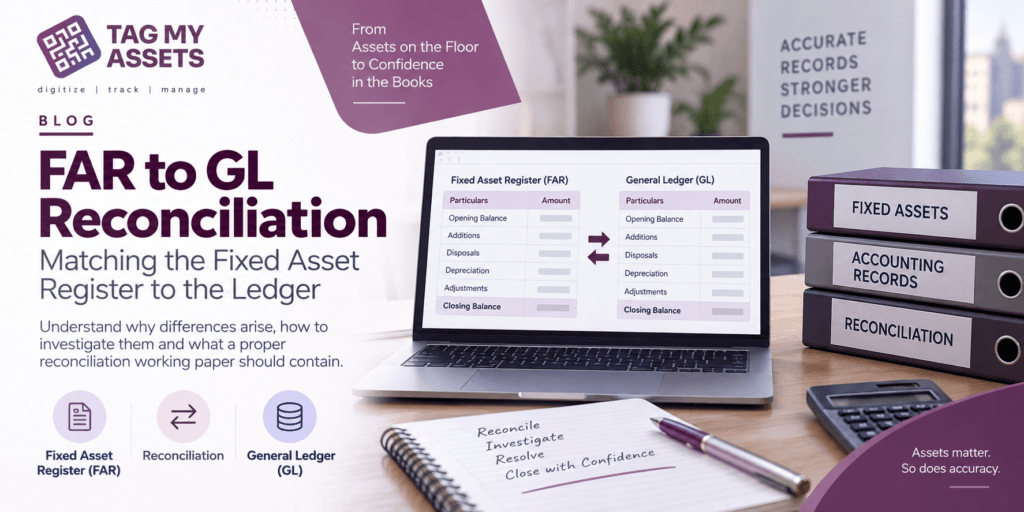
For each asset class, the FAR and GL can be placed side by side using a simple movement structure:
| Particulars | Fixed Asset Register | General Ledger | Difference | Explanation |
|---|---|---|---|---|
| Opening balance | xxx | xxx | xxx | |
| Additions during the period | xxx | xxx | xxx | |
| Disposals/deletions | xxx | xxx | xxx | |
| Depreciation for the period | xxx | xxx | xxx | |
| Transfers/adjustments | xxx | xxx | xxx | |
| Closing balance | xxx | xxx | xxx |
The same exercise should normally be performed for the relevant asset classes rather than only for the company-wide total.
But the most important column in this working paper is not necessarily Difference.
It is Explanation.
A number appearing in the difference column tells you that something does not agree.
It does not tell you why.
For example:
“Difference: ₹4,25,000”
is not a reconciliation conclusion.
But:
“₹4,25,000 relates to three additions recorded in the GL in March but not created in the FAR”
is an explanation.
Once the difference has a reason, the next action becomes clearer. The FAR may need to be updated. The GL may require correction. Supporting documents may need to be obtained. An asset may need to be reclassified. Or the matter may require further investigation.
This distinction is important:
A difference without an explanation is not a reconciliation.
And even a zero closing difference should not automatically end the exercise. Two or more errors can offset each other.
The working paper is complete when the movements have been compared and material reconciling items have been identified, understood and appropriately dealt with or documented — not simply when the final difference happens to be zero.
FAR to GL reconciliation and physical verification should connect
The three records involved in a fixed asset exercise tell you different things.
Physical verification tells you what exists and where it exists.
The FAR tells you what the organisation identifies as individual fixed assets.
The General Ledger tells you what has been accounted for financially.
Problems arise when these three are treated as completely separate exercises.
Consider an asset appearing in the FAR but not found during physical verification.
The immediate conclusion may be that the asset is missing.
But that is only one possibility.
The asset may have moved to another location. It may have been scrapped. It may have been sold. The disposal may already have been correctly recorded in the GL but never removed from the FAR.
In that situation, physical verification is reporting an exception created by the quality of the register, not necessarily by a failure on the ground.
The reverse can also happen.
An asset may be physically found but not appear in the FAR. Before treating it simply as an “excess asset”, the finance team may need to check whether its acquisition was already recorded somewhere in the GL.
This is why physical verification and accounting reconciliation become more useful when their findings are connected.
When should FAR to GL reconciliation be performed?
Waiting until the statutory audit begins is rarely the most efficient approach.
For organisations with significant fixed asset activity, FAR to GL reconciliation is better incorporated into the periodic financial close process, with the frequency depending on the volume and complexity of transactions.
It becomes particularly important:
- at financial year-end
- before the statutory audit
- where there have been significant additions or disposals
- after major CWIP capitalisation
- following an ERP or accounting-system migration
- after a merger, demerger or business restructuring
- when a physical verification exercise identifies significant exceptions
The longer a difference remains unexplained, the harder it can become to trace the original transaction and supporting documents.
A current-period difference may be traced quickly to an invoice, disposal document or journal entry.
The same difference carried forward for several years may require considerably more effort to reconstruct.
Why FAR to GL reconciliation matters during an audit
The Fixed Asset Register is an important supporting record for Property, Plant and Equipment reported in the financial statements.
Where the FAR does not agree with the books, the finance team first needs to understand which record requires correction and why.
From an audit perspective, unresolved differences can also affect the extent to which the register can be relied upon as supporting information and may lead to additional reconciliation, documentation and substantive procedures.
There is an important distinction here regarding CARO 2020.
Clause 3(i) deals, among other things, with the maintenance of proper records of Property, Plant and Equipment and physical verification by management. It should not be described as a specific requirement to reconcile the FAR with the General Ledger.
FAR to GL reconciliation is nevertheless an important accounting control because the fixed asset records ultimately need to support the amounts reported in the books and financial statements.
A corrected FAR is not necessarily a reconciled FAR
Imagine that a company completes a detailed physical verification exercise.
Assets have been located.
Asset descriptions have been corrected.
Locations and custodians have been updated.
Missing and excess items have been investigated.
The FAR now reflects the position on the ground much better than it did before.
That is valuable work.
But one final question remains:
Does the updated FAR agree with the General Ledger?
If that question has not been answered, the accounting reconciliation is still incomplete.
There is another reason this matters.
An unreconciled register can itself create misleading physical-verification exceptions. Assets already disposed of in the books may continue to appear as “not found”. Assets already capitalised in the GL may appear on the floor as “excess” simply because the corresponding FAR record was never created.
So reconciliation is not something that starts only after physical verification ends.
The quality of the register influences the quality of the physical-verification result itself.
An updated register that has never been agreed to the ledger is not a reconciled register. It is a corrected list.
A complete fixed asset reconciliation process should therefore connect what exists on the ground, what appears in the Fixed Asset Register and what has been recorded in the General Ledger.
FAR Reconciliation and Physical Asset Verification Services
Tag My Assets supports organisations with physical verification of fixed assets, asset tagging, FAR reconciliation and related fixed asset verification activities.
Our approach can cover both sides of the exercise: establishing the physical position of assets at the location and supporting reconciliation of the resulting Fixed Asset Register with the relevant records.
For multi-location assignments, the objective is not simply to produce another list of assets.
It is to establish a clear trail from what was found on the ground → what appears in the FAR → what is reflected in the accounting records.
Frequently Asked Questions
What is FAR to GL reconciliation?
FAR to GL reconciliation is the process of comparing the balances and movements recorded in the Fixed Asset Register with the corresponding fixed asset accounts in the General Ledger. Differences are identified and investigated so that the reason for each reconciling item can be understood and appropriately addressed.
What is the difference between FAR reconciliation and FAR to GL reconciliation?
Physical FAR reconciliation generally compares assets recorded in the Fixed Asset Register with assets physically available at the location. FAR to GL reconciliation compares the values and movements in the Fixed Asset Register with the accounting records.
Both answer different questions, and one does not replace the other.
Why does the Fixed Asset Register not match the General Ledger?
Differences can arise from additions not entered in the FAR, disposals not removed from the register, depreciation differences, manual journals, CWIP capitalisation, asset transfers, classification differences or old opening-balance differences.
The purpose of reconciliation is not simply to calculate the variance. It is to identify why the variance exists
How often should the FAR be reconciled to the General Ledger?
The appropriate frequency depends on the volume and complexity of fixed asset transactions. Organisations with significant asset activity may incorporate the reconciliation into their periodic financial close process.
At a minimum, the exercise becomes particularly relevant at financial year-end and before the statutory audit.
What does a fixed asset reconciliation working paper contain?
A typical working paper compares opening balances, additions, disposals, depreciation, transfers or adjustments and closing balances between the FAR and GL.
It should show differences at the relevant asset-class level and, importantly, document the explanation and required action for each material reconciling item.