
Managing assets across multiple countries, factories, warehouses, and offices is a major challenge for multinational companies. Without standardized asset tagging practices, organizations face issues such as duplicate records, missing assets, inconsistent asset registers, and audit risks.
Global asset tagging standards help organizations maintain uniform asset identification, tracking, and verification across all locations.
Companies operating across countries must implement consistent asset tagging policies to ensure that assets can be identified, tracked, audited, and verified easily.To understand asset tagging in detail, read our complete guide on asset tagging.
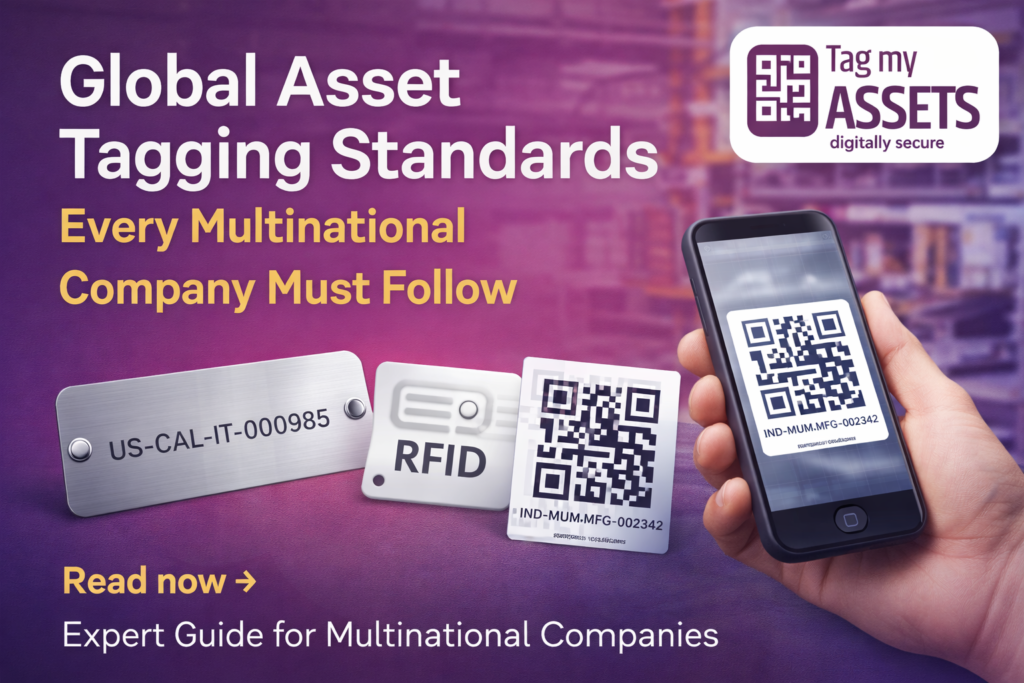
Why Multinational Companies Need Global Asset Tagging Standards
Large companies often operate across:
- Manufacturing plants
- Corporate offices
- Warehouses and logistics hubs
- Retail stores
- Data centers and IT infrastructure
Without global standards, each location may follow different tagging formats, making asset reconciliation extremely difficult.
Common problems faced by multinational companies include:
- Duplicate asset numbers across locations
- Inconsistent asset descriptions
- Missing assets during audits
- Difficulties during mergers or acquisitions
- Non-standardized fixed asset registers
Implementing global asset tagging standards ensures consistency and transparency.
9 Global Asset Tagging Standards Every Multinational Company Must Follow
1. Standardized Asset ID Format
Every asset must have a unique identification number across the organization.
Example format:
Country Code – Location – Department – Asset Category – Serial Number
Example:
IND-DEL-IT-000245
This prevents duplication across different countries and locations.
2. Uniform Asset Tag Materials
Different assets require different tag materials such as:
- Polyester asset labels
- Aluminium metal tags
- RFID tags
- QR code asset tags
For global projects, companies must define approved tag specifications for durability and consistency.
3. Standardized Data Fields in Asset Register
Multinational companies must maintain uniform asset data fields across locations.
Typical fields include:
- Asset ID
- Asset Description
- Serial Number
- Location
- Department
- Purchase Date
- Asset Value
- Responsible Employee
This ensures that asset registers across countries follow the same structure.
4. Global Asset Tag Placement Guidelines
Companies must define standard tag placement rules for assets.
Examples:
- IT assets → backside or bottom panel
- Machinery → visible non-moving part
- Furniture → underside or side panel
Standard placement ensures that asset tags are easily visible during audits and verification.
5. QR Code or Barcode-Based Asset Identification
Modern global asset tagging standards recommend QR code or barcode labels instead of manual numbering.
Benefits include:
- Faster asset verification
- Mobile-based asset scanning
- Reduced human errors
- Digital asset records
QR code tags are widely used in large corporate offices and manufacturing plants.
6. Standard Asset Verification Procedures
Global companies must define uniform verification procedures, such as:
- Annual physical asset verification
- Periodic surprise audits
- Mobile scanning during verification
- Exception reporting for missing assets
This ensures consistent verification across all global locations.
7. Centralized Asset Database
Multinational companies should maintain a single centralised asset register rather than separate spreadsheets at each location.
This allows:
- A single asset register across all locations
- Consistent asset data between countries
- Faster audit reporting
- Global asset reconciliation
Centralised systems replace fragmented spreadsheets maintained by different locations.
8. Asset Transfer Procedures
Global asset tagging policies must define how asset transfers between locations are recorded.
For example:
- Office transfers
- Factory relocation
- Employee asset assignments
Movement logs must be recorded to maintain accurate asset history.
9. Audit-Ready Asset Registers
Asset registers must always be audit ready for:
- Financial audits
- Internal audits
- Insurance verification
- Regulatory compliance
Standardized tagging ensures that assets recorded in books actually exist physically.
How TagMyAssets Helps Multinational Companies Implement Global Asset Tagging Standards
TagMyAssets helps large organizations implement standardized asset tagging frameworks across multiple locations.
Our services include:
- Physical verification of fixed assets
- QR code / barcode asset tagging
- Standardized asset register preparation
- Mobile-based asset verification systems
- Reconciliation with existing FAR (Fixed Asset Register)
Our team ensures that asset records are accurate, verifiable, and audit-ready.
Final Thoughts
Global asset tagging standards are essential for multinational companies to maintain accurate asset records, reduce audit risks, and improve asset visibility across locations.
By implementing standardized tagging practices, organizations can ensure that their fixed asset registers reflect the actual physical assets on the ground.
Good Reads
ICAI Guidance Note on Fixed Assets
ISO Asset Management Standards (ISO 55000)
Frequently Asked Questions
What are global asset tagging standards?
Global asset tagging standards are standardized policies used by multinational companies to uniquely identify, tag, and track assets across different locations and countries.
Why do multinational companies need asset tagging standards?
These standards ensure consistent asset identification, improve audit accuracy, and reduce asset misplacement across multiple locations.
What types of tags are used in global asset tagging?
Common asset tags include QR code labels, barcode labels, RFID tags, and metal asset tags depending on asset type and environment.