
Introduction
RFID vs QR Code Asset Tagging is one of the most common decisions organizations face when implementing a fixed asset management system.
When organizations decide to improve fixed asset tracking and verification, one of the first questions they face is whether they should use RFID tags or QR code tags.
Should we use RFID tags or QR code tags?
Both technologies are widely used for asset management, but they serve different business requirements.
Many organizations assume RFID is always the better choice because it is more advanced. In reality, the right decision depends on factors such as asset volume, operational environment, budget, verification frequency, and long-term objectives.
In our experience, a large percentage of Indian businesses can achieve excellent results using QR code asset tagging. RFID becomes valuable in specific situations where speed, scale, and automation are critical.
This guide explains nine practical factors to help you choose the right technology for your organization.
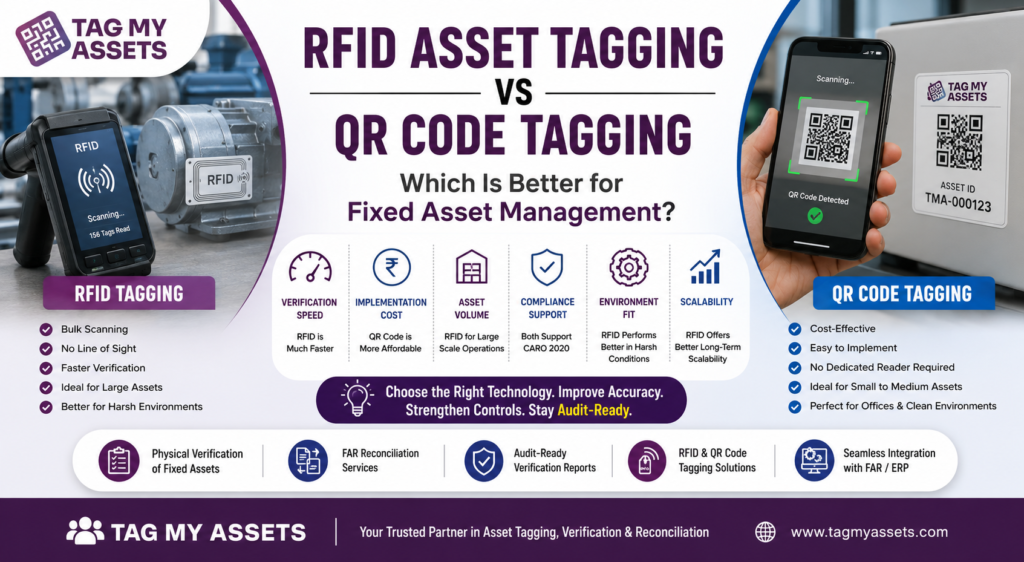
1. Asset Volume
The number of assets you manage is the first and most important factor.
QR Code Tagging is suitable for:
- Small and medium businesses
- Offices
- Schools
- Hospitals
- Single-site facilities
Typical range: 500 to 5,000 assets
RFID Tagging is suitable for:
- Large enterprises
- Manufacturing plants
- Warehouses
- Multi-location operations
Typical range: 5,000+ assets
As asset volume increases, the efficiency advantage of RFID becomes more significant.
An RFID reader captures tags in bulk without individual line-of-sight scanning. For a plant with 10,000 assets, that is the difference between a verification exercise measured in days and one measured in weeks.
For moderate asset bases, QR code tagging is practical, cost-effective, and entirely sufficient.
2. Verification Speed
Verification speed is one of the most visible differences between the two technologies.
QR Code
- One asset scanned at a time
- Requires direct line of sight to the tag
- Manual scanning process
- Accurate but time-intensive
RFID
- Multiple assets read simultaneously
- No direct line of sight required
- Bulk verification possible across rooms, aisles, or bays
To put this into practical terms, the approximate productivity comparison is:
| Verification Method | Approximate Productivity |
|---|---|
| Manual Verification (No Tags) | 100–150 for office furniture, 100–120 for laptops and IT equipment, 80–100 for plant and machinery |
| QR Code Verification | Faster than manual; scan replaces written capture |
| RFID Verification | Substantially faster again; bulk reading removes the one-at-a-time constraint |
For annual physical verification under CARO 2020 or Companies Act requirements, QR codes are often sufficient.
For organizations conducting frequent verification cycles or managing large warehouses and factories, RFID can significantly reduce verification time and operational disruption.
3. Budget Considerations
Budget is frequently the deciding factor, particularly for first-time tagging projects.
QR Code Solution Typically Includes
- Printed QR tags (₹2–₹15 per tag depending on material and lamination)
- Mobile application for scanning
- Asset database or FAR integration
Advantages:
- Low implementation cost
- No dedicated reader hardware required
- Smartphone camera is sufficient for scanning
- Easy deployment and training
RFID Solution Typically Includes
- RFID tags (₹10–₹200 per tag depending on type and application)
- RFID handheld readers or fixed reader infrastructure
- Software integration and implementation services
Advantages:
- Faster verification
- Bulk scanning
- Better scalability
- Lower verification effort for large asset bases
Although RFID has a higher initial investment, organizations with large asset counts and frequent verification cycles often recover costs through reduced manpower and faster verification.
Organizations should evaluate the total cost of ownership, not just the tag cost.
4. Type of Assets
Asset characteristics significantly influence which technology is appropriate.
QR Codes Work Well For
- Furniture
- Computers
- Laptops
- Printers
- Office equipment
- Educational institutions
- Corporate offices
They are ideal for assets that are:
- Stationary
- Visible
- Easily accessible
- Located in relatively clean environments
RFID Works Well For
- Industrial equipment
- Warehouse racking
- Returnable containers
- Server racks
- Manufacturing assets
- High-volume movable assets
RFID is particularly useful for:
- Assets stored in large quantities
- Assets located in difficult-to-access areas
- Assets requiring frequent verification
- Industrial and outdoor environments
Important Note About Metal Assets
One of the most common RFID mistakes is using standard RFID tags directly on metal surfaces.
Standard RFID tags generally do not perform well when attached directly to:
- Machinery
- Electrical panels
- Metal cabinets
- Industrial equipment
For such assets, On-Metal RFID Tags (Anti-Metal RFID Tags) should be used.
These tags are specifically designed for metallic surfaces and provide reliable read performance.
Selecting the wrong RFID tag type can lead to poor read rates and project failure.
5. Audit and Compliance Requirements
Most organizations conduct physical verification primarily for statutory and compliance purposes.
Examples include:
- CARO 2020 reporting
- Companies Act compliance
- Internal audits
- Statutory audits
- Asset verification exercises
- FAR reconciliation
If your primary objective is:
- Annual asset verification
- Fixed asset audit support
- CARO compliance
- FAR reconciliation
Then QR code tagging is often sufficient.
QR code tagging produces:
- Accurate scan records
- Timestamped verification evidence
- Audit trails
- Asset-wise verification history
At a significantly lower cost than RFID.
RFID becomes more valuable when:
- Verification frequency increases
- Asset counts become very large
- Verification timelines are tight
- Operational disruption must be minimized
Organizations planning either implementation should evaluate:
- Physical verification methodology
- FAR reconciliation process
- Asset data quality
- Compliance objectives
The technology is only as useful as the process it supports.
6. Operational Environment
The physical environment where assets are located is a factor many organizations overlook during planning.
QR Code Labels Perform Well In
- Offices
- Boardrooms
- Educational institutions
- IT labs
- Libraries
- Administrative facilities
These environments are generally:
- Clean
- Dry
- Low-risk
- Easy to access
QR code labels can remain readable for years when properly laminated and protected.
RFID Tags Are Better Suited For
- Manufacturing plants
- Chemical facilities
- Food processing units
- Warehouses
- Logistics centers
- Outdoor environments
RFID performs well where there is:
- Dust
- Oil
- Moisture
- Vibration
- Extreme temperatures
Industrial RFID tags can often remain operational for 5–10 years even in demanding environments.
In harsh conditions, repeated replacement of damaged QR labels may eventually cost more than the initial RFID investment.
7. Multi-Location Operations
Managing assets across multiple locations introduces significant complexity.
Common challenges include:
- Asset transfers between sites
- Location tracking
- Asset movement monitoring
- Verification coordination
- FAR accuracy maintenance
RFID Becomes Valuable When Organizations Operate
- Multiple manufacturing plants
- Distribution centers
- Warehouses
- Retail store networks
- Branch offices
- Hospitals with multiple facilities
Particularly when assets frequently move between locations.
QR Codes Remain Effective When
- Locations are limited
- Asset movement is minimal
- Internal controls are strong
- Location updates are properly maintained
The correct choice depends on operational complexity rather than simply the number of locations.
8. Human Effort and Manpower Requirements
QR code verification requires personnel to individually scan each asset.
The process is simple but labor-intensive.
QR Code Verification Requires
- Locating the asset
- Finding the tag
- Pointing the scanner at the tag
- Capturing the scan
- Confirming the record
This process is repeated for every asset.
RFID Verification Reduces Manual Effort
A person carrying an RFID reader can walk through an area and simultaneously capture multiple asset tags.
Benefits include:
- Faster verification
- Lower manpower requirements
- Reduced operational disruption
- Improved productivity
- Lower risk of missed assets
For organizations with:
- Large asset bases
- Limited shutdown windows
- Lean internal teams
RFID can provide meaningful operational advantages.
9. Future Growth and Total Cost of Ownership
Technology decisions should reflect not only current requirements but also future growth plans.
Questions worth asking include:
- Will asset count increase significantly over the next 3–5 years?
- Will additional locations be added?
- Will ERP integration become necessary?
- Will real-time tracking be required?
- Will verification frequency increase?
RFID Offers Better Scalability
For rapidly growing organizations, RFID infrastructure can support expansion without proportional increases in verification effort.
Reader infrastructure and automated processes can accommodate significantly larger asset populations.
Evaluate Total Cost of Ownership
Do not focus solely on tag prices.
Consider:
- Tag costs
- Reader costs
- Software costs
- Integration costs
- Training costs
- Maintenance costs
- Future upgrade costs
- Replacement costs
Many organizations discover that QR code tagging offers the best balance between functionality and cost.
Others justify RFID investment because of:
- Faster verification
- Reduced manpower
- Greater scalability
- Better performance in industrial environments
The correct decision depends on business objectives—not technology preference.
Quick Comparison: RFID vs QR Code
| Factor | QR Code | RFID |
|---|---|---|
| Bulk Scanning | No | Yes |
| Line of Sight Required | Yes | No |
| Initial Cost | Lower | Higher |
| Per Tag Cost (Approx.) | ₹2–₹15 | ₹10–₹200 |
| Verification Speed | Moderate | Very Fast |
| Dedicated Reader Required | No (Smartphone) | Yes |
| Suitable for Harsh Environments | Limited | Yes |
| On-Metal Application | Yes | Requires On-Metal Tags |
| Works for Annual Audits | Excellent | Good |
| Works for Large Warehouses | Good | Excellent |
| CARO 2020 Compliance Support | Yes | Yes |
| Real-Time Tracking Capability | No | Yes (With Fixed Readers) |
Which Technology Should You Choose?
Choose QR Code Tagging If:
- Budget is a primary consideration
- Asset count is moderate (typically under 5,000 assets)
- Annual or periodic verification is sufficient
- Assets are located in clean and accessible environments
- A mobile-based solution is preferred
- You want a low-cost implementation with minimal infrastructure
QR codes are often the ideal solution for:
- Corporate offices
- Educational institutions
- Hospitals
- Retail stores
- Small and medium enterprises
Choose RFID Tagging If:
- Asset count exceeds 5,000 assets
- Verification must be completed quickly
- Assets are located in harsh environments
- Bulk scanning is important
- Verification frequency is high
- ERP integration or real-time tracking is planned
RFID is particularly beneficial for:
- Manufacturing facilities
- Warehouses
- Logistics operations
- Utility companies
- Large multi-location organizations
Consider a Hybrid Approach
The decision does not always have to be RFID or QR code.
Many organizations achieve the best results by using both technologies.
Example
QR Codes For:
- Office furniture
- Chairs
- Tables
- Desktop computers
- Printers
- General office equipment
RFID For:
- Plant and machinery
- Server infrastructure
- Warehouse assets
- High-value equipment
- Frequently verified assets
- Difficult-to-access assets
This hybrid approach allows organizations to optimize both cost and efficiency.
The right technology is used where it delivers the greatest value.
Why Many RFID Asset Tagging Projects Fail
Many RFID implementations fail—not because of the technology, but because of poor planning and execution.
Common reasons include:
Wrong Tag Selection
Using standard RFID tags on metal surfaces often results in poor readability and read failures.
Poor Tag Placement
Tags are sometimes positioned where signals are blocked, reflected, or difficult for readers to capture.
No Physical Verification Before Tagging
Organizations implement RFID without first conducting a Physical Verification of Fixed Assets exercise.
As a result:
- Missing assets remain in the FAR
- Duplicate records remain unresolved
- Ghost assets continue to exist
The RFID system simply inherits existing data problems.
Inaccurate FAR Data
RFID records are often built on:
- Duplicate assets
- Incorrect locations
- Incomplete descriptions
- Outdated asset records
Technology cannot correct inaccurate master data.
No Reconciliation Process
RFID scan data is collected but never reconciled through a structured FAR Reconciliation process.
Without reconciliation:
- Variances remain unresolved
- Audit readiness is not achieved
- Management cannot rely on the data
Inadequate Staff Training
Field teams may lack the knowledge to:
- Handle unreadable tags
- Resolve exceptions
- Manage damaged tags
- Follow standardized verification procedures
RFID tagging should always be combined with physical verification and FAR reconciliation.
A tagging project that ends with tag installation is only half a project.
The most successful RFID implementations begin with accurate asset data, proper verification, correct tag selection, and a well-defined reconciliation process.
What to Look for in an Asset Tagging Partner
Whether you choose RFID, QR codes, or a combination of both, the quality of the engagement depends heavily on the implementation partner.
Look for a partner who can:
- Assess your asset base before recommending a technology
- Understand compliance and audit requirements
- Supply correctly specified tags
- Conduct physical verification as part of the engagement
- Perform FAR reconciliation
- Deliver audit-ready reports
- Integrate outputs with FAR, ERP, or accounting systems
- Provide trained field teams
The technology is only as good as the process and expertise behind it.
A successful asset tagging project combines:
- Correct technology
- Correct tags
- Accurate asset records
- Strong verification methodology
- Proper reconciliation
- Ongoing asset governance
Frequently Asked Questions
Many organizations compare RFID vs QR Code Asset Tagging before starting an asset tagging project because both technologies offer different advantages.
What is the difference between RFID and QR code asset tagging?
QR code tagging uses printed labels that are scanned one at a time using a smartphone camera or handheld scanner.
RFID uses radio-frequency tags that can be read in bulk without requiring direct line of sight.
Key Differences
| Feature | QR Code | RFID |
|---|---|---|
| Line of Sight | Required | Not Required |
| Bulk Scanning | No | Yes |
| Cost | Lower | Higher |
| Verification Speed | Moderate | Very Fast |
| Reader Required | No | Yes |
QR codes are simpler and more economical.
RFID is faster and more scalable for large organizations.
Is RFID Always Better Than QR Codes?
No.
RFID is not automatically the better option.
The right choice depends on:
- Asset volume
- Verification frequency
- Operating environment
- Compliance requirements
- Budget
For many offices, hospitals, schools, and retail stores, QR code tagging provides excellent results at a lower cost.
RFID becomes more valuable when organizations manage large asset bases or require frequent verification.
Can RFID Tags Work on Metal Assets?
Yes—but only when the correct tag type is selected.
Standard RFID tags generally perform poorly when attached directly to metal surfaces.
For metallic assets such as:
- Machinery
- Electrical panels
- Metal cabinets
- Industrial equipment
Organizations should use:
On-Metal RFID Tags (Anti-Metal RFID Tags)
These tags are specifically designed for metallic environments and provide reliable performance.
How Much Does RFID Asset Tagging Cost in India?
Costs vary depending on:
- Asset quantity
- RFID tag type
- Reader requirements
- Software requirements
- Scope of verification services
Typical ranges are:
- QR Code Tags: ₹2–₹15 per tag
- RFID Tags: ₹10–₹200 per tag
Additional costs may include:
- RFID readers
- Software
- Implementation
- Verification services
- FAR reconciliation
A detailed assessment is the most accurate way to estimate project costs.
Which Industries Benefit Most from RFID Asset Tagging?
RFID provides the greatest benefits in:
- Manufacturing
- Warehousing and logistics
- Healthcare and hospitals
- Pharmaceuticals
- Utilities
- Data centers
- IT infrastructure management
Industries with:
- Large asset bases
- High verification frequency
- Multiple locations
- Operational complexity
typically gain the most value from RFID implementation.
Can RFID Help With CARO 2020 Compliance?
Yes.
RFID-based verification generates:
- Timestamped scan records
- Verification history
- Asset-wise audit trails
- Location-based verification evidence
When combined with FAR reconciliation and proper reporting, RFID can support organizations in meeting physical verification requirements commonly reviewed during CARO 2020 reporting and statutory audits.
The RFID vs QR Code Asset Tagging decision should be based on operational requirements, asset volume, verification frequency, and long-term business objectives.
Conclusion
RFID and QR code technologies both play important roles in modern fixed asset management.
While RFID delivers exceptional speed and automation for large-scale operations, QR code tagging remains a practical, cost-effective, and fully compliant solution for many organizations.
Before making a decision, organizations should evaluate:
- Asset volume
- Operational environment
- Verification frequency
- Compliance requirements
- Budget
- Long-term growth plans
A structured assessment ensures that the selected technology delivers real value while supporting compliance, asset visibility, and efficient asset management.
Organizations that focus only on tag technology often overlook the importance of verification, reconciliation, and data accuracy.
The most successful asset tagging projects combine the right technology with the right process.
Whether an organization chooses RFID, QR codes, or a hybrid approach, the ultimate objective should be:
- Accurate asset records
- Stronger internal controls
- Better visibility
- Faster verification
- Audit-ready documentation
Need Help Choosing Between RFID and QR Code Tagging?
Not sure whether RFID or QR code tagging is right for your organization?
- Asset volume
- Operating environment
- Compliance requirements
- Verification frequency
- Budget
to recommend the most suitable solution.
We provide:
- RFID Asset Tagging Services
- QR Code Asset Tagging Services
- Physical Verification of Fixed Assets
- FAR Reconciliation Services
- Audit-Ready Asset Verification Reports
Whether you operate a manufacturing plant, warehouse, hospital, corporate office, retail chain, educational institution, or multi-location business, we can help you implement the right asset tagging strategy for long-term success.
Talk to Our Asset Tagging Team Today
Learn how RFID, QR codes, physical verification, and FAR reconciliation can improve asset visibility, compliance, and audit readiness across your organization.
This article is part of our content series supporting RFID Asset Tagging Services, Fixed Asset Verification, FAR Reconciliation, and Asset Management Solutions across India.
RFID vs QR Code Asset Tagging: Quick Decision Guide
Choose QR Code Tagging if:
- Budget is important
- Asset count is moderate
- Annual verification is sufficient
Choose RFID Tagging if:
- Asset count exceeds 5,000 assets
- Bulk scanning is required
- Verification speed is critical
RFID for Fixed Asset Verification: Complete Guide for Audit, CARO 2020 & Compliance in India (2026)RFID Asset Tagging in India – Cost, Types & Implementation Guide (2026)RFID Asset Tagging in India – Cost, Types & Implementation Guide (2026)RFID for Fixed Asset Verification: Complete Guide for Audit, CARO 2020 & Compliance in India (2026)