
Most companies focus on visible expenses — salaries, procurement, operations. But real financial damage often comes from something less visible: poor asset management.
The hidden costs of poor asset management sit quietly against profitability, operational efficiency, and financial control — and many organisations only notice them once the losses have already become visible. This guide breaks down where those costs actually come from.
What Is Poor Asset Management?
Poor asset management means a lack of asset visibility, an inaccurate Fixed Asset Register, no tracking of asset movement, missing or unverified assets, and weak control across locations. It isn’t just an operational inconvenience — it’s a financial risk.
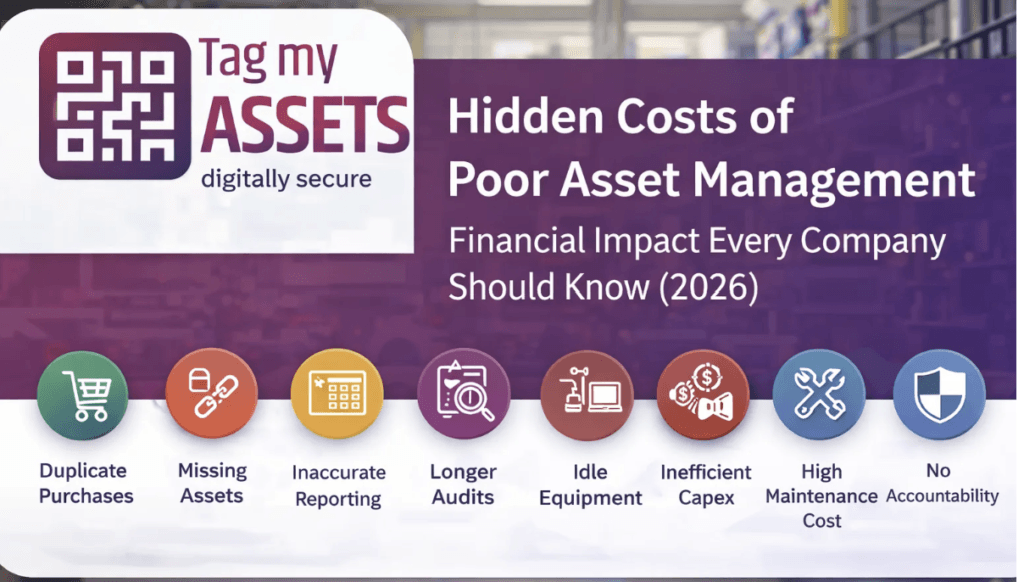
Nine Hidden Costs of Poor Asset Management
1. Duplicate Asset Purchases
When assets aren’t tracked properly, departments request new equipment while existing assets sit unused elsewhere. Procurement increases for no operational reason — a direct, avoidable cash outflow.
2. Missing or Untraceable Assets
Assets go missing, get shifted without a record, or simply become unaccounted for over time. Each one eventually has to be written off, and that write-off is a real financial loss, not just a paperwork correction.
3. Inaccurate Financial Reporting
If the FAR is wrong, depreciation calculations are wrong, asset valuation becomes unreliable, and audit observations increase. The compliance risk compounds every reporting period the register stays uncorrected.
4. Longer Audit Time and Higher Cost
Without proper tagging, audit teams spend time simply identifying assets before they can even begin verifying them. Reconciliation stretches out, and that extra time has a direct cost — both in audit fees and in internal disruption.
5. Poor Asset Utilisation
Assets sit idle, get underused, or never get shared across departments that could use them — because nobody has visibility into what already exists. That’s a direct hit to return on the original capital spent.
6. Insurance Claim Challenges
When a loss or damage claim needs to be filed, mismatched records make it hard to prove an asset existed, where it was, or what it was worth. Claims get delayed, reduced, or rejected outright.
7. Inefficient Capital Allocation
Without accurate asset data, capex decisions get made on assumptions rather than facts — leading to budget allocated toward the wrong priorities.
8. Increased Maintenance Cost
Poor tracking means maintenance schedules get missed, which leads to breakdowns and reactive repairs — almost always more expensive than planned maintenance would have been.
9. Lack of Accountability
When nobody clearly owns an asset, misuse goes unnoticed and responsibility is never assigned — weakening internal control across the board.
Why These Costs Stay Hidden
These costs are rarely tracked in one place — they’re spread across departments, treated as routine operational inefficiency, and never directly linked back to the financial statements they actually affect. Individually, each one looks small. Together, they add up to a real and often underestimated drag on profitability.
How to Identify Hidden Asset Costs in Your Company
A few honest questions surface most of it: Do we have accurate asset records? Can we locate assets quickly when asked? Are duplicate purchases happening because nobody knew an asset already existed? Is audit time creeping up year over year? Do we actually track asset movement, or just assume it?
If the honest answer to several of these is no, hidden costs are very likely already there.
How to Reduce Hidden Costs
- Implement proper asset tagging
- Conduct physical verification
- Clean and standardise the FAR
- Use QR or barcode-based tracking
- Improve asset visibility across locations
See our guide to the five ways a Fixed Asset Register goes wrong for the detailed patterns behind most of these costs.
Conclusion
The hidden costs of poor asset management are often ignored precisely because they’re hidden — but they’re real, and they compound. Companies that address these gaps reduce unnecessary spending, improve asset utilisation, strengthen financial control, and get better audit outcomes. Asset management isn’t just an operational function; it’s a financial discipline.
Frequently Asked Questions
What are hidden costs in asset management?
Costs like duplicate purchases, missing assets, audit inefficiencies, and poor utilisation — expenses that don’t show up as a clear line item but drain profitability over time.
How does poor asset management affect finance?
It leads to unnecessary losses, incorrect financial reporting, and capital allocated on assumptions rather than facts.
Can asset tagging reduce hidden costs?
Yes — by improving visibility, tracking, and control, tagging removes much of the guesswork that creates these costs in the first place.
What is usually the biggest hidden cost?
Duplicate purchases and untraceable assets tend to be the largest and most avoidable, since both stem directly from not knowing what’s already owned.
How can poor asset management be detected?
Through audit gaps, FAR inaccuracies, and a general lack of asset visibility across the organisation.