
Your auditor walks in. Your Fixed Asset Register shows ₹18 crore in assets. Your shop floor tells a different story — assets that cannot be found, machines listed twice, and locations that have not been updated since the last ERP migration.
What happens next is expensive.
As Indian companies scale across warehouses, manufacturing plants, retail stores, and corporate offices, their physical footprint grows rapidly. Unfortunately, their Fixed Asset Registers often do not keep pace.
A single duplicate asset entry looks harmless. Multiply it across thousands of assets, multiple locations, ERP migrations, acquisitions, and years of manual updates — and your statutory audit becomes a costly nightmare.
Most audit failures during physical verification do not happen because assets are physically missing. They happen because the asset data is inconsistent, incomplete, or impossible to reconcile.
With auditors increasingly scrutinising internal controls under CARO 2020, Asset Data Standardization has become a non-negotiable requirement for any company that takes audit readiness seriously in 2026.
Asset Data Standardization in Fixed Asset Registers is one of the biggest hidden reasons behind audit delays, failed FAR reconciliations, ghost assets, and inaccurate depreciation calculations in Indian companies.
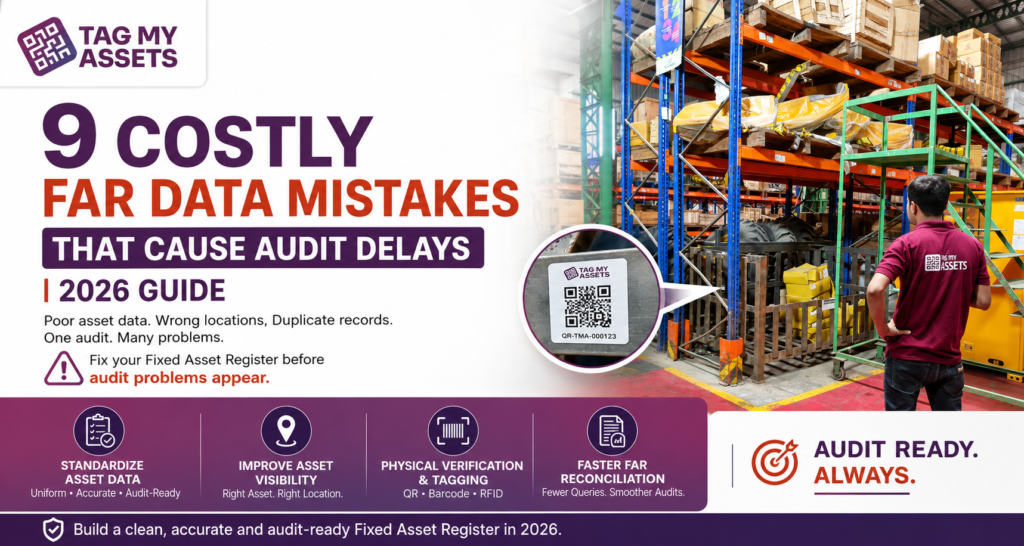
What Is Asset Data Standardization in Fixed Asset Registers?
Asset Data Standardization means creating a uniform structure, naming convention, and mandatory field framework for every asset recorded in your Fixed Asset Register.
Instead of vague entries such as:
| What’s in FAR | Problem |
|---|---|
| Dell Laptop | No model, serial number, location, or tag ID |
| DELL LT | Inconsistent abbreviation |
| HP Laptop | Missing model and cost centre |
| Computer System | Ambiguous description |
A standardized FAR record should include:
| Field | Example |
|---|---|
| Asset Class | IT Equipment |
| Sub-Class | Laptop |
| Manufacturer | Dell |
| Model | Latitude 5430 |
| Serial Number | SN-DL2024-ABC12345 |
| Cost Centre | Admin – Gurgaon HO |
| Location Code | GGN-HO-F3-ADMIN |
| Tag ID | QR-TMA-000123 |
| Last Verified | FY 2025-26 Physical Verification |
Standardized data makes FAR reconciliation faster, physical verification conclusive, and audits smoother. Without it, every audit season becomes a reconciliation fire drill.
Why Indian Companies Get Asset Data Wrong
Many Indian companies maintain FARs through years of manual entries, ERP migrations, location transfers, and inconsistent department-wise practices.
Poor Asset Data Standardization in Fixed Asset Registers often develops over years through ERP migrations, inconsistent naming conventions, manual updates, and lack of physical verification.
The main reasons are:
1. Multi-location naming chaos
Different plants or offices use different names for the same asset. One location may call an asset “CNC Lathe”, another may call it “CNC-L”, and another may call it “Turning Centre”.
2. Legacy ERP data dumps
ERP migrations from Tally to SAP, Oracle, Excel, or other systems often happen without proper FAR cleanup.
3. Inter-state asset transfer gaps
Assets physically moved to another state may still remain mapped to the old location or GSTIN.
4. Annual-only FAR updates
Many companies update the FAR only when statutory audit begins.
5. No physical tagging system
Without QR codes, barcodes, or RFID tags, physical verification remains manual and error-prone.
9 Costly Asset Data Mistakes That Cause Audit Problems
| No. | Asset Data Error | Audit Impact | Regulatory Risk |
|---|---|---|---|
| 1 | Duplicate asset entries | Overstatement of gross block | Schedule III misstatement |
| 2 | Missing serial numbers | Physical verification failure | CARO 2020 reporting observation |
| 3 | Incorrect capitalization dates | Wrong depreciation start | Incorrect WDV block |
| 4 | Missing or vague location details | Cannot verify floor-to-sheet | CARO 2020 Clause 3(i)(a)(A) issue |
| 5 | Inactive assets still active | Ghost assets inflate balance sheet | Wrong asset reporting |
| 6 | Wrong asset classification | Incorrect useful life applied | Wrong depreciation and tax block |
| 7 | Missing component mapping | Ind AS 16 non-compliance risk | Depreciation mismatch |
| 8 | No asset tags linked to FAR | Zero traceability | Verification and insurance risk |
| 9 | Non-standard descriptions | FAR reconciliation delays | Schedule III roll-forward errors |
1. Duplicate Asset Entries
Duplicate assets usually arise during ERP migration, manual capitalization, or department-wise asset recording.
If the same item is capitalized twice, the gross block becomes inflated, depreciation may be overstated, and Schedule III disclosures may become unreliable.
2. Missing Serial Numbers and Technical Specifications
CARO 2020 requires auditors to review whether the company maintains proper records showing full particulars, including quantitative details and the situation of Property, Plant and Equipment.
If your FAR record has no serial number, model, or location code, physical verification becomes difficult and audit observations may arise.
3. Wrong Asset Classification
Wrong asset classification affects depreciation under the Companies Act and Income Tax Act.
For example, classifying IT equipment as general office equipment may lead to incorrect useful life, incorrect WDV computation, and additional tax exposure depending on the facts of the case.
What Companies Commonly Do
- Server rack booked as office equipment
- UPS classified differently across locations
- Dies and tools clubbed with general plant machinery
- Leased assets mixed with owned fixed assets
Correct Approach
- Define a master classification tree
- Map each category with Schedule II and tax block
- Use unique classification codes
- Maintain a separate ROU Asset register where applicable
4. Missing Location Details
A location field that simply says “Factory” or “HO” is not enough for companies operating across multiple plants, offices, warehouses, or retail outlets.
Location drives:
- Cost centre allocation
- Physical verification routing
- Custodian accountability
- GST tracking
- Internal control responsibility
Best practice is to use a 4-level location hierarchy:
Entity → Site → Building / Block → Floor / Department
Example:
ACME Ltd → Pune Plant 2 → Shop Floor B → Machine Bay 3
Assign a compact location code such as:
ACME/PUN2/SFB/MB3
This makes FAR reconciliation and asset verification far more reliable.
5. Ghost Assets on the Books
Ghost assets are assets that exist in the Fixed Asset Register but are not physically available.
These may arise due to:
- Disposal not recorded
- Scrapping not updated
- Theft
- Asset write-offs not reflected in FAR
- Location transfers not updated
Ghost assets can:
✓ Inflate gross block
✓ Distort depreciation calculations
✓ Increase insurance costs
✓ Create false balance sheet entries
✓ Trigger audit observations
Removing ghost assets usually requires:
- Physical verification
- Management approval
- Proper documentation
- FAR update
- Accounting treatment where applicable
6. Gross Block Understated Due to Incomplete Capitalization
Under Ind AS 16, asset cost may include:
- Purchase cost
- Freight
- Installation cost
- Duties
- Site preparation
- Directly attributable costs
Many organizations capitalize only invoice value.
Result:
Understated gross block → Wrong depreciation → Potential reporting errors
7. No Component Accounting
Some assets contain significant components having different useful lives.
Examples:
Power Plant
Main Asset:
Power Plant
Components:
- Boiler
- Turbine
- Generator
- Electrical systems
Manufacturing Machine
Main Asset:
Production Machine
Components:
- Machine body
- Die
- Controller
- Motor
If everything is grouped into one asset:
Depreciation may not reflect economic reality.
This becomes important under Ind AS 16.
8. No Physical Asset Tags Linked to FAR
Each physical asset should have a one-to-one relationship with its FAR record through:
- QR code
- Barcode
- RFID tag
Common problems:
❌ Asset capitalized but never tagged
❌ Tag replaced but FAR not updated
❌ QR code affixed but number not recorded
❌ Asset disposed physically but FAR remains active
This disconnect is one of the biggest reasons physical verification reports become difficult to reconcile.
9. Non-Standard Descriptions Causing Schedule III Errors
Schedule III requires movement disclosure of:
- Opening balance
- Additions
- Disposals
- Closing balance
If asset descriptions vary across locations:
Example:
Plant 1:
Desktop Computer
Plant 2:
Computer System
Plant 3:
Dell Desktop
Plant 4:
IT Equipment
Preparing Schedule III disclosures becomes:
- Manual
- Slow
- Error-prone
Ind AS 116 — The Overlooked Risk
Many companies accidentally mix:
Leased Assets (ROU Assets)
with
Owned Assets
in the same FAR.
This may create:
- Incorrect depreciation
- Missing lease disclosures
- FAR mismatch
- Reporting issues
Maintain:
Separate ROU Asset Register
for leased assets wherever applicable.
CARO 2020, Schedule III & Tax Compliance: What You Risk
| Risk Area | Root Cause | Potential Impact |
|---|---|---|
| Statutory audit issue | FAR does not reconcile | Audit observations |
| CARO reporting | Missing particulars | Reporting under Clause 3(i)(a)(A) |
| Schedule III issue | Weak roll-forward | Material misstatement risk |
| Income Tax | Wrong classification | Tax demand, interest |
| Insurance | Missing asset proof | Claim rejection risk |
| Ind AS 16 | Wrong useful life | Depreciation mismatch |
Poor FAR data is not only an audit issue.
It can affect:
- Finance
- Tax
- Insurance
- Internal controls
- Capital allocation
- Compliance
That is why Asset Data Standardization is becoming a business necessity rather than only an audit requirement.
Part 4
The Hidden Cost of Poor FAR Data
Poor asset data does not only affect statutory audit.
It impacts your entire finance and asset management ecosystem.
| Hidden Cost | Impact |
|---|---|
| Higher audit effort | Longer audit timelines |
| Wrong depreciation | Financial misstatement |
| Missing assets | Capital loss |
| Ghost assets | Inflated balance sheet |
| Insurance claims | Settlement challenges |
| Budgeting errors | Wrong CAPEX planning |
Poor FAR quality ultimately affects:
✓ CFO decision-making
✓ Internal controls
✓ Budgeting accuracy
✓ Asset lifecycle tracking
✓ Compliance confidence
5-Step Framework to Standardize FAR Data Before Audit
Organizations struggling with Asset Data Standardization in Fixed Asset Registers frequently experience longer audits, increased reconciliation effort, and weaker internal controls.
Organizations can improve FAR quality using a structured approach.
Step 1: Create a Uniform Asset Taxonomy
Avoid free-text entries.
Use:
Asset Class → Sub-Class → Manufacturer → Model → Serial Number → Tag ID
Example:
IT Equipment → Laptop → Dell → Latitude 5430 → SN123 → QR0001
This creates consistency.
Step 2: Enforce Mandatory Fields
No asset should enter FAR without:
✓ Manufacturer
✓ Model
✓ Serial Number
✓ Location
✓ Cost Centre
✓ GSTIN (where relevant)
✓ Tag ID
✓ Component details
Incomplete records create future audit problems.
Step 3: Conduct Physical Verification
Perform:
Sheet-to-Floor Verification
Compare:
FAR → Physical Asset
and
Floor-to-Sheet Verification
Compare:
Physical Asset → FAR
This helps identify:
- Missing assets
- Ghost assets
- Duplicate assets
- Wrong locations
- Untagged assets
Step 4: Implement Asset Tagging
Use:
- QR Codes
- Barcode Tags
- RFID Tags
Benefits:
✓ Faster verification
✓ Better traceability
✓ Easier reconciliation
✓ Improved audit readiness
Step 5: Build an Audit-Ready FAR
Update:
- Missing fields
- Wrong locations
- Classification issues
- Asset conditions
- Disposal records
- Depreciation mapping
The objective is not one-time cleanup.
The objective is:
Continuous audit readiness
6 Signals That Your Company Needs FAR Cleanup Immediately
You may require immediate FAR standardization if:
1. Your company has 10,000+ assets
Large asset bases become difficult to manage manually.
2. Multiple ERP migrations occurred
Example:
Excel → SAP → Oracle → New ERP
Historical inconsistencies accumulate.
3. Multi-location operations exist
Factories
Branches
Warehouses
Retail stores
Increase complexity.
4. Audit begins within few months
Late cleanup creates pressure.
5. Physical verification has not been done recently
Ghost assets increase over time.
6. Asset tagging is incomplete
Verification becomes slower and less reliable.
Organizations showing multiple signals should consider structured FAR reconciliation and physical verification support.
Case Example: How FAR Standardization Improved Audit Readiness
(Illustrative multi-location organization scenario based on common fixed asset challenges)
A manufacturing company with operations across multiple plants maintained a FAR containing:
- Duplicate asset records
- Missing serial numbers
- Incorrect locations
- Legacy ERP entries
- Untagged assets
- Ghost assets
The organization struggled every year with:
✓ Extended audit timelines
✓ Reconciliation delays
✓ Large volumes of audit queries
✓ Inconsistent depreciation records
The company implemented:
Phase 1: Physical Verification
Performed:
- Sheet-to-floor verification
- Floor-to-sheet verification
- Asset condition assessment
Phase 2: Asset Tagging
Implemented:
- QR asset tagging
- Location coding
- Asset mapping
Phase 3: FAR Cleanup
Updated:
- Missing locations
- Asset classifications
- Serial numbers
- Disposal records
- Duplicate entries
Phase 4: Standardization
Created:
Uniform naming structure
Standard location hierarchy
Mandatory FAR fields
Tag-to-asset linkage
Result
The organization achieved:
✓ Faster FAR reconciliation
✓ Improved asset visibility
✓ Reduced audit queries
✓ Better audit preparedness
✓ Improved control over fixed assets
Pre-Audit FAR Readiness Checklist (2026)
Use this checklist before statutory audit.
If multiple answers are NO, FAR cleanup may be required.
Data Quality Checklist
□ Does every asset have a unique ID?
□ Are serial numbers available?
□ Are asset descriptions standardized?
□ Are locations updated?
□ Are cost centres mapped?
□ Are manufacturers recorded?
Classification Checklist
□ Is asset classification correct?
□ Are useful lives reviewed?
□ Is Schedule II mapping complete?
□ Are leased assets separately maintained?
Physical Verification Checklist
□ Has physical verification been performed during current year?
□ Are discrepancies documented?
□ Are missing assets investigated?
□ Are ghost assets removed?
Tagging Checklist
□ Are assets tagged?
□ Is tag ID linked with FAR?
□ Are damaged tags replaced?
Reconciliation Checklist
□ Does FAR reconcile with GL?
□ Are disposals updated?
□ Are depreciation schedules reviewed?
□ Are additions properly recorded?
How Technology Improves FAR Standardization
Manual FAR management through Excel creates long-term data quality issues. Technology supports Asset Data Standardization in Fixed Asset Registers through controlled data entry, tagging systems, and automated reconciliation workflows.
Technology improves FAR through:
Controlled Data Entry
Dropdowns
Mandatory fields
Restricted formats
Tag Integration
QR
Barcode
RFID
linked directly with FAR.
Mobile Verification
Allows:
Real-time scanning
Image capture
Geo evidence
Immediate discrepancy reporting
Audit Trails
Tracks:
Who changed records
When records changed
Reason for changes
Technology reduces dependency on spreadsheets and improves FAR governance.
Why Asset Data Standardization Matters More in 2026
The importance of standardized FAR data is increasing because of:
Increasing ERP migrations
Organizations continue moving systems.
Multi-location operations
Factories
Warehouses
Retail stores
Branches
Increase asset complexity.
Greater audit scrutiny
Auditors increasingly focus on:
- Physical verification
- Asset existence
- Documentation quality
Digital transformation
Organizations need structured asset data to support:
- Automation
- Reporting
- Analytics
Companies treating FAR as a static Excel file may face increasing compliance challenges in future.
Organizations investing in Asset Data Standardization in Fixed Asset Registers experience faster audits, better FAR reconciliation, and stronger compliance readiness.
Conclusion: Audit Readiness Is a Data Quality Problem
Most audit failures are not caused because physical assets are missing.
They happen because poor asset data prevents auditors from connecting:
Physical Assets ↔ Financial Records ↔ FAR ↔ Depreciation ↔ Compliance Reporting
When asset records are incomplete, inconsistent, or outdated:
The result is often:
- Longer audits
- Reconciliation challenges
- Incorrect depreciation
- Ghost assets
- Reporting issues
- Increased compliance risk
Organizations investing in Asset Data Standardization, Physical Verification, Asset Tagging, and FAR Reconciliation today are likely to experience:
✓ Faster audits
✓ Better asset visibility
✓ Stronger internal controls
✓ Improved compliance readiness
✓ More reliable financial reporting
The cost of fixing FAR data before audit is usually lower than the cost of correcting issues after audit observations arise.
The question is not:
“Should FAR cleanup be done?”
The question is:
“Will it be done before or after audit problems appear?”
About TagMyAssets
TagMyAssets supports organizations across India through:
- Fixed Asset Tagging Services
- Physical Verification of Assets
- FAR Reconciliation
- Fixed Asset Management
- Inventory Verification
- QR / Barcode / RFID Asset Tagging
- Audit Support Services
Our teams help organizations improve:
✓ Asset traceability
✓ FAR accuracy
✓ Audit readiness
✓ Multi-location asset visibility
✓ Compliance reporting
Frequently Asked Questions (FAQs)
Asset Data Standardization in Fixed Asset Registers helps reduce audit delays, improve asset visibility, and support audit-ready FAR management.
1. What is Asset Data Standardization in a Fixed Asset Register?
Asset Data Standardization means applying a consistent structure, naming convention, and mandatory information fields across all asset records in the FAR.
This improves:
- Accuracy
- Reconciliation
- Verification
- Audit readiness
2. Why is FAR reconciliation important?
FAR reconciliation helps ensure:
Physical assets = FAR records = Financial records
Differences may indicate:
- Missing assets
- Duplicate assets
- Wrong depreciation
- Classification errors
3. What are ghost assets?
Ghost assets are assets appearing in FAR but not existing physically.
They commonly arise due to:
- Disposal not recorded
- Scrapping
- Transfers
- Theft
- Incorrect updates
4. How often should physical verification of assets be performed?
Frequency depends on:
Asset volume
Risk profile
Industry
Location spread
Many organizations perform annual verification, while others adopt periodic verification programs.
5. Does asset tagging improve audit readiness?
Yes.
Asset tagging using QR, Barcode, or RFID improves:
✓ Traceability
✓ Verification speed
✓ FAR reconciliation
✓ Audit preparedness
6. What causes FAR discrepancies?
Common reasons include:
- ERP migration
- Manual errors
- Duplicate records
- Missing updates
- Wrong classifications
- Missing locations
7. Can poor FAR data affect depreciation?
Yes.
Wrong classification, useful life, capitalization date, or component accounting may affect depreciation calculations.
8. What is the difference between Sheet-to-Floor and Floor-to-Sheet verification?
Sheet-to-Floor:
FAR → Physical Asset
Checks whether recorded assets physically exist.
Floor-to-Sheet:
Physical Asset → FAR
Checks whether physical assets are missing from records.
Both are important.
9. Why is Asset Data Standardization in Fixed Asset Registers important?
Asset Data Standardization in Fixed Asset Registers helps reduce audit delays, improve FAR reconciliation, eliminate duplicate records, and support more accurate depreciation calculations.
Need Help With FAR Reconciliation or Asset Verification?
If your organization is experiencing:
✓ Duplicate asset records
✓ Missing locations
✓ Ghost assets
✓ Audit delays
✓ FAR mismatch
✓ Asset tagging gaps
It may be useful to review your FAR before the next audit cycle.
Learn more:
Fixed Asset Tagging Services:
https://tagmyassets.com/fixed-asset-tagging-services/
Inventory Verification Services:
https://tagmyassets.com/inventory-verification-services/
Contact Us:
https://tagmyassets.com/contact-us/
Final Thought
Asset Data Standardization is no longer only an operational improvement.
For many organizations in 2026:
It is becoming an audit survival strategy.