
Manufacturing Asset Tagging Services for Factory Asset Management
Manufacturing companies manage thousands of physical assets including plant machinery, production equipment, tools, utility infrastructure, material handling systems, electrical assets, and factory furniture. Without structured asset tracking systems, manufacturers often struggle with missing assets, inaccurate records, audit mismatches, maintenance issues, and poor operational visibility.
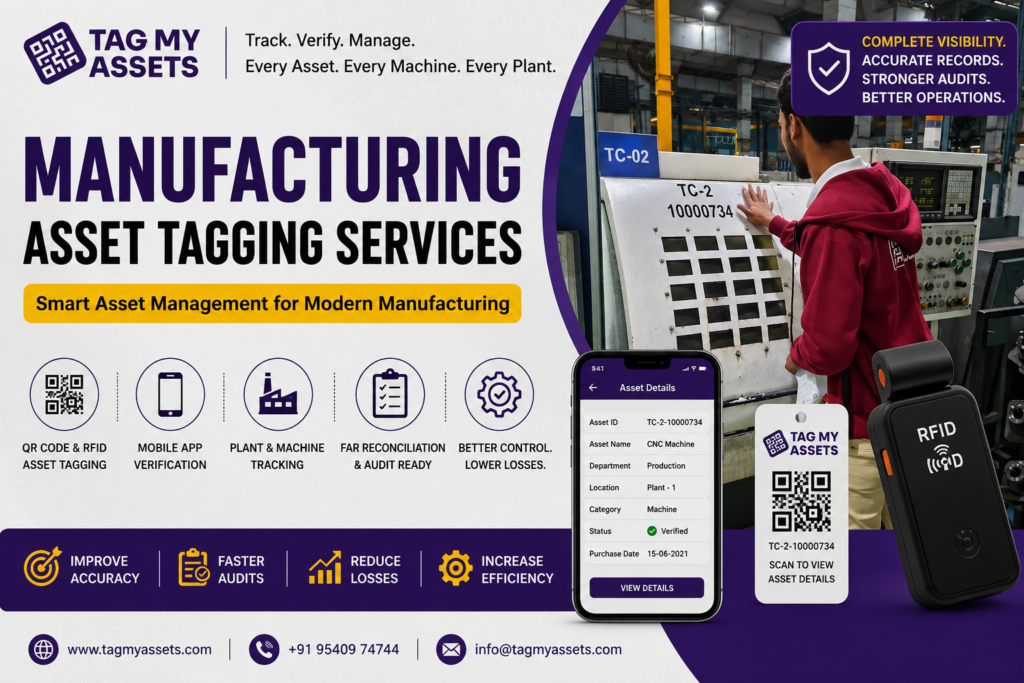
Manufacturing Asset Tagging Services help factories digitally identify, verify, track, and manage industrial infrastructure using QR code, barcode, and RFID-based asset tracking systems.
Today, automotive manufacturers, engineering companies, FMCG plants, pharmaceutical factories, textile industries, chemical plants, and industrial units across India are increasingly adopting Manufacturing Asset Tagging Services to improve infrastructure visibility, strengthen audits, and maintain accurate fixed asset records.
What are Manufacturing Asset Tagging Services?
Manufacturing Asset Tagging Services involve assigning unique identification tags to factory assets for digital tracking and verification.
These tags may include:
- QR Code Asset Tags
- Barcode Labels
- RFID Tags
- Serialized Asset IDs
- Industrial Metal Asset Tags
Each tagged asset is linked to a centralized asset management database containing:
- Asset Name
- Machine Number
- Department
- Plant Location
- Asset Category
- Purchase Date
- Warranty Details
- FAR Reference Number
- Verification Status
This enables factories to maintain structured and accountable industrial asset management systems.
Why Manufacturing Companies Need Asset Tagging Services
Factory environments involve continuous movement and usage of infrastructure assets.
For example:
- Machines shift production lines
- Tools move between departments
- Utility assets relocate during plant expansion
- Spare equipment transfers across plants
- Production infrastructure gets upgraded frequently
Without proper tracking systems, factories may face:
- Missing plant assets
- Inaccurate FAR records
- Duplicate procurement
- Audit mismatches
- Weak maintenance tracking
- Poor operational visibility
- Infrastructure losses
Manufacturing Asset Tagging Services improve factory visibility and operational control.
Common Manufacturing Assets That Can Be Tagged
Plant & Machinery
- CNC Machines
- Production Equipment
- Hydraulic Systems
- Compressors
- Industrial Boilers
- Conveyor Systems
Utility Infrastructure
- DG Sets
- Air Compressors
- Electrical Panels
- HVAC Systems
- Water Treatment Systems
Material Handling Equipment
- Pallets
- Trolleys
- Forklifts
- Storage Racks
- Industrial Containers
IT & Electronics Assets
- Computers
- Printers
- Servers
- CCTV Systems
- Networking Devices
Factory Furniture & Fixtures
- Workstations
- Cabinets
- Storage Units
- Inspection Tables
Types of Tags Used in Manufacturing Asset Tagging Services
QR Code Asset Tags
QR code tags are widely used because they are:
- Affordable
- Easy to scan
- Fast to deploy
- Suitable for industrial environments
Ideal for:
- Factory equipment
- Utility assets
- Furniture
- IT infrastructure
RFID Asset Tags
RFID tagging is highly effective for:
- Large factories
- Industrial warehouses
- Bulk verification
- Movable infrastructure assets
Benefits include:
- Contactless scanning
- Faster audits
- Improved infrastructure visibility
Metal Asset Tags
Manufacturing environments often require:
- Heat-resistant tags
- Oil-resistant tags
- Chemical-resistant tags
- Heavy-duty industrial tags
These are commonly used on:
- Machines
- Compressors
- DG Sets
- Electrical panels
20 Powerful Benefits of Manufacturing Asset Tagging Services
1. Faster Asset Identification
Each factory asset receives a unique digital identity.
2. Improved Plant Infrastructure Visibility
Factories gain centralized visibility over infrastructure assets.
3. Reduced Asset Misplacement
Asset tagging minimizes missing industrial assets.
4. Better Machine Tracking
Production equipment becomes easier to monitor.
5. Improved FAR Accuracy
Manufacturing Asset Tagging Services improve fixed asset record accuracy.
6. Faster Physical Verification
QR and RFID scanning speed up factory audits.
7. Improved Audit Readiness
Manufacturers can prepare more efficiently for audits.
8. Better Utility Asset Management
Factories gain improved visibility over utility infrastructure.
9. Reduced Duplicate Purchases
Organizations avoid unnecessary procurement.
10. Better Maintenance Tracking
Factories can maintain:
- AMC schedules
- maintenance history
- service records
- warranty tracking
11. Mobile App-Based Verification
Teams can digitally verify assets using mobile applications.
12. Reduced Manual Errors
Digital systems minimize spreadsheet-based mistakes.
13. Improved Multi-Plant Asset Management
Manufacturers can standardize tracking across multiple plants.
14. Better Department-Wise Accountability
Assets can be assigned department-wise.
15. Improved Asset Lifecycle Tracking
Factories can monitor aging and replacement planning.
16. Faster Annual Verification
Industrial audits become faster and more accurate.
17. Stronger Operational Control
Management gains better visibility over factory infrastructure.
18. Better Cost Control
Factories can reduce infrastructure losses and unnecessary procurement.
19. Improved Compliance Documentation
Verification reports support audit and compliance requirements.
20. Increased Operational Efficiency
Manufacturing teams can improve overall infrastructure management efficiency.
Manufacturing Asset Verification Process
Step 1 – FAR Review
Existing asset records are analyzed.
Step 2 – Asset Categorization
Assets are classified into:
- Taggable
- Countable
- Non-Auditable
Step 3 – Tag Design Approval
QR or RFID tag formats are finalized.
Step 4 – Physical Verification
Assets are physically verified department-wise and machine-wise.
Step 5 – Tag Pasting
Approved assets are tagged.
Step 6 – Mobile App Scanning
Assets are digitally scanned and recorded.
Step 7 – FAR Reconciliation
Physical assets are reconciled with asset records.
Step 8 – Final Reporting
Verification and reconciliation reports are shared.
Common Challenges Factories Face Without Asset Tagging
- Missing plant assets
- Weak accountability
- Duplicate procurement
- Poor maintenance tracking
- Inaccurate asset records
- Delayed audits
- Infrastructure losses
- Weak visibility over movable assets
QR Code vs RFID for Manufacturing Asset Tagging Services
| Feature | QR Code | RFID |
|---|---|---|
| Cost | Lower | Higher |
| Scanning | Manual | Contactless |
| Bulk Reading | No | Yes |
| Best For | General Factory Assets | Large Industrial Plants |
| Deployment Speed | Fast | Very Fast |
Many factories adopt a hybrid QR + RFID model.
Why Manufacturing Companies Need Factory Asset Management
Manufacturing companies operating across multiple plants require standardized infrastructure visibility and operational control.
Without centralized systems, factories may face:
- inconsistent records
- audit mismatches
- poor accountability
- infrastructure losses
Manufacturing Asset Tagging Services improve industrial infrastructure management and operational visibility.
How TagMyAssets Helps Factories with Manufacturing Asset Tagging Services
TagMyAssets provides Manufacturing Asset Tagging Services across India.
Services include:
- QR Code Asset Tagging
- RFID Asset Tagging
- Physical Asset Verification
- FAR Reconciliation
- Mobile App-Based Verification
- Plant Infrastructure Tracking
- Multi-Plant Asset Management
The solution helps factories improve accountability, operational efficiency, and audit readiness.
Conclusion
Manufacturing Asset Tagging Services have become essential for modern factories managing large industrial infrastructure and movable assets.
By implementing QR code or RFID-based industrial asset management systems, manufacturers can improve infrastructure visibility, reduce operational losses, strengthen audits, and maintain accurate fixed asset records.
Factories investing in structured Manufacturing Asset Tagging Services today are building more efficient and digitally managed industrial infrastructure.
FAQs
What are Manufacturing Asset Tagging Services?
Manufacturing Asset Tagging Services involve assigning QR, barcode, or RFID tags to factory assets for identification, tracking, and verification.
Which manufacturing assets are commonly tagged?
Machines, utility infrastructure, forklifts, electrical panels, compressors, and production equipment are commonly tagged.
Why do factories use RFID asset tagging?
RFID helps factories conduct faster audits and improve infrastructure visibility.
Can Manufacturing Asset Tagging Services improve FAR accuracy?
Yes. Physical verification and digital tagging improve fixed asset record accuracy.
Which is better for factories — QR code or RFID?
QR codes are cost-effective for general factory assets, while RFID is useful for large industrial plants and bulk verification.
Why is asset verification important in manufacturing?
Asset verification improves accountability, reduces operational losses, strengthens audits, and maintains accurate infrastructure records.
Hospitals across India are increasingly adopting Hospital Asset Tagging Services by TagMyAssets to improve healthcare asset management, medical equipment tracking, FAR reconciliation, and audit readiness
Educational institutions and student accommodation providers are implementing Hostel Asset Tagging Services by TagMyAssets to improve room-wise asset tracking, infrastructure visibility, and audit-ready asset management
Warehouses and logistics companies are adopting Warehouse Asset Tagging Services by TagMyAssets to improve infrastructure visibility, rack-wise asset tracking, operational efficiency, and FAR reconciliation
Retail chains and multi-location businesses are using Retail Store Asset Tagging Services by TagMyAssets to improve store-wise asset visibility, fixture tracking, audit readiness, and operational control.
Good Resources
GS1 Barcode Standards
https://www.gs1.org
RFID Journal
https://www.rfidjournal.com
ISO Asset Management Standards
https://www.iso.org