
Does Industry Type Really Matter in Asset Tagging Services?
Industrial asset tagging services are becoming increasingly important for organizations managing large-scale infrastructure, multiple locations, and complex fixed asset registers.
Asset tagging services are no longer limited to one specific industry. Today, organizations need execution partners capable of handling large-scale verification, reconciliation, and tagging projects across multiple infrastructure environments.
One of the most common questions we receive from new clients is:
“Have you worked in our industry before?”
Sometimes the client belongs to:
- manufacturing,
- healthcare,
- telecom,
- logistics,
- retail,
- hospitality,
- education,
- warehousing,
- or infrastructure sectors.
At first glance, every industry appears completely different.
A manufacturing plant may contain:
- CNC machines,
- compressors,
- DG Sets,
- conveyors,
- utility systems,
- and production machinery.
A hospital may contain:
- ventilators,
- diagnostic equipment,
- ICU assets,
- medical devices,
- and biomedical systems.
A telecom company may manage:
- towers,
- battery banks,
- routers,
- transmission systems,
- and outdoor infrastructure.
A retail chain may involve:
- display fixtures,
- POS systems,
- branding assets,
- shelving,
- and store infrastructure.
So yes — the assets are different.
But after executing large-scale physical verification and asset tagging projects across multiple industries, we have realized something very important:
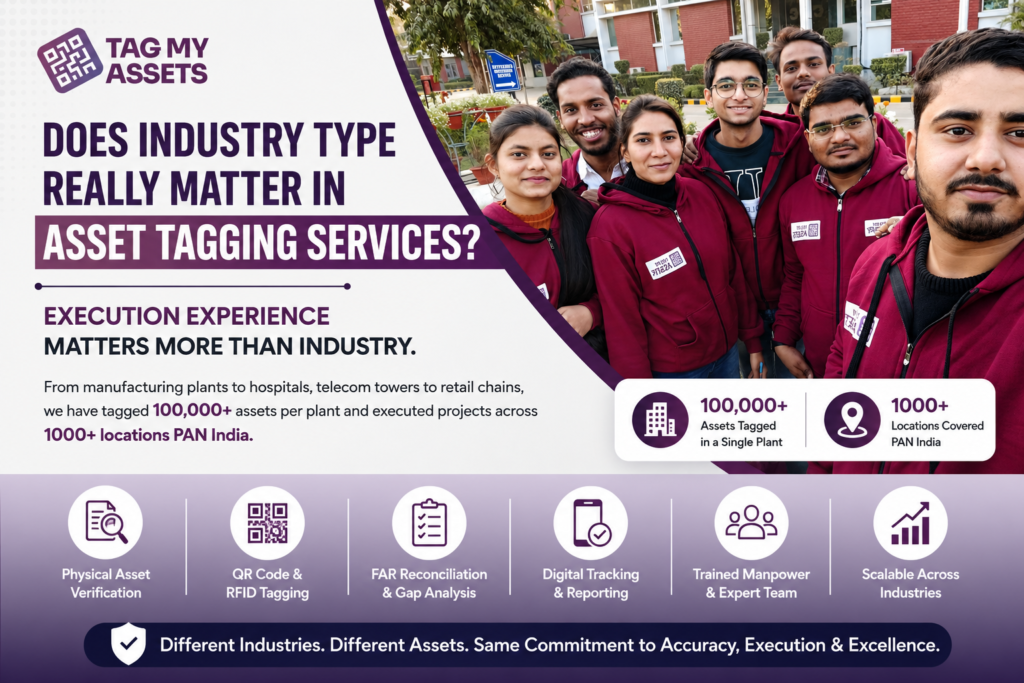
In asset tagging projects, execution capability matters far more than industry type.
Asset Categories Change — But Execution Logic Remains Similar
Every industry has unique infrastructure.
However, the core methodology of professional asset tagging projects remains largely the same:
- Understanding the FAR structure
- Identifying assets physically
- Categorizing assets correctly
- Verifying quantities and locations
- Pasting QR or RFID tags
- Digitally scanning assets
- Reconciling physical assets with FAR data
- Reporting mismatches and exceptions
Whether the asset is:
- a ventilator,
- a telecom battery bank,
- a warehouse rack,
- a retail fixture,
- or a factory machine,
the execution discipline remains fundamentally similar.
The Better Question Is Not “Have You Worked in Our Industry Before?”
In many discussions, clients ask:
“Do you have previous experience in our industry?”
But in large-scale asset tagging and physical verification projects, the more important question is:
“What is your execution experience?”
Because successful asset tagging projects depend far more on:
- operational capability,
- reconciliation expertise,
- manpower management,
- scalability,
- reporting systems,
- and execution discipline
than industry labels alone.
A company that has:
- physically verified 100,000+ assets,
- executed PAN India projects,
- managed 1000+ locations,
- handled multiple asset categories,
- and completed large-scale reconciliation exercises
is usually far better prepared to handle complex projects — regardless of whether the assets belong to a hospital, factory, telecom site, warehouse, or retail chain.
In asset tagging projects, execution experience matters more than industry names.
Industrial asset tagging services help organizations improve physical verification accuracy, FAR reconciliation, infrastructure visibility, and digital asset tracking across multiple business locations. Modern industrial asset tagging services are now used across manufacturing plants, warehouses, telecom infrastructure, hospitals, offices, and retail chains.
What Actually Makes Asset Tagging Projects Difficult?
Why Execution Experience Matters in Industrial Asset Tagging Services
In our experience, the real complexity in asset tagging projects is usually not the industry itself.
The actual challenges are:
1. Scale of Operations
A company operating:
- 5 locations
is very different from one operating:
- 1000+ locations PAN India.
Managing manpower, coordination, reporting, timelines, and consistency at scale requires strong operational systems.
2. FAR Complexity
Many organizations maintain highly complicated Fixed Asset Registers containing:
- grouped assets,
- child components,
- duplicate descriptions,
- inconsistent naming conventions,
- quantity mismatches,
- and missing locations.
This is where reconciliation expertise becomes critical.
3. Asset Diversity
A single project may contain:
- machinery,
- furniture,
- IT assets,
- electrical systems,
- utility infrastructure,
- movable equipment,
- and fixed installations.
The ability to identify and categorize different asset types accurately matters far more than simply understanding one industry.
4. Multi-Location Coordination
Projects involving:
- factories,
- telecom sites,
- warehouses,
- hospitals,
- retail chains,
- branch offices,
- or educational campuses
require strong coordination systems and standardized execution processes.
5. Project Execution Speed
Large organizations often require:
- strict timelines,
- parallel execution,
- rapid reporting,
- real-time tracking,
- and audit-ready documentation.
Execution discipline becomes one of the most important success factors.
What We Have Learned After Large-Scale Asset Tagging Projects
Across 395+ projects, 1,500+ locations, and 10 lakh+ assets tagged, we have worked with diverse asset categories, machinery types, and multi-location infrastructure environments.
After a certain level of execution experience, the industry itself no longer becomes the challenge.
The real differentiators become:
- execution capability,
- operational control,
- reconciliation expertise,
- manpower management,
- reporting systems,
- and scalability.
Industrial asset tagging services are now widely used by companies managing large infrastructure, multi-location operations, and high-value fixed assets across India.
Industry Knowledge Still Matters — But Only to a Certain Extent
Industry understanding is definitely useful.
For example:
- hospitals require operational sensitivity,
- telecom projects involve outdoor infrastructure,
- factories involve heavy machinery,
- retail stores require fast execution,
- warehouses involve large movable infrastructure.
These operational nuances matter.
However, they are usually manageable through:
- proper SOPs,
- planning,
- asset categorization,
- trained execution teams,
- and strong project management.
What clients actually need is confidence that the execution partner can:
- handle complexity,
- maintain accuracy,
- manage large-scale operations,
- and complete projects professionally.
Many organizations prefer industrial asset tagging services because they improve audit readiness, physical verification accuracy, and digital asset traceability.
Modern Asset Tagging Projects Are More About Systems Than Industry
Today, asset tagging projects are no longer just about pasting labels.
Organizations now expect:
- digital visibility,
- QR code tracking,
- RFID integration,
- mobile app verification,
- reconciliation reports,
- audit support,
- infrastructure accountability,
- and centralized asset management.
As projects become larger and more data-driven, execution systems matter far more than industry specialization alone.
Professional industrial asset tagging services also help companies standardize asset records, improve FAR reconciliation, and simplify future asset audits.
What Truly Defines a Strong Asset Tagging Company?
A professional asset tagging company should be able to:
- manage large-scale projects,
- execute PAN India operations,
- handle multiple asset categories,
- perform accurate FAR reconciliation,
- maintain audit-ready reporting,
- deploy QR and RFID systems,
- manage complex infrastructure environments,
- and maintain operational consistency across locations.
That capability matters much more than simply working within one specific industry.
Final Thoughts
Every industry has different assets.
But the foundation of successful asset tagging projects remains the same:
- structured execution,
- operational discipline,
- scalable manpower,
- digital tracking,
- accurate verification,
- and strong reconciliation systems.
At the end of the day, organizations do not simply need a vendor who understands one industry.
They need a partner capable of handling:
- scale,
- complexity,
- execution pressure,
- and infrastructure diversity.
And that is what truly defines successful asset tagging services today.
About TagMyAssets
TagMyAssets provides:
- Asset Tagging Services
- RFID Asset Tagging
- QR Code Asset Tracking
- Physical Asset Verification
- FAR Reconciliation
- PAN India Asset Verification Projects
- Multi-Location Asset Management Solutions
across manufacturing plants, hospitals, telecom infrastructure, retail chains, logistics networks, warehouses, corporate offices, educational institutions, and industrial environments across India.
GS1 Standards
https://www.gs1.org/
RFID Journal
https://www.rfidjournal.com/
ISO Asset Management
https://www.iso.org/iso-55001-asset-management.html