
At TagMyAssets, we’ve executed fixed asset tagging, physical verification, FAR reconciliation, and RFID implementation projects across retail chains, manufacturing plants, corporate offices, hospitals, and multi-location enterprises across India.
Understanding QR Code vs RFID vs Barcode helps businesses choose the right asset tagging technology based on cost, scalability, compliance requirements, and operational efficiency.
One question comes up in almost every project:
Should we use QR Codes, RFID, or Barcodes?
The answer is never one-size-fits-all.
Choosing the wrong technology increases:
✔ Audit effort
✔ FAR mismatches
✔ Ghost assets
✔ Compliance risks
✔ Verification costs
This guide compares QR Code vs RFID vs Barcode across cost, compliance, speed, ROI, and physical verification requirements.
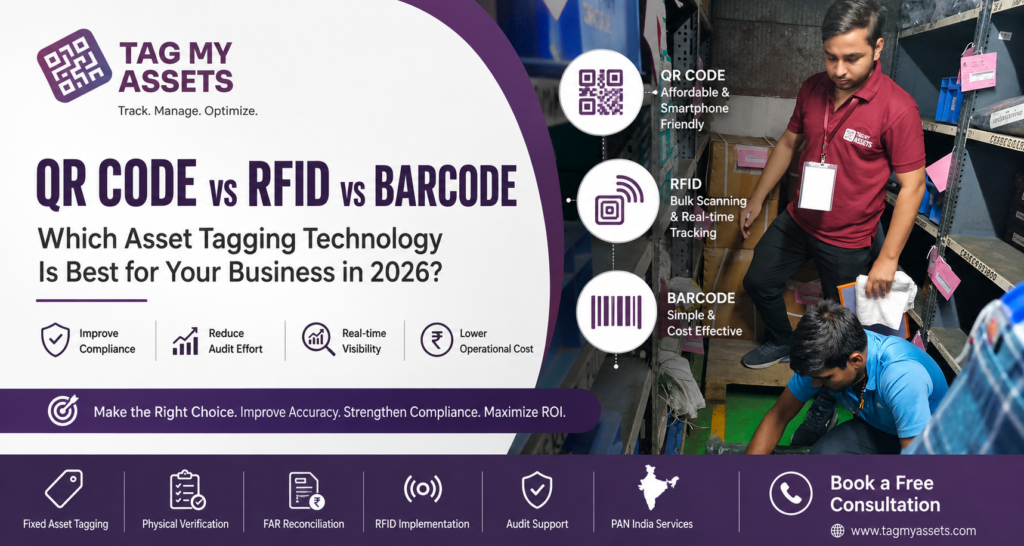
Table of Contents
- Quick Comparison
- What Are We Comparing?
- Cost Comparison
- Speed & Audit Efficiency
- Line of Sight
- Data Capacity
- Durability
- Security
- Setup Complexity
- Scalability
- Smartphone Compatibility
- CARO Compliance
- Industry Recommendations
- ROI Analysis
- Future Trends
- Final Verdict
- FAQ
QR Code vs RFID vs Barcode: Quick Comparison
| Requirement | Best Technology | Why? |
|---|---|---|
| Lowest upfront cost | QR Code | Smartphones work as scanners |
| Fastest scanning | RFID | Bulk scanning capability |
| Office assets | QR Code | Affordable implementation |
| Warehouses | RFID | No line-of-sight required |
| <5,000 assets | QR Code | Better ROI |
| >5,000 assets | RFID | Labor savings justify investment |
| CARO compliance | QR / RFID | Better audit trail |
| Industrial environments | RFID | Rugged |
The biggest advantage of comparing QR Code vs RFID vs Barcode is identifying which technology delivers the best ROI for your industry and asset volume.
Need a recommendation?
Whether you manage 500 assets or 5,00,000 assets, selecting the wrong technology increases audit effort and compliance risk.
👉 Book a consultation with TagMyAssets
What Are We Comparing?
Barcode (1D Barcode)
Traditional linear black-and-white lines storing simple numeric or alphanumeric data.
Best For:
- Small businesses
- Legacy systems
- Basic inventory tracking
- Short-life products
Advantages
✔ Cheapest option
✔ Easy implementation
✔ Widely used
Limitations
✘ Needs dedicated scanner
✘ Requires line of sight
✘ Poor durability
QR Code (2D Barcode)
QR Codes store significantly more data than traditional barcodes and can be scanned directly using smartphones.
Best For:
- Fixed asset management
- Offices
- Schools
- Hospitals
- NBFCs
- Physical verification
Advantages
✔ Smartphone scanning
✔ Low cost
✔ Better audit trail
✔ Good for CARO compliance
Limitations
✘ Requires line of sight
✘ One-by-one scanning
RFID (Radio Frequency Identification)
RFID uses radio waves to identify tags automatically without direct visibility.
Best For:
- Warehouses
- Manufacturing
- Retail chains
- Large enterprises
- High-value assets
Advantages
✔ No line of sight
✔ Bulk scanning
✔ Higher security
✔ Real-time tracking
Limitations
✘ Higher investment
✘ Reader hardware required
Cost Comparison (India)
When selecting technology:
Match tag cost with asset value
A hardened on-metal RFID tag on a low-value chair is over-specified; a paper label on high-value
machinery in a hot, oily environment will not survive a verification cycle.
When evaluating QR Code vs RFID vs Barcode, businesses should compare implementation costs, hardware requirements, and long-term maintenance expenses.
Cost Comparison Table
| Technology | Reader Requirement | Typical Use |
|---|---|---|
| Barcode | Dedicated scanner | Small asset bases, legacy systems |
| QR Code | Smartphone — no hardware purchase | Offices, periodic verification |
| RFID Paper | RFID reader | Retail, low-value high-volume |
| RFID On-Metal | RFID reader | Plant machinery, harsh environments |
Per-tag and per-asset pricing varies with tag material, volume, and number of locations. Current India price bands are set out on our RFID tagging cost page.
QR Code vs RFID vs Barcode: Cost Verdict
Lowest Cost Winner:
🏆 QR Code
Reason:
- Minimal tag cost
- No reader investment
- Existing smartphones work
Scanning Speed & Audit Efficiency
Speed matters during:
✔ Physical verification
✔ FAR reconciliation
✔ CARO audits
✔ Multi-location asset checks
Speed Comparison Table
| Technology | Approx Speed | Method |
|---|---|---|
| Barcode | One at a time | line of sight Individual |
| QR Code | One at a time | smart phone camera Individual |
| RFID | Multiple tags in a single pass | Bulk |
Example:
10,000 Assets
Using QR:
Each asset located and scanned individually — a team working over several days
Using RFID:
Bulk reading removes the one-at-a-time constraint, cutting the field time substantially. The actual duration depends on asset density, layout and tag readability.
Speed Winner:
🏆 RFID
RFID significantly reduces:
✔ Verification time
✔ Labor cost
✔ Audit delays
Practical Recommendation
Use:
QR Codes → Periodic audits + offices
RFID → Continuous tracking + warehouses
Scanning Range & Line of Sight
One of the biggest differences between QR, Barcode and RFID is:
Does the scanner need to physically see the tag?
Line of Sight Comparison Table
| Technology | Line of Sight Required? | Typical Read Range |
|---|---|---|
| Barcode | Yes | Few cm–1m |
| QR Code | Yes | Up to 1–2m |
| RFID Passive | No | 1–10m |
| RFID Active | No | Up to 100m+ |
Example:
Asset behind:
✔ Shelf
✔ Cabinet
✔ Box
✔ Server Rack
QR:
Must physically locate and scan
RFID:
Can read without direct visibility
Winner:
🏆 RFID
Best for:
- Warehouses
- Manufacturing
- Retail backrooms
- Dense storage environments
Data Capacity Comparison
How much information can each technology store?
Data Capacity Table
| Technology | Approx Storage | Typical Use |
|---|---|---|
| Barcode | Low | Serial number |
| QR Code | Up to 4,296 characters | Asset details, URLs |
| RFID | Unique ID linked to database | Full asset history |
Example Data Stored
Barcode:
Asset ID only
Example:
LAP00123
QR Code:
Can include:
✔ Asset name
✔ Purchase date
✔ Location
✔ Department
✔ Vendor
✔ URL
RFID:
Linked database can store:
✔ Asset value
✔ Depreciation
✔ Maintenance history
✔ User allocation
✔ Movement logs
Winner:
Standalone:
🏆 QR Code
Enterprise Ecosystem:
🏆 RFID + Cloud
Durability Comparison
Asset tags face:
✔ Heat
✔ Oil
✔ Dust
✔ Chemicals
✔ Rain
✔ Physical damage
Durability Table
| Technology | Durability | Environment |
|---|---|---|
| Barcode | Low | Indoor |
| QR Code | Medium–High | Offices |
| Metal QR | High | Industrial |
| RFID | Highest | Harsh conditions |
QR Advantage:
QR codes contain:
Error Correction
Even if 30% damaged, scanning may still work.
RFID Advantage:
RFID tags:
✔ Waterproof (IP68)
✔ Heat resistant
✔ Chemical resistant
✔ Heavy-duty options
Durability Winner
🏆 RFID
For:
- Plants
- Outdoor assets
- Heavy machinery
Security & Anti-Tamper Resistance
Security matters for:
✔ Laptops
✔ IT Assets
✔ High-value equipment
✔ Theft-prone assets
Security Comparison Table
| Factor | Barcode | QR | RFID |
|---|---|---|---|
| Easy to copy | Yes | Moderate | No |
| Encryption | No | Possible | Yes |
| Anti-tamper | No | Limited | Advanced |
| Password protection | No | Limited | Yes |
Security Winner:
🏆 RFID
Useful for:
- Servers
- Laptops
- IT Infrastructure
- High-value assets
Practical Recommendation
Choose:
QR Codes
If priority is:
✔ Cost
✔ Simplicity
✔ Smartphone access
Choose:
RFID
If priority is:
✔ Security
✔ Durability
✔ Automation
✔ Bulk scanning
Setup & Implementation Complexity
Some technologies are easy to deploy.
Others require planning, hardware, and specialist support.
Setup Complexity Table
| Technology | Implementation Difficulty | Hardware Needed | Deployment Speed |
|---|---|---|---|
| Barcode | Easy | Scanner | Fast |
| QR Code | Easiest | Smartphone | Fastest |
| RFID | Complex | RFID Reader | Moderate |
QR Code Advantages
QR deployment can begin quickly because:
✔ Smartphones already available
✔ Low infrastructure requirement
✔ Easy software integration
✔ Faster rollout across locations
RFID Requires Planning
Typical RFID implementation involves:
✔ Reader positioning
✔ Frequency selection (UHF/HF)
✔ Interference testing
✔ On-metal testing
✔ ERP integration
Setup Winner:
🏆 QR Code
Best for:
- Fast implementation
- Compliance projects
- One-time verification
- PAN India rollouts
Scalability Comparison
How well does technology perform as asset count increases?
Scalability Table
| Asset Volume | Barcode | QR Code | RFID |
|---|---|---|---|
| <500 assets | Good | Excellent | Expensive |
| 500–5,000 | Moderate | Excellent | Moderate |
| 5,000–10,000 | Difficult | Good | Excellent |
| 10,000+ | Poor | Moderate | Best |
RFID generally scales more efficiently in high-volume environments.
Scalability Winner
🏆 RFID
Best for:
✔ Warehouses
✔ Manufacturing
✔ Large enterprises
✔ Retail chains
Smartphone Compatibility
This matters for:
✔ Field teams
✔ Auditors
✔ PAN India verification
✔ Branch operations
Mobile Compatibility Table
| Technology | Smartphone Compatible? | Additional Hardware |
|---|---|---|
| Barcode | With App | Scanner |
| QR Code | Native | None |
| RFID | No | RFID Reader |
Smartphone Winner
🏆 QR Code
Reason:
Any Android or iPhone camera can scan QR.
No extra device needed.
CARO 2020 Compliance & Audit Impact
For companies focused on audit readiness, QR Code vs RFID vs Barcode comparisons become important because technology selection directly affects physical verification efficiency.
Under CARO 2020, companies are expected to maintain:
✔ Proper asset records
✔ Physical verification
✔ Discrepancy reporting
✔ Supporting documentation
Poor asset tracking directly increases audit risk.
Common Risks Without Proper Tagging
1. Ghost Assets
Assets appearing in FAR but missing physically.
Impact:
❌ Wrong depreciation
❌ Balance sheet distortion
❌ Audit observations
2. FAR Mismatch
Books ≠ Physical Assets
Impact:
❌ Audit qualification risk
❌ Delayed reconciliation
3. Audit Delays
Manual verification slows:
✔ Internal audit
✔ Statutory audit
✔ IFC
✔ Physical verification
Compliance Risk Table
| Risk | Without Tagging | QR/RFID Based Verification |
|---|---|---|
| Ghost Assets | High | Reduced |
| FAR Mismatch | Frequent | Lower |
| Audit Delays | Common | Reduced |
| Audit Trail | Weak | Strong |
| Compliance Readiness | Moderate | High |
Technology Recommendation for CARO
Most Businesses
Recommended:
🏆 QR Code
Reason:
✔ Low cost
✔ Easy deployment
✔ Digital trail
✔ Smartphone scanning
Large Enterprises (>10K Assets)
Recommended:
🏆 RFID
Reason:
✔ Speed
✔ Automation
✔ Continuous tracking
Need support?
Explore:
→ Fixed Asset Verification Services
→ FAR Reconciliation Services
→ RFID Asset Tagging Services
→ Fixed Asset Management Services
Quick Summary
Use QR if:
✔ CARO compliance
✔ Offices
✔ FAR projects
✔ Physical verification
Use RFID if:
✔ Large asset base
✔ Warehouses
✔ High-value assets
✔ Manufacturing
Industry-Wise Recommendations
Different industries require different asset tagging strategies.
There is no single best technology for every business.
Recommended Technology by Industry
| Industry | Recommended Technology | Reason |
|---|---|---|
| Corporate Offices | QR Code | Cost-effective and easy verification |
| NBFCs | QR Code | Periodic audits & compliance |
| Retail Chains | QR + RFID Hybrid | Inventory + fixed assets |
| Manufacturing Plants | RFID + Metal QR | Harsh environment |
| Warehouses | RFID | Bulk scanning |
| Hospitals | QR + RFID | Movable + fixed equipment |
| Schools & Universities | QR | Budget-friendly |
| Government Institutions | QR | Easy deployment |
| Data Centers | RFID | Security and automation |
Choose QR If:
✔ Office assets
✔ FAR reconciliation
✔ Physical verification
✔ Compliance projects
✔ Budget-sensitive implementation
✔ Smartphone-based operations
Choose RFID If:
✔ Warehouses
✔ Manufacturing
✔ High-value movable assets
✔ Real-time tracking
✔ Large enterprises
Consider Hybrid If:
Many enterprises deploy:
QR →
Office furniture
IT equipment
General assets
RFID →
Warehouse inventory
Movable assets
High-value equipment
Single dashboard:
QR + RFID + Barcode
for unified reporting
ROI Analysis — When Does RFID Pay Off?
The biggest concern:
Is RFID worth the investment?
Answer:
Depends on asset volume.
Example
RFID economics depend on asset volume and how often you verify. The reader investment is fixed; the saving is in field hours per cycle. Below roughly 5,000 assets, QR usually gives better returns. Above 10,000, RFID’s bulk-scanning advantage starts to justify the hardware. We work the numbers per site rather than from a formula.
RFID Becomes Attractive When:
Usually:
5,000–10,000+ assets
Especially:
✔ Warehouses
✔ Manufacturing
✔ Retail
✔ Distribution
ROI Recommendation
<5,000 Assets
Choose:
🏆 QR Code
>10,000 Assets
Evaluate:
🏆 RFID
What’s New in 2026?
Asset tagging technology is changing rapidly.
1. Printable RFID
RFID costs are reducing.
This may increase adoption.
2. AI-Powered QR Scanning
Modern systems can scan:
✔ Damaged QR
✔ Dirty tags
✔ Partial codes
3. UWB Tracking
Ultra-Wideband enables:
Real-time asset location
with high precision.
4. Hybrid Asset Platforms
Single dashboards integrating:
QR + RFID + Barcode
Final Verdict
There is no universally best technology.
Only:
The right technology for your environment.
Use Barcode If:
✔ Legacy systems
✔ Small businesses
Use QR If:
✔ Offices
✔ Compliance
✔ Verification
✔ Cost optimization
Use RFID If:
✔ Large enterprises
✔ Automation
✔ Warehouses
✔ High-value assets
TagMyAssets Recommendation
For most Indian businesses:
Start with QR
As complexity grows:
Add RFID selectively
Why Enterprises Partner With TagMyAssets
TagMyAssets provides:
✔ Fixed Asset Tagging
✔ RFID Implementation
✔ FAR Reconciliation
✔ Physical Verification
✔ PAN India Execution
✔ Audit Support
✔ QR + RFID Hybrid Solutions
Experience Across India
TagMyAssets has executed:
Fixed asset tagging
Physical verification
FAR reconciliation
RFID implementation
across:
✔ Retail
✔ Manufacturing
✔ Offices
✔ Multi-location enterprises
Need Help Choosing Between QR, RFID or Barcode?
Whether you manage:
500 assets or 5,00,000 assets
Choosing the wrong technology increases:
❌ Audit effort
❌ FAR mismatches
❌ Compliance risk
❌ Asset losses
❌ Verification costs
TagMyAssets helps with:
✔ Asset Tagging
✔ RFID Deployment
✔ FAR Reconciliation
✔ Physical Verification
✔ PAN India Execution
✔ Audit Support
👉 Book a Free Consultation with TagMyAssets
Choosing between QR Code vs RFID vs Barcode depends on asset volume, compliance requirements, and industry environment.
Frequently Asked Questions (FAQ)
Most businesses searching for QR Code vs RFID vs Barcode are trying to balance affordability, compliance, and scalability.
Which is cheaper: RFID or QR?
QR Codes are cheaper.
They eliminate reader investment.
Can QR replace RFID?
For offices:
Usually yes
For warehouses:
Usually no
Which is better for CARO 2020 compliance?
QR and RFID both support compliance.
QR suits most businesses.
What is a ghost asset?
Assets appearing in books but missing physically.
What is the difference between Asset Tagging and Asset Tracking?
Asset Tagging:
Assigning identity
Asset Tracking:
Monitoring movement/location
How long do QR tags last?
Printed labels: depends on material, lamination and environment — indoor office assets outlast anything exposed to heat, grease or cleaning.
Engraved metal QR: survives conditions no printed label will, which is why it is specified for plant and kitchen equipment.
Can RFID work on metal?
Yes
Using:
On-metal RFID tags
When should businesses switch from QR to RFID?
Generally:
5,000–10,000 assets
depending on complexity.
Final Note
This article is based on TagMyAssets’ experience executing fixed asset tagging, physical verification, FAR reconciliation, and RFID projects across India.
For most businesses evaluating QR Code vs RFID vs Barcode, QR offers the best starting point while RFID becomes valuable at scale.