
Many companies assume that maintaining a Fixed Asset Register (FAR) is enough to remain audit-ready. However, when statutory audits, internal audits, CARO reporting, ERP implementations, mergers, acquisitions, or physical verification exercises begin, organizations often discover significant gaps in their asset records.
Missing assets, duplicate entries, incorrect locations, outdated capitalization records, and unreconciled CWIP balances are common issues found across organizations of all sizes.
This is where fixed asset consulting becomes valuable.
Fixed asset consultants help organizations improve the accuracy, completeness, and reliability of their fixed asset records — before these issues result in audit observations, compliance risks, or financial reporting errors.
Learn more about our Fixed Asset Consulting Services.
Fixed Asset Data Issues We Commonly Observe
- 2%–10% of assets are missing during physical verification
- 3%–8% of FAR records contain data inconsistencies such as incorrect locations, descriptions, or duplicate entries
- 5%–15% of CWIP balances remain pending for capitalization beyond expected timelines
- ERP migration projects frequently create duplicate asset records that persist undetected for years
- Ghost assets drawing depreciation and insurance charges are found across organizations of all sizes
These observations are drawn from fixed asset engagements conducted across manufacturing plants, warehouses, retail chains, laboratories, depots and corporate offices.
What Organizations Typically Discover During Fixed Asset Reviews
During fixed asset verification assignments, the following issues are commonly found across Indian organizations:
- 2%–10% of assets missing from physical locations
- Assets relocated without FAR or ERP updates
- CWIP balances pending capitalization for 12 months or more
- Duplicate asset records created during ERP migration
- Incorrect useful lives and depreciation rates applied for years
- Ghost assets continuing to draw depreciation and insurance charges
These problems often remain unnoticed until a statutory audit, internal audit, due diligence exercise, or CARO reporting requirement brings them to the surface.
By that point, the issues are no longer internal. They become audit observations, management findings, and in some cases, regulatory concerns.
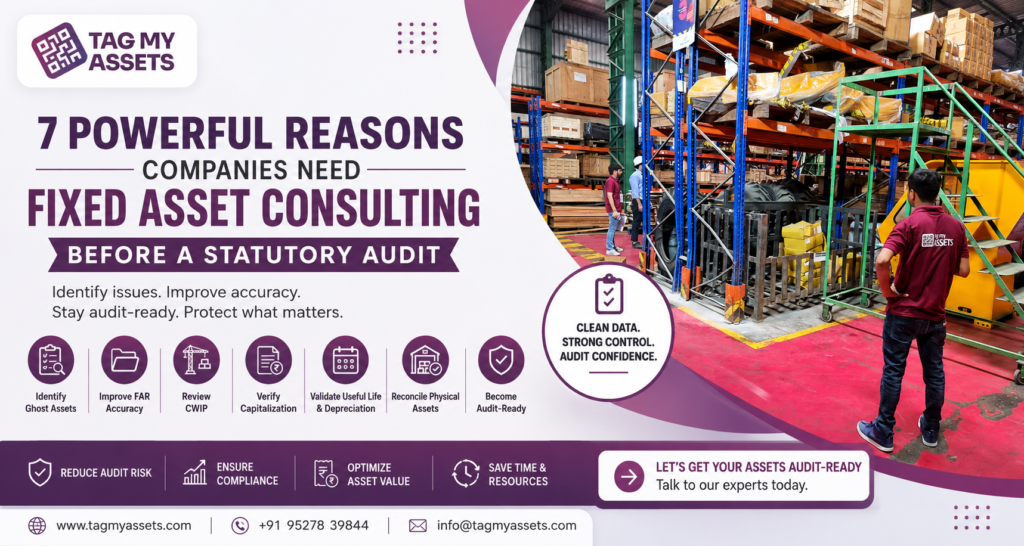
Here are seven reasons why organizations are choosing to address fixed asset issues before the audit begins — rather than during it.
1. Identify and Eliminate Ghost Assets
One of the most common findings during physical verification is the presence of ghost assets — assets that continue to appear in the Fixed Asset Register but no longer exist physically.
These situations arise because of:
- Unrecorded disposals or scrapping
- Asset theft or loss
- Transfers not updated in records
- Incorrect capitalization entries
- Historical data migration errors
Ghost assets have real financial consequences:
- Excess depreciation charges reducing stated profits
- Inflated gross block and net block in financial statements
- Insurance premiums paid on non-existent assets
- Potential tax liability on unrecorded disposals under the Income Tax Act
- Audit qualifications and management observations
Fixed asset consultants identify and eliminate ghost assets through structured physical verification and FAR review — before your auditors encounter them first.
2. Improve FAR Accuracy and Data Quality
Over time, fixed asset registers accumulate inconsistent descriptions, duplicate records, and outdated information.
Common examples include:
- Multiple names for the same asset category
- Duplicate asset records across branches or after ERP migrations
- Missing asset codes or incorrect tagging references
- Wrong locations recorded for transferred assets
- Incorrect classifications affecting depreciation rates
Poor data quality creates problems not just during audits, but across asset management, insurance, and budgeting activities.
Fixed asset consulting helps standardize descriptions, rationalize coding structures, and improve overall FAR quality through a structured FAR Reconciliation engagement.
A clean, structured FAR makes future audits — and day-to-day asset management — significantly easier.
3. Review Capital Work-in-Progress (CWIP)
CWIP is one of the most scrutinized line items on any balance sheet — and for good reason.
Many organizations maintain substantial CWIP balances for months or years. In numerous cases, projects are already operational but continue to remain under CWIP instead of being capitalized.
This leads to:
- Understated depreciation in financial statements
- Inflated CWIP balances that attract auditor attention
- Incorrect tax depreciation claims under the Income Tax Act
- Non-compliance with Ind AS 16 / AS 10 on the date of capitalization
Common CWIP issues include:
- Delayed capitalization
- Incomplete project closures
- Duplicate project records
- Incorrect cost allocation
Fixed asset consultants review CWIP balances, identify projects ready for capitalization, flag items requiring write-off, and support management in closing aged CWIP within reasonable timelines.
4. Verify Capitalization Practices
Incorrect capitalization is a frequent audit concern across industries.
Common examples include:
- Revenue expenses incorrectly capitalized as fixed assets
- Assets below the organization’s capitalization threshold still appearing in the FAR
- Incorrect asset grouping affecting depreciation rates
- Incomplete cost accumulation for complex or multi-phase projects
These issues affect:
- Profitability
- Depreciation calculations
- Tax computations under the Income Tax Act
- Accuracy of financial statements
Under Schedule II of the Companies Act, 2013, the consequences of incorrect asset classification compound every year.
A capitalization review ensures that accounting policies are applied consistently across all locations and departments — and that what is on your books is there for the right reasons.
5. Validate Useful Life and Depreciation
Organizations often apply standard useful lives established during ERP implementation or asset creation — sometimes years ago — without reviewing whether they still reflect reality.
Operational circumstances change.
Assets may:
- Last longer than originally estimated
- Become obsolete earlier than expected
- Experience higher or lower usage than assumed at the time of capitalization
- Qualify for component accounting under Ind AS 16, requiring separate life assignments
Incorrect useful lives result in depreciation that is either overstated or understated — both of which can become audit findings.
Under Schedule II of the Companies Act, prescribed useful lives apply to most asset categories, and deviations require disclosure and justification.
Fixed asset consultants assess asset categories, review useful life assignments, and identify areas requiring management attention or policy revision before the audit.
6. Reconcile Physical Assets with Accounting Records
A primary objective of any fixed asset audit is confirming that assets recorded in the books actually exist at the stated locations.
Many companies discover differences between:
- Physical assets present on the ground
- FAR records in the asset management system
- ERP asset module records
- General ledger balances
Common discrepancies include:
- Missing assets
- Excess assets not yet recorded
- Wrong locations
- Duplicate records
- Incorrect quantities
These issues are particularly common in organizations managing assets across multiple plants, branches, offices, warehouses, or project sites.
Fixed asset consulting includes reconciliation support through Fixed Asset Verification Services to align physical records with accounting records, resolving variances before the auditor begins independent testing.
This is what being truly audit-ready means.
7. Become Audit-Ready Before Auditors Arrive
Waiting for auditors to identify asset issues often leads to:
- Extended audit timelines and delays in financial statement filing
- Management time spent on explanations and additional documentation
- Corrective entries raised during the audit process
- Audit qualifications or emphasis of matter paragraphs
- Regulatory consequences for listed companies with delayed filings
A proactive fixed asset review resolves these issues beforehand.
The practical benefits:
- Faster, smoother audit cycles
- Fewer audit observations
- Stronger internal controls over assets
- Better asset visibility for management
- Improved credibility of financial statements with audit committees and lenders
Where a review is conducted before the audit rather than during it, the corrections are made on management’s timetable instead of the auditor’s.
Why Asset Management Software Alone Is Not Enough
Many organizations invest in asset management software expecting asset data problems to resolve automatically.
In practice, this is rarely the case.
Software can only manage the information available in the system. If the underlying FAR contains duplicate assets, incorrect locations, ghost assets, pending CWIP balances, or poor capitalization records, the software simply digitizes those problems — and often scales them.
There is a further distinction that is frequently overlooked.
Software vendors are technology specialists. They configure systems, manage data imports, and train users on platform features.
They do not typically perform:
- Physical verification of assets
- FAR clean-up and standardization
- FAR reconciliation
- Capitalization reviews
- Asset life reviews
- CWIP verification
Fixed asset consultants bridge this gap.
Through a structured Physical Verification of Fixed Assets engagement, consultants help organizations build an accurate and verified asset database before and during software implementation, ensuring the system delivers meaningful results from day one.
Sequencing the clean-up before implementation means the data migrated into the new system has already been verified against the physical position.
Why Fixed Asset Consulting Is Becoming More Important
Modern organizations manage thousands of assets across multiple locations — factories, warehouses, offices, branches, and remote sites.
While ERP systems help maintain records, they cannot independently verify whether assets physically exist, are correctly located, or are accurately classified.
At the same time, regulatory requirements are increasing.
CARO reporting, Ind AS disclosures, income tax block reconciliations, and audit committee oversight all demand a higher standard of fixed asset data quality than many organizations currently maintain.
Specialized expertise is now required for:
- FAR clean-up and data standardization
- CWIP verification and capitalization
- Capitalization review and policy alignment
- Asset life review under Schedule II and Ind AS 16
- Ghost asset detection and elimination
- FAR reconciliation with GL and financial statements
- Physical verification planning and execution support
Professional Fixed Asset Consulting Services bridge the gap between accounting records and physical asset reality — and do so before the audit begins, not during it.
Internal Team vs. Fixed Asset Consultant: Capability Comparison
| Activity | Internal Team | Fixed Asset Consultant |
|---|---|---|
| Physical Verification | Partial | Yes |
| FAR Clean-Up | Limited | Yes |
| CWIP Review | Limited | Yes |
| Capitalization Review | Limited | Yes |
| Depreciation Validation | Limited | Yes |
| Ghost Asset Detection | Partial | Yes |
| Audit Readiness | Partial | Yes |
Internal teams play an important role in ongoing asset management.
However, specialist engagements bring structured methodology, independent assessment, and dedicated bandwidth that internal teams managing day-to-day operations alongside audit preparation are rarely positioned to provide.
Who Should Consider Fixed Asset Consulting?
This engagement is particularly relevant for:
- Companies with large manufacturing plants, warehouses, or distributed branch networks
- Organizations that have undergone mergers, acquisitions, demergers, or business restructuring
- Companies preparing for ERP implementation and requiring a clean, verified asset database before data migration
- Organizations that have recently migrated to a new ERP or accounting system
- Businesses that have not conducted a physical verification exercise in two or more years
- Listed companies preparing for statutory audits with audit committee oversight
- Organizations with significant CWIP balances or recent large capital expenditure programs
From the Field: What a Typical Engagement Uncovers
The following example is illustrative and based on composite observations across multiple engagements. No client name or confidential information is referenced.
Illustrative Example
Multi-Location Organization – Fixed Asset Review
Scope: Physical verification, FAR reconciliation, CWIP review, and capitalization audit across 6 manufacturing plants and 4 warehouses.
Issues Identified
- 5%–8% of assets missing from physical locations
- Duplicate asset records created during a prior ERP migration
- Significant number of assets recorded at incorrect locations
- Aged CWIP balances pending capitalization beyond expected timelines
- Ghost assets continuing to draw depreciation charges
Outcomes After Consulting Engagement
- FAR accuracy improved significantly after clean-up and reconciliation
- CWIP backlog resolved with clear capitalization timelines
- Audit queries on fixed assets reduced substantially during the subsequent statutory audit
- Insurance premiums reviewed and corrected based on the verified asset base
Observations are illustrative and based on composite experience across engagements. No client name or confidential data is referenced.
Findings of this nature are not isolated. They are representative of what organizations across industries discover when a structured fixed asset review is conducted—often for the first time in several years.
Conclusion
Fixed asset consulting is no longer limited to large enterprises.
Organizations of all sizes benefit from periodic reviews of their fixed asset records to ensure accuracy, compliance, and audit readiness.
Whether the objective is FAR clean-up, CWIP verification, capitalization review, or reconciliation of physical assets with accounting records, a structured consulting approach significantly improves the reliability of asset data.
A clean, accurate, and audit-ready Fixed Asset Register does more than support compliance. It enables better business decisions, stronger asset control, and more credible financial governance year after year.
Organizations that wait for auditors to identify fixed asset issues often incur higher correction costs, greater management effort, and longer audit cycles than those that conduct a proactive review. Addressing these issues before the audit begins improves compliance, strengthens financial governance, and enables management to make decisions based on reliable asset information.
Speak With Our Fixed Asset Consulting Team
If your organization is preparing for a statutory audit, internal audit, ERP implementation, merger, acquisition, or CARO compliance review, a proactive fixed asset consulting exercise can help identify issues before they become audit observations.
Speak with our fixed asset consulting team to assess your FAR, CWIP balances, capitalization practices, and asset verification requirements.
Explore Fixed Asset Consulting Services in India
Explore RFID Asset Tagging Services India
Frequently Asked Questions
Q1. What Are Fixed Asset Consulting Services?
Fixed asset consulting services help organizations improve the accuracy, completeness, and compliance of their fixed asset records.
Engagements typically include:
- Physical verification of assets
- FAR clean-up and data standardization
- CWIP review and capitalization analysis
- Useful life and depreciation assessment
- FAR reconciliation with accounting records
- Audit readiness reviews
The objective is to create a reliable, accurate, and audit-ready Fixed Asset Register.
Q2. How Is Fixed Asset Consulting Different From Physical Verification?
Physical verification confirms whether assets recorded in the books exist at the stated locations.
Fixed asset consulting is broader in scope.
In addition to physical verification, consulting engagements may include:
- FAR data quality assessment
- CWIP review
- Capitalization review
- Depreciation analysis
- Ghost asset identification
- FAR reconciliation
- Audit readiness assessment
Physical verification is one component of a comprehensive fixed asset consulting engagement.
Q3. What Is FAR Clean-Up?
FAR clean-up is the process of reviewing and correcting the Fixed Asset Register to improve accuracy and consistency.
Typical activities include:
- Removing duplicate asset records
- Updating asset descriptions
- Correcting asset locations
- Eliminating ghost assets
- Standardizing asset categories
- Correcting classification errors
A clean FAR improves audit readiness, insurance accuracy, compliance, and asset management effectiveness.
Q4. Why Is CWIP Verification Important?
Capital Work-in-Progress (CWIP) balances attract significant attention during statutory audits because they represent expenditure that has been incurred but not yet capitalized.
Delayed or incorrect capitalization can result in:
- Understated depreciation
- Overstated CWIP balances
- Incorrect tax depreciation claims
- Potential non-compliance with Ind AS 16 and AS 10
CWIP verification helps identify projects ready for capitalization, items requiring write-off, and aged balances requiring management action.
Q5. How Often Should Companies Review Their Fixed Asset Register?
For most organizations, an annual FAR review aligned with the statutory audit cycle is recommended.
Additional reviews should be considered when:
- Significant capital expenditure has occurred
- An ERP migration has been completed
- Mergers or acquisitions have taken place
- Business restructuring has occurred
- Physical verification has not been conducted for several years
Organizations with large multi-location asset bases often benefit from verification cycles every one to two years per location.
Q6. Can Fixed Asset Consulting Help Before ERP Implementation?
Yes. Many organizations perform FAR clean-up, physical verification, and reconciliation before ERP implementation to ensure that only accurate and verified asset data is migrated into the new system.
Migrating poor-quality asset data into a new ERP simply transfers existing problems into a new environment.
Issues such as:
- Duplicate asset records
- Incorrect locations
- Ghost assets
- Pending CWIP balances
- Capitalization errors
often become more difficult and expensive to correct after implementation.
A fixed asset consulting engagement before ERP go-live helps organizations create a clean, reconciled, and audit-ready asset database, resulting in smoother implementation, better user adoption, reduced post-go-live corrections, and a stronger audit trail from day one.