
Introduction
Physical inventory verification is one of the most critical processes any organization can undertake to ensure accurate asset records, maintain financial integrity, and pass statutory audits.
Yet many companies still treat it as a one-day compliance checkbox rather than a structured, technology-enabled exercise. The result? Missed assets, unreconciled discrepancies, and audit findings that damage credibility.
This guide explains everything you need to know about physical inventory verification: what it is, when to do it, how to do it right, and why professional execution matters.
By the Numbers: TagMyAssets Track Record
Across 250+ verification projects, our teams have physically verified and reconciled inventory in more than 1,500 locations across India. We’ve worked with retail chains, warehouses, manufacturing units, pharmaceutical companies, and government organizations to ensure audit-ready accuracy.
What is Physical Inventory Verification?
Physical inventory verification is the process of physically counting and inspecting actual inventory items in a facility (warehouse, retail store, manufacturing plant, office) and reconciling them against system records (ERP, accounting software, or inventory management system).
The goal is simple: Ensure physical stock matches what the books say should be there.
Key Differences: Physical Verification vs Related Processes
Physical Inventory Verification:
• Counts actual items on hand
• Reconciles with system/book records
• Identifies discrepancies and variances
• Conducted periodically or at year-end
• Audit-focused
Cycle Counting:
• Continuous, rolling count of inventory
• Small sections counted regularly
• Reduces disruption
• Maintains accuracy year-round
• Operational focus
Stock Audit:
• Broader review including compliance, controls, procedures
• Examines not just quantity but quality, condition, placement
• Includes financial audit elements
• More time-intensive
Why Physical Inventory Verification Matters
Regulatory & Compliance Reasons
Physical verification is a key internal control for reliable inventory reporting. For applicable companies, auditors report on inventory verification procedures under CARO 2020.
Auditors specifically examine whether:
• Physical verification was conducted before year-end
• Records were reconciled with system data
• Variances were properly explained and adjusted
• Procedures were followed consistently
Missing or poorly documented physical verification is an audit red flag.
Business Reasons
Beyond compliance, physical inventory verification helps:
1. Identify Ghost Assets — Items recorded in books but no longer physically present (theft, loss, obsolescence)
2. Catch Slow-Moving Inventory — Identify inventory that should be written off
3. Improve Financial Accuracy — Correct inventory valuation in financial statements
4. Reduce Shrinkage — Understand where inventory is being lost
5. Strengthen Controls — Reveal gaps in asset management processes
6. Support Decision-Making — Accurate inventory data leads to better procurement and production decisions
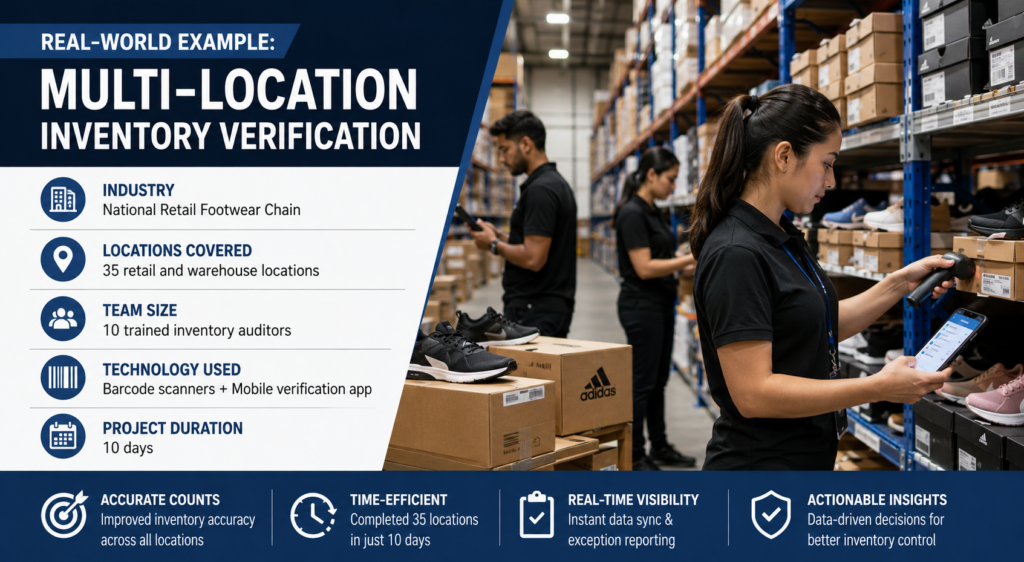
Real-World Example: Multi-Location Inventory Verification
| Industry | National Retail Footwear Chain |
| Locations Covered | 35 retail and warehouse locations |
| Team Size | 10 trained inventory auditors |
| Technology Used | Barcode scanners + Mobile verification app |
| Project Duration | 10 days |
Key Results
✔ 10,112 inventory items verified (52.8% verified rate)
✔ 9,022 discrepancies identified
✔ Variance quantified and analyzed
✔ 35% time savings vs manual counting
✔ Audit-ready report delivered 2 days early
✔ Inventory register updated and reconciled
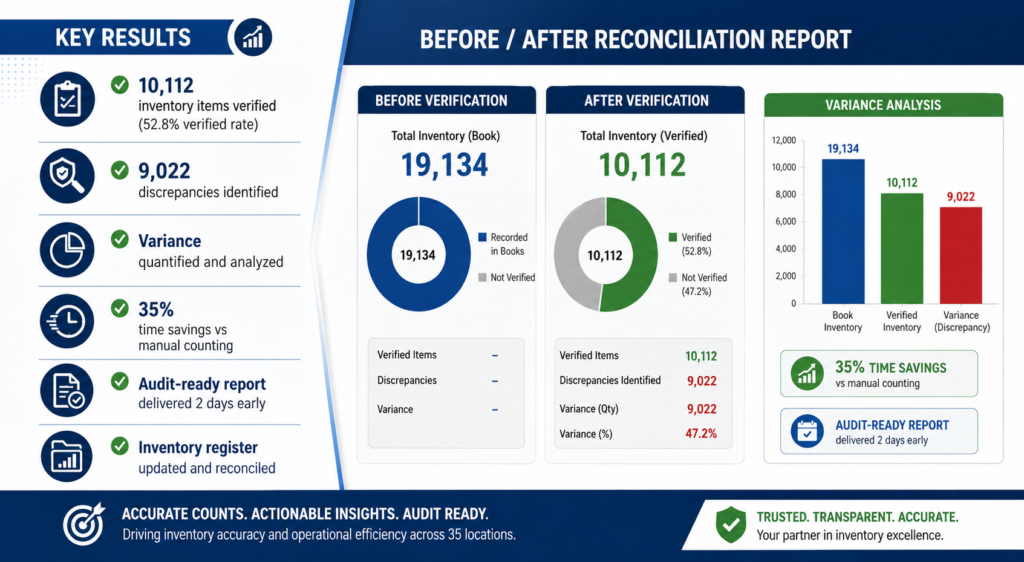
Key Insight
Almost half of the inventory register required reconciliation because of obsolete items, transfers, duplicate entries, or classification issues. This project enabled management to update inventory records before statutory reporting, adjust depreciation schedules, and strengthen asset controls.
*Client identity withheld due to confidentiality obligations. Project metrics shared with client approval.
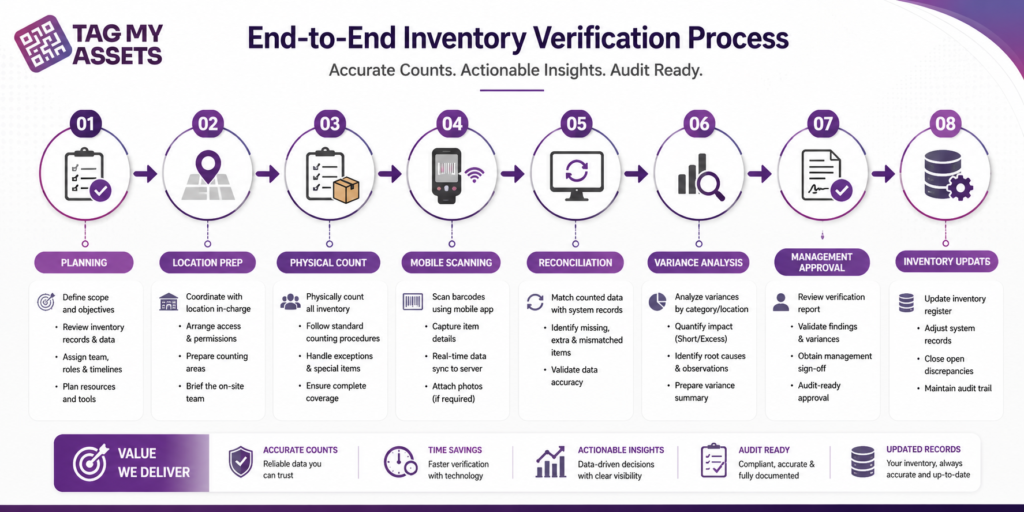
Physical Inventory Verification Process (Step-by-Step)
Step 1: Planning and Scope Definition
Before counting begins:
• Define inventory scope (which locations, which asset categories)
• Determine timeline and scheduling (weekend count, phased approach, overnight)
• Identify team size and roles
• Prepare documentation and count sheets
• Communicate with stakeholders
Step 2: Location Preparation
Ensure facilities are ready:
• Organize inventory into logical sections/bins
• Clear obstructions and access points
• Segregate obsolete or damaged items
• Lock down the area to prevent additions/removals during counting
• Arrange proper lighting and safety conditions
Step 3: Physical Counting
The actual count:
• Count every item systematically (by location, category, bin)
• Record quantities on count sheets or mobile devices
• Verify SKU numbers, serial numbers, condition
• Use barcode/QR code scanning when available
• Flag discrepancies immediately
Step 4: Reconciliation
Compare physical counts to system records:
• Input count data into system
• Generate reconciliation report showing variances
• Identify items that are: (a) Physically present but not in system, (b) In system but not physically found, (c) Quantity mismatches
• Recount high-value items or suspicious variances
Step 5: Variance Analysis
Understand WHY discrepancies exist:
• Damaged or obsolete items → Write-off
• Misplaced inventory → Location correction
• System errors → Data cleanup
• Theft or loss → Control improvements
• Unrecorded receipts → Documentation review
Step 6: Adjustment & Closure
Update records:
• Post journal entries to correct inventory balances
• Update fixed asset register (for asset inventory)
• Document all variances and resolutions
• Obtain management approvals
• Archive all count documentation for audit trail
Process Flow Diagram
When Should Companies Conduct Physical Inventory Verification?
Statutory Requirements:
• At minimum, once annually (typically year-end)
• Per CARO 2020, before audit closure
Additional Scenarios:
• After significant inventory events (natural disaster, suspected theft)
• When system data seems unreliable
• Quarterly for high-value or fast-moving inventory
• Before major financial decisions (acquisitions, financing)
• When control procedures are questioned
Industries Where Physical Inventory Verification is Critical
Retail & FMCG
For retail chains and FMCG businesses, inventory is the core asset on the balance sheet. Physical verification is critical because retail environments operate with high transaction volumes, multiple locations, and constant merchandise movement. Common challenges include SKU proliferation, shelf stock mismatches, and damage during handling. Multi-location counting requires synchronized execution, often conducted over weekends to minimize disruption to sales operations. In our experience, retail inventory verification frequently identifies discrepancies arising from unrecorded stock transfers, damaged merchandise, clearance items, and delays in updating inventory records.
Manufacturing
Manufacturing operations require verification of raw materials, work-in-progress (WIP), and finished goods. Classification accuracy is critical because improper categorization affects financial statements and production planning. Verification must account for materials in various stages of production, semi-finished components awaiting assembly, and finished goods awaiting shipment. Manufacturing environments also present unique challenges: high-value inventory, just-in-time (JIT) procurement, and potential for double-counting during shift changes. Physical verification helps identify scrapped materials that weren’t recorded, work-in-progress on held orders, and obsolete raw materials.
Pharmaceuticals
Pharmaceutical inventory verification is both a regulatory requirement and a critical operational control. Beyond standard quantity verification, auditors examine batch numbers, expiration dates, storage conditions, and potency documentation. Regulatory bodies (FDA, local drug authorities) expect rigorous verification procedures. Verification teams must document shelf-life compliance and flag expired medications for proper disposal. Additionally, pharmaceutical organizations must track high-value active ingredients, controlled substances (if applicable), and verify that inventory matches production records for accountability.
Warehousing & Logistics
Warehousing and logistics operations handle third-party inventory for multiple clients, making accuracy critical for customer relationships. High transaction volumes create opportunities for misplacement, unrecorded receipts, and short shipments. Regular physical verification prevents loss of customer trust and identifies operational gaps (labeling errors, bin misplacement, or receiving discrepancies). Logistics providers also manage temporary storage, cross-docking operations, and seasonal inventory surges, requiring dynamic verification approaches.
Hospitals & Labs
Critical inventory tracking for patient care is non-negotiable in healthcare. Hospital pharmacies, surgical supplies, diagnostic materials, and blood products require precise inventory management. Expiration tracking is essential; expired medications or blood products can compromise patient safety. Verification procedures must account for emergency draw-downs, interdepartmental transfers, and waste. Health information regulations require detailed documentation of inventory movement and destruction of expired products.
12 Most Common Findings During Physical Inventory Verification
Based on 250+ verification projects across multiple industries, certain discrepancies appear repeatedly. Understanding these findings helps organizations prepare for verification and strengthen controls.
1. Missing Inventory
Why It Occurs: Theft, unreported damage, or system errors where items were recorded but never received.
Business Impact: Overstated inventory balances inflate current assets and reduce reported profitability.
Corrective Action: Investigate high-value missing items, strengthen receiving procedures, implement GPS tracking for high-risk inventory.
2. Duplicate Inventory Codes
Why It Occurs: Manual data entry errors, system migrations, or legacy code formats mixed with new coding schemes.
Business Impact: Inventory data becomes unreliable; reconciliation becomes impossible; audit trails are unclear.
Corrective Action: Conduct data cleanup in ERP, implement barcode/QR code standards, enforce SKU uniqueness at receipt.
3. Wrong Warehouse/Location Mapping
Why It Occurs: Inventory transferred between locations without ERP updates, or items physically moved during reorganization.
Business Impact: Location-based analytics become unreliable; procurement forecasts are inaccurate.
Corrective Action: Update ERP location records, implement bin management system, require location confirmation during physical count.
4. Unrecorded Transfers
Why It Occurs: Inter-company or inter-location transfers that happen informally without system documentation.
Business Impact: Stock outs at one location despite inventory at another; inaccurate location-specific valuation.
Corrective Action: Implement mandatory transfer documentation, use transfer orders in ERP before physical movement.
5. Obsolete Inventory
Why It Occurs: Products no longer in demand, discontinued product lines, or inventory held beyond useful life.
Business Impact: Overstated inventory value; potential write-offs; warehouse space tied up.
Corrective Action: Conduct age-based analysis, establish disposal procedures, set thresholds for automatic obsolescence flagging.
6. Damaged Inventory
Why It Occurs: Handling damage, environmental exposure, or product deterioration over time.
Business Impact: Inventory recorded at full value but unsaleable; potential loss on disposal.
Corrective Action: Document damage during receipt, establish quality inspection checkpoints, implement condition assessment during verification.
7. Quantity Mismatch
Why It Occurs: Transaction lag between physical shipment and system recording, or counting errors.
Business Impact: System balances don’t reconcile to physical counts, creating audit exceptions.
Corrective Action: Implement receipt-to-record matching, use barcode scanning to reduce counting errors, conduct count verification (two counters).
8. Wrong SKU Classification
Why It Occurs: Similar products recorded under wrong product codes, or variant codes not properly differentiated in the system.
Business Impact: Procurement forecasts are inaccurate; product discontinuation decisions become unreliable.
Corrective Action: Implement barcode/QR verification, use photo identification during count, clean up product master data.
9. Slow-Moving Stock
Why It Occurs: Inventory with low sales velocity due to changing demand patterns or discontinued items.
Business Impact: Working capital tied up; carrying costs exceed profitability; potential for further obsolescence.
Corrective Action: Conduct age-based stock analysis, identify items not moved in 12+ months, plan clearance sales or donations.
10. Incorrect Unit of Measure
Why It Occurs: Inventory recorded in different units (pieces vs. pallets vs. liters) without proper conversion in the system.
Business Impact: Reconciliation becomes impossible; procurement orders may specify wrong quantities.
Corrective Action: Standardize unit of measure across the system, enforce unit verification during receipt and count.
11. Duplicate Records in System
Why It Occurs: Same item created twice in the system with different SKU numbers due to system migrations or manual entry.
Business Impact: Total inventory quantity appears higher than actual; financial statements overstate assets.
Corrective Action: Implement data governance, consolidate duplicate SKUs, establish unique identifier policy.
12. Inventory Recorded but Never Received
Why It Occurs: Goods ordered and recorded in the system but not physically received (supplier failure or in-transit loss).
Business Impact: Accounts payable overstated; inventory valuation inaccurate; payment made for non-existent stock.
Corrective Action: Implement receipt-to-record matching, require delivery proof (transport documents), establish receiving checkpoints.
Common Challenges in Physical Inventory Verification
Challenge 1: Counting Accuracy in Large Locations
Problem: High-volume warehouses or multi-location retail chains make 100% accuracy difficult. Manual errors increase with volume.
Solution: Use structured methodology, trained teams, mobile-based scanning, and systematic section-by-section approach.
Challenge 2: Time Constraints
Problem: Counting disrupts operations. Retail stores can’t close for days. Manufacturing can’t stop production.
Solution: Phased counting over weekends/nights, cycle counting approach, or outsourcing to specialized teams.
Challenge 3: Inventory Spread Across Multiple Locations
Problem: Coordinating counts across 50+ stores or warehouses is logistically complex.
Solution: Centralized project management, mobile real-time data capture, unified reporting platform.
Challenge 4: Reconciliation Complexity
Problem: Even after physical counting, reconciling to system records is tedious without proper tools.
Solution: Inventory management software with automated reconciliation, ERP integration, variance reports.
Challenge 5: Obsolete or Slow-Moving Inventory
Problem: Identifying which items should be written off or reclassified.
Solution: Detailed condition assessment during count, age analysis of inventory, management review of slow movers.
Challenge 6: Audit-Ready Documentation
Problem: Auditors require proper documentation, but manual counting often lacks traceability.
Solution: Use technology (photos, GPS timestamps, auditor sign-offs), maintain detailed count sheets, archive electronically.
Best Practices for Accurate Physical Inventory Verification
1. Use Structured Methodology
• Don’t leave counting to chance
• Define systematic approach (aisle-by-aisle, bin-by-bin)
• Use two-count verification for high-value items
• Document the methodology in advance
2. Leverage Technology
• Barcode/QR Code Scanning: Reduces manual errors
• Mobile Apps: Real-time data capture in the field
• Geo-Location Tagging: Proves physical presence with timestamps
• Automated Reconciliation: Compares counts to system instantly
• Photo Documentation: Visual proof of counts and conditions
3. Train Your Team
• Ensure counters understand SKU classification
• Brief on common mistakes (missing tags, double-counting)
• Clarify roles (counter, verifier, recorder)
• Provide clear count sheets or app instructions
4. Plan for Contingencies
• Have backup counters if someone is unavailable
• Prepare for extended timelines if variances are high
• Flag unusual items (sealed boxes, hazardous goods, high-value assets) in advance
5. Reconcile Quickly
• Don’t wait weeks to reconcile counts to system data
• Conduct daily or same-day reconciliation if possible
• Recount high-variance items immediately while physical layout is fresh
• Document all discrepancies while memory is clear
6. Maintain Audit Trail
• Keep all count sheets and reconciliation reports
• Document reasons for every variance adjustment
• Obtain approvals and sign-offs from management
• Preserve digital records (photos, mobile app logs)
Why Companies Choose TagMyAssets for Inventory Verification
Proven Track Record:
• 250+ inventory verification projects completed
• 1,500+ locations covered across India
• 10 lakh+ assets tagged and verified (across applicable projects)
Execution Capabilities:
• Pan-India deployment for multi-location projects
• Expertise in handling large SKU volumes and complex inventories
• Fast execution with minimal operational disruption
Technology & Methodology:
• Mobile app-based verification for real-time data capture
• Barcode, QR, RFID, and advanced scanning integration
• Automated reconciliation with detailed variance analysis
Credibility & Compliance:
• CA-led team with audit backgrounds
• Methodology aligned with AS-2 and CARO 2020
• Audit-ready reports with full documentation
Frequently Asked Questions
How often should we conduct physical inventory verification?
At minimum annually (year-end for compliance). High-value or critical inventory may require quarterly verification. Cycle counting can supplement annual full counts.
Can we conduct physical verification during operations?
Yes, but it’s risky (items moved, additions/removals affect accuracy). Best practice is to freeze operations during the count or use phased approach over multiple days/weekends.
What’s the difference between physical verification and stock audit?
Physical verification counts items and reconciles to records. Stock audit is broader—it also reviews compliance, controls, procedures, and quality.
How do we handle variances?
Investigate why variances exist (damage, theft, system error, misplaced items). Adjust records if items are confirmed missing. Document the reason and obtain approval.
Is physical inventory verification mandatory in India?
Physical verification is a key internal control for reliable inventory reporting. For applicable companies, auditors report on inventory verification procedures under CARO 2020.
Can we use cycle counting instead of annual physical verification?
Cycle counting is excellent for operational accuracy but doesn’t replace annual physical verification for statutory audit compliance.
What should we do if we find significant variances?
Investigate root cause (theft, system error, damage, obsolescence), adjust records, implement corrective controls, and document for audit.
How long should physical inventory verification take?
Depends on size and complexity. Small warehouses: 1–2 days. Large facilities: 5–10 days. Multi-location projects: 2–6 weeks.
What technology makes physical verification easier?
Barcode scanning, mobile apps, real-time reconciliation software, photo documentation, and ERP integration all improve accuracy and speed.
How many items can one auditor verify per day?
Varies by inventory type and location complexity. Average: 150–300 items per auditor per day with mobile scanning. Manual counting: 50–100 items per day.
What documents should be ready before verification?
System printouts (inventory master list), previous year count sheets, location maps, asset registers, and any known obsolete/damage items.
How accurate is barcode-based inventory verification?
When barcodes or QR codes are correctly applied and maintained, scanning significantly improves counting consistency, reduces manual data-entry errors, and speeds up reconciliation compared with manual counting.
How much does physical inventory verification cost?
Verification costs depend on several factors: number of locations, total inventory volume, inventory complexity, technology requirements, and project timeline. A small warehouse verification may cost significantly less than a multi-location retail chain project. We recommend discussing your specific requirements to receive a customized quotation that reflects your unique circumstances.
Physical Inventory Verification for Compliance
CARO 2020 Requirements
Physical verification is a key internal control for reliable inventory reporting. For applicable companies, auditors report on inventory verification procedures under CARO 2020.
Companies must disclose in their audit report whether physical verification was:
• Conducted before year-end
• Properly documented
• Reconciled with system records
• Procedures followed consistently
Auditor Focus Areas:
• Was inventory actually counted (not just assumed)?
• Were count procedures reasonable?
• Were variances investigated and explained?
• Are adjustments properly supported?
• Is documentation complete?
Missing or weak physical verification often leads to audit qualifications or findings.
Planning an inventory verification exercise across multiple locations? Our experts can help you execute audit-ready verification with barcode-enabled reconciliation and minimal operational disruption.
Related Resources and Guides
• Inventory Verification Services
• Fixed Asset Verification
• Stock Audit Services
• FAR Reconciliation After Physical Verification
• Physical Verification for Retail Chains
• Warehouse Inventory Verification
• Asset Tagging Services
• RFID Inventory Tracking
• Barcode Asset Tagging
• Inventory Verification Checklist (Downloadable)
Ready to Improve Your Inventory Accuracy?
Physical inventory verification done right ensures compliance, improves accuracy, and strengthens your financial reporting. Our team can design and execute a verification project tailored to your operations.