
CWIP full form: Capital Work-in-Progress. CWIP refers to assets under construction, installation, or development that are not yet ready for their intended use — and therefore not yet capitalised or depreciated. Under CARO 2020 and Ind AS 16, companies must physically verify CWIP, review its ageing schedule, and ensure timely capitalisation once assets are put to use.
Many organisations invest substantial amounts in expansion projects, plant upgrades, office fit-outs, technology implementations, and infrastructure development. Until these projects are completed and ready for their intended use, the related expenditure is generally accumulated under Capital Work-in-Progress (CWIP).
Over time, CWIP balances can grow significantly. Projects get delayed, invoices remain under review, assets become operational without formal capitalisation, and ageing balances continue to appear in financial statements year after year.
As a result, CWIP often becomes one of the most scrutinised areas during statutory audits and internal reviews.
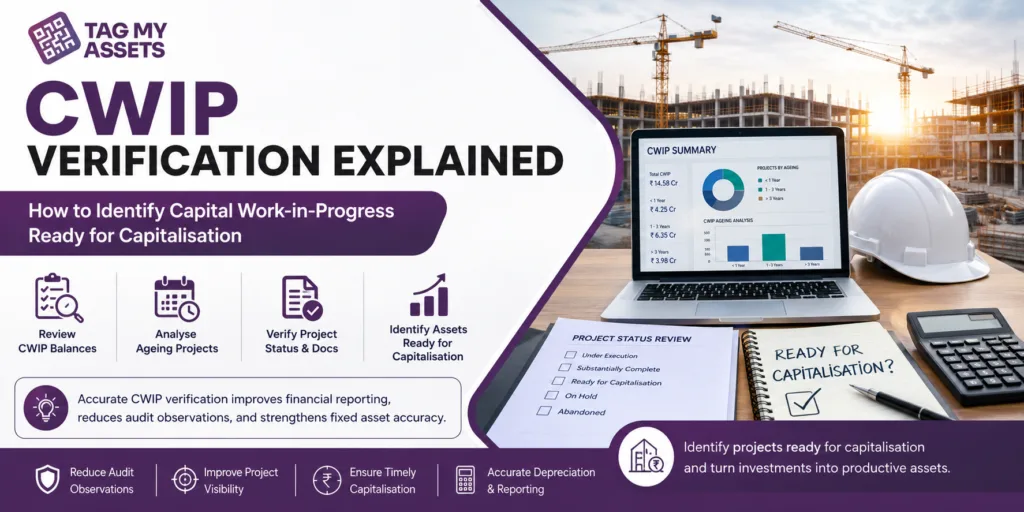
A structured CWIP verification exercise helps organisations determine which projects are ready for capitalisation, identify obsolete or inactive balances, improve financial reporting accuracy, and strengthen control over capital expenditure.
What Is Capital Work-in-Progress (CWIP)?
Capital Work-in-Progress (CWIP) represents expenditure incurred on assets that are still under construction, installation, development, or implementation and are not yet ready for their intended use.
In simple terms:
CWIP represents future fixed assets that are still in progress.
Examples of CWIP include:
- Construction of factory buildings.
- Installation of production machinery.
- Office renovation and fit-out projects.
- ERP implementation costs.
- Electrical infrastructure upgrades.
- Warehouse development projects.
- Plant expansion activities.
- IT infrastructure implementation.
- Solar power installations.
- Building automation systems.
Once these projects are substantially complete and capable of operating in the manner intended by management, the accumulated expenditure is generally transferred from CWIP to the relevant fixed asset category.
How CWIP Appears in the Balance Sheet
CWIP is shown under non-current assets, separately from Property, Plant and Equipment. It is not depreciated — depreciation begins only when the asset is available for use, not when the project formally closes.
Schedule III to the Companies Act requires an ageing schedule for CWIP in four buckets: less than 1 year, 1–2 years, 2–3 years, and more than 3 years. Projects that are overdue or have exceeded their original cost require a separate completion schedule showing expected completion.
Capital advances are not CWIP. Advances paid to vendors before work begins sit under other non-current assets, and the distinction is one auditors check every year.
Under IFRS the same balance is described as assets under construction, and US GAAP calls it construction in progress. The accounting treatment is the same.
Why CWIP Verification Matters
Many organisations review CWIP only during the year-end audit process. By then, discrepancies may have accumulated over several years.
Regular CWIP verification helps organisations identify issues early and improve financial reporting.
Timely Capitalisation
Completed projects can be transferred to fixed assets without unnecessary delays, ensuring that financial records accurately reflect operational realities.
Accurate Depreciation
Depreciation begins only after assets are capitalised appropriately. Delayed capitalisation can distort profitability and asset values.
Reduced Audit Observations
Ageing CWIP balances are among the most common areas questioned by statutory auditors.
Better Capital Allocation
Management gains visibility into stalled, inactive, or delayed projects and can make informed decisions regarding future investments.
Improved Financial Reporting
Financial statements more accurately represent the status of ongoing and completed projects.
Enhanced Internal Controls
Regular reviews strengthen governance over capital expenditure and project monitoring.
Common CWIP Issues Identified During Reviews
CWIP verification exercises frequently reveal problems that remain unnoticed during routine accounting processes.
Projects Completed but Not Capitalised
Assets may already be operational while costs continue to remain under CWIP.
For example, a production line commissioned six months ago may still be classified as CWIP because the finance team has not received formal closure documentation.
Ageing Balances Without Movement
Certain balances remain unchanged for years without clear explanations.
These ageing projects often require management intervention to determine whether they should be capitalised, investigated further, or written off.
Duplicate Accumulation of Costs
The same expenditure may inadvertently be recorded more than once under different project codes.
Incomplete Supporting Documentation
Invoices, approvals, contracts, and project files may be missing or difficult to trace.
Abandoned Projects
Projects discontinued midway may continue appearing in CWIP schedules despite having no future economic benefit.
Incorrect Classification
Revenue expenses may inadvertently be capitalised under CWIP, resulting in inaccurate financial reporting.
Red Flags That Indicate CWIP Problems
Certain warning signs often indicate the need for a detailed CWIP review.
Watch out for these indicators:
- CWIP balances continue to increase every year.
- Projects remain under CWIP for unusually long periods.
- There is limited movement in ageing schedules.
- Operational teams confirm assets are already in use.
- Supporting documents cannot be traced easily.
- Internal or statutory auditors repeatedly raise observations.
- Significant differences exist between project status reports and accounting records.
- Management lacks visibility into project completion status.
- Projects have exceeded original budgets substantially.
- Departments provide conflicting information regarding project status.
If one or more of these situations exists, organisations should consider conducting a formal CWIP verification exercise.
How to Conduct CWIP Verification
A structured methodology ensures that CWIP balances are reviewed consistently and efficiently.
Step 1: Obtain the Detailed CWIP Schedule
Review the complete CWIP register, including:
- Project descriptions.
- Project codes.
- Opening balances.
- Additions during the year.
- Current balances.
- Responsible departments.
- Project commencement dates.
- Budgeted costs.
Understanding the composition of CWIP is the foundation of an effective review.
Step 2: Perform Ageing Analysis
Identify projects that have remained under CWIP for unusually long periods.
Schedule III requires four ageing buckets:
- Less than 1 year.
- 1–2 years.
- 2–3 years.
- More than 3 years.
Older balances generally require additional investigation because they often indicate delays, disputes, or projects that have already been completed.
Step 3: Verify Physical Status of Projects
Discuss project status with operational teams and conduct site visits where necessary.
Determine whether projects are:
- Under execution.
- Substantially complete.
- Operational.
- Suspended.
- On hold.
- Abandoned.
Physical verification provides valuable insights that may not be evident from accounting records alone.
Step 4: Review Supporting Documentation
Examine documentation supporting the CWIP balances, including:
- Vendor invoices.
- Purchase orders.
- Contract agreements.
- Work completion certificates.
- Project approval notes.
- Capital expenditure approvals.
- Internal project status reports.
Missing documentation often signals control gaps requiring attention.
Step 5: Assess Readiness for Intended Use
Determine whether the asset is capable of operating in the manner intended by management.
This is often the most critical step in deciding whether capitalisation is appropriate.
Questions to consider include:
- Has installation been completed?
- Have trial runs been conducted successfully?
- Is the asset capable of performing its intended function?
- Are only administrative formalities pending?
- Has operational use commenced?
The answers to these questions frequently determine whether balances should continue under CWIP or move to fixed assets.
Step 6: Recommend Appropriate Action
Based on the review findings, management may decide to:
- Capitalise completed projects.
- Continue classification under CWIP.
- Conduct further investigation.
- Reclassify incorrect balances.
- Consider write-offs for abandoned projects.
- Escalate inactive projects for management review.
A well-documented recommendation process helps strengthen governance and supports future audits.
When Should CWIP Be Capitalised?
One of the most common questions during CWIP reviews is:
When should a project move from CWIP to Fixed Assets?
A common misconception is that capitalisation should occur only after formal project closure. In reality, capitalisation generally becomes appropriate when the asset is substantially complete and ready for its intended use.
According to the principles of Ind AS 16 – Property, Plant and Equipment, an asset is typically capitalised when it is capable of operating in the manner intended by management.
Indicators That a Project Is Ready for Capitalisation
- Installation has been completed.
- Trial runs have concluded successfully.
- Required approvals have been obtained.
- The asset is available for operational use.
- Production or business operations have commenced.
- Only minor administrative activities remain pending.
For example, if a manufacturing machine has been installed, tested, and is producing output, it may be ready for capitalisation even if final documentation is still being processed.
Organisations should establish clear policies defining capitalisation criteria to ensure consistency across locations and projects.
Risks of Delayed Capitalisation
Failure to capitalise completed projects on time can create several financial and operational issues.
Understatement of Depreciation
Depreciation expenses may not be recognised appropriately, resulting in inaccurate profit calculations.
Distorted Asset Values
Fixed asset balances may be understated while CWIP remains overstated.
Audit Queries
Statutory auditors frequently seek explanations for long-outstanding CWIP balances.
Weak Governance
Delayed decision-making reduces transparency over capital expenditure and project monitoring.
Misleading Project Reporting
Management may continue treating completed projects as “under progress” despite operational use.
Inefficient Resource Allocation
Capital expenditure decisions become less reliable when project status is not accurately reflected.
Best Practices for Managing CWIP
Organisations can strengthen CWIP controls through the following practices.
Conduct Periodic CWIP Reviews
Review CWIP balances quarterly rather than waiting for year-end audits.
Implement Ageing Reports
Track long-pending balances separately and investigate delays promptly.
Define Capitalisation Policies
Document objective criteria for determining readiness for intended use.
Improve Coordination Between Departments
Finance, projects, procurement, engineering, and operations teams should collaborate regularly.
Maintain Complete Documentation
Ensure all project-related approvals, invoices, contracts, and completion certificates are retained systematically.
Escalate Stalled Projects
Management should periodically review inactive projects and determine appropriate actions.
Link CWIP Reviews with Physical Verification
Where possible, validate project status through physical inspections rather than relying solely on accounting records.
How Fixed Asset Consultants Help
CWIP verification often requires coordination across multiple departments, locations, and project teams.
Many organisations struggle because project information is scattered across engineering teams, finance departments, procurement records, and operational functions.
Fixed asset consultants can support organisations by:
- Reviewing detailed CWIP schedules.
- Conducting ageing analysis.
- Verifying project status.
- Performing physical inspections.
- Reviewing supporting documentation.
- Identifying projects ready for capitalisation.
- Highlighting inactive or abandoned balances.
- Assisting management during statutory and internal audits.
- Recommending process improvements.
- Supporting CWIP-to-fixed-asset transfers.
An independent review often provides management with greater clarity over capital expenditure, project progress, and governance controls.
Conclusion
Capital Work-in-Progress represents future productive assets, but prolonged CWIP balances can obscure the true status of projects and create unnecessary audit concerns.
A structured CWIP verification exercise enables organisations to identify projects ready for capitalisation, investigate ageing balances, improve depreciation accuracy, and strengthen governance over capital expenditure.
Rather than waiting for year-end audits to uncover issues, periodic CWIP reviews help ensure that financial records accurately reflect operational realities.
Organisations that actively monitor CWIP balances are better positioned to improve financial reporting accuracy, strengthen internal controls, and make informed capital allocation decisions.
If your organisation carries significant CWIP balances, now may be the right time to assess whether projects are progressing as expected and whether completed assets are ready to move into the Fixed Asset Register.
Frequently Asked Questions
What is CWIP verification?
CWIP verification is the process of reviewing Capital Work-in-Progress balances to assess project status, validate supporting documentation, and identify projects ready for capitalisation.
Why is CWIP verification important?
It helps improve financial reporting accuracy, reduce audit observations, identify ageing balances, and ensure timely capitalisation of completed projects.
When should CWIP be capitalised?
CWIP is generally capitalised when an asset is substantially complete and ready for its intended use.
What are common CWIP issues?
Common issues include ageing balances, delayed capitalisation, incomplete documentation, duplicate costs, and abandoned projects.
How often should CWIP reviews be conducted?
Organisations should ideally review CWIP balances quarterly or at least annually as part of their fixed asset governance process.
What is the full form of CWIP?CWIP stands for Capital Work-in-Progress — capital expenditure on assets under construction or installation that are not yet ready for use, shown separately from fixed assets in the balance sheet.
Why is physical verification of CWIP required?CARO 2020 requires auditors to report on CWIP ageing and completion status. Physical verification confirms the CWIP actually exists at site, identifies abandoned or delayed projects, and ensures assets put to use are capitalised on time instead of remaining in CWIP.
Good Reads
- Fixed Asset Consulting Services
- Asset Verification Services
- Ghost Assets: How to Detect and Remove Them from FAR
- 7 Powerful Reasons Companies Need Fixed Asset Consulting Before a Statutory Audit
- Why Asset Management Software Fails Without Physical Verification and FAR Reconciliation
Recommended
Ind AS 16 – Property, Plant and Equipment
ICAI Guidance on Audit Procedures Relating to Fixed Assets
ICAI Guidance on Internal Financial Controls
Call to Action
At TagMyAssets, we assist organisations in reviewing CWIP balances through structured verification procedures, ageing analysis, project status assessments, and fixed asset consulting services. Our approach helps management identify projects ready for capitalisation, strengthen internal controls, improve audit readiness, and enhance the reliability of fixed asset reporting across multiple locations.