
Fixed assets that go missing have often not been stolen at all. They were moved, and nobody wrote it down.
An asset movement register is the record that closes that gap. It captures every relocation of an item of property, plant and equipment before the move happens, so the fixed asset register continues to show where each asset actually is. Without it, a company can maintain an accurate purchase record, run depreciation correctly under Schedule II, and still fail to locate a material asset during physical verification.
This article covers what an asset movement register should contain, how the process runs in practice, and the specific reporting requirement it supports under CARO 2020.
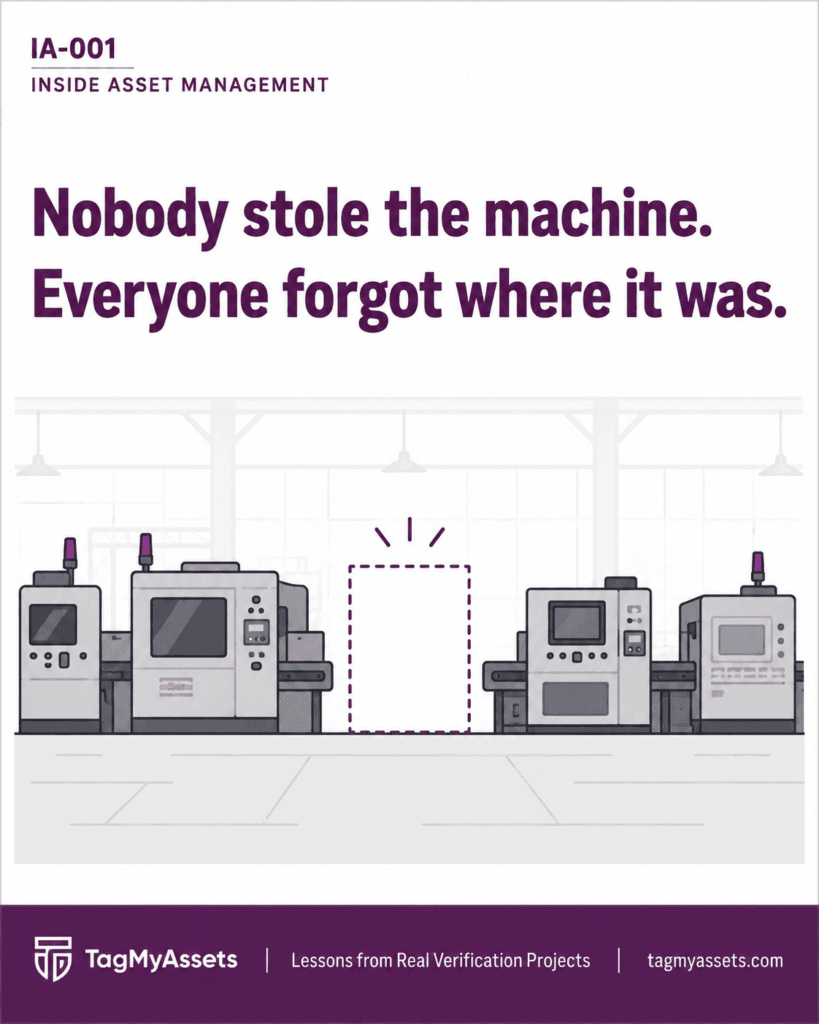
Why assets go missing without leaving the premises
Acquisition is documented carefully. There is a purchase order, an invoice, a goods receipt, a capitalisation entry and an asset code. Disposal is documented too, because it affects the books.
Movement sits between the two, and it is the only event in an asset’s life that repeats. A machine is shifted during a line reconfiguration. A laptop follows an employee to another branch. Furniture is redistributed when a floor is renovated. Each of these changes the physical location of a capitalised asset, and in most organisations none of them generates a record.
The consequence surfaces during verification. The register says the asset sits at one location. The verification team walks that location and finds an empty space. Production has one recollection of what happened. Maintenance has another. The asset is eventually traced, or it is not, and either way the reconciliation absorbs hours that were never budgeted.
In the engagements we have run, undocumented movement is among the most common causes of verification differences. In our experience it arises more often than theft.
What CARO 2020 actually requires
Clause 3(i)(a)(A) of the Companies (Auditor’s Report) Order, 2020 requires the auditor to report whether the company is maintaining proper records showing full particulars, including quantitative details and situation, of property, plant and equipment.
The word that matters is situation. It means where the asset is, and it is written in the present tense. A register that records the location at which an asset was originally installed is a historical record. It is not a record of situation once the asset has moved.
Clause 3(i)(b) then requires the auditor to report whether property, plant and equipment have been physically verified by management at reasonable intervals, whether any material discrepancies were noticed on such verification, and if so, whether they have been properly dealt with in the books of account.
These two clauses work together. Physical verification is the test. The register is what the test is run against. If the register does not track movement, the verification produces discrepancies that are not accounting errors at all — they are location errors, and they still have to be investigated, explained and cleared before the audit can close.
The audit evidence angle
Under SA 500, the auditor is required to obtain sufficient appropriate audit evidence to draw reasonable conclusions. Under SA 330, the auditor designs and performs procedures that respond to the risks assessed at the assertion level.
For property, plant and equipment, the existence assertion is usually tested by physical inspection. A movement register does not replace that inspection. What it does is make the inspection efficient and its results interpretable, because the population being tested reflects current locations rather than historical ones.
No standard and no provision of the Companies Act, 2013 mandates asset tagging by name. Tagging is a method, not a requirement. It earns its place because identifying an asset by a tag is faster and more reliable than identifying it by description, and because a tag gives the movement entry something unambiguous to refer to.
Fields an asset movement register should carry
The register can sit in a spreadsheet, in an ERP module, or in a verification application. The medium matters less than the discipline. These are the fields that make an entry useful during a subsequent verification:
| Field | Why it is needed |
| Asset tag number | The unambiguous identifier. Description alone is not sufficient when several similar assets exist. |
| Asset code in the FAR | Links the movement to the accounting record. |
| Asset description | Human-readable confirmation that the tag was read correctly. |
| From location | Building, floor, department or cost centre — at the same level of detail used in the FAR. |
| To location | Recorded at the same level as the from location. |
| Date of movement | The planned date, recorded before the move. |
| Reason | Reconfiguration, employee transfer, repair, renovation, inter-unit transfer. |
| Released by | The custodian at the origin location. |
| Received by | The custodian at the destination. This is the field most often left blank, and the one that matters most. |
| Approved by | Department head or admin authority, depending on value threshold. |
| Expected return date | Applies where the movement is temporary, such as equipment sent for repair. |
| FAR updated on | Date the fixed asset register was amended. Closes the loop. |
Running the process so it survives contact with operations
A movement register fails for predictable reasons. The form is too long. It is filed after the move rather than before. It has no approver, so it is skipped. Or it exists in a folder that operations staff never open.
A few design choices reduce that risk:
- Record before, not after. An entry raised after the asset has moved is a reconstruction, and reconstructions are unreliable.
- Make the destination custodian sign. Accountability transfers with the asset or it does not transfer at all.
- Set a value threshold for approval so routine low-value movements do not require a department head, and high-value movements always do.
- Use the same location taxonomy as the fixed asset register. If the FAR says Unit II – Assembly, the movement form should not say shop floor.
- Reconcile monthly. Movement entries raised in the month should reconcile to FAR location updates made in the month, with no unexplained gap.
- Review temporary movements quarterly. Assets sent out for repair are a frequent source of items that are physically absent but still capitalised.
What this changes at verification
When movement is recorded as it happens, physical verification becomes a confirmation exercise rather than an investigation. The team walks a location list that reflects reality. Differences that do arise are genuine differences, and they can be classified quickly — asset not found, asset found without a tag, asset present but recorded elsewhere, asset scrapped but still in the books.
When movement is not recorded, the same verification produces a long list of items that require tracing before anyone can say whether an accounting adjustment is needed at all. The cost is not the tagging. The cost is the reconstruction.
Frequently asked questions
Does the Companies Act require asset movements to be recorded?
Not in those words. The requirement is indirect. CARO 2020 clause 3(i)(a)(A) requires proper records showing the situation of property, plant and equipment, and a register that is not updated when assets move stops reflecting that situation.
How often should physical verification be carried out?
The Act does not prescribe a fixed frequency for all companies. Management determines a reasonable interval based on the nature, value and location spread of its assets, and the auditor reports under clause 3(i)(b) on whether the interval adopted is reasonable and whether material discrepancies were properly dealt with.
Is a spreadsheet sufficient for a movement register?
It can be, for a single location with a small asset base. It becomes difficult when assets are spread across sites, because version control and custodian sign-off are hard to enforce in a shared file.
Should movement be tracked for low-value assets as well?
Track what is capitalised. Where a company applies a capitalisation threshold, assets below it are expensed and do not sit in the fixed asset register, so movement tracking for those items is an operational choice rather than a reporting one.
Conclusion
An asset movement register is a small control. It costs one form and one signature per relocation. What it prevents is the situation where an asset exists, is depreciating on schedule, and cannot be found by anyone — not because it was taken, but because its record stopped following it.
TagMyAssets carries out fixed asset tagging, physical verification and fixed asset register reconciliation across India. If your last verification produced more location differences than accounting differences, the movement process is usually where to look first.