
A fixed asset disposal review examines assets that have been scrapped, sold, written off, or retired to verify whether each disposal is properly recorded in the books, the proceeds (if any) are accounted for, and no assets remain on the Fixed Asset Register after physical removal.
Many organisations focus heavily on acquiring and capitalising fixed assets but pay far less attention to what happens when those assets reach the end of their useful lives.
Assets are scrapped, sold, replaced, transferred, or abandoned during the normal course of business. However, disposal entries are often delayed or overlooked entirely. As a result, assets that no longer exist continue to remain in the Fixed Asset Register (FAR), depreciation schedules, and financial statements.
Over time, these inaccuracies accumulate and create significant challenges during statutory audits, internal audits, physical verification exercises, and management reviews.
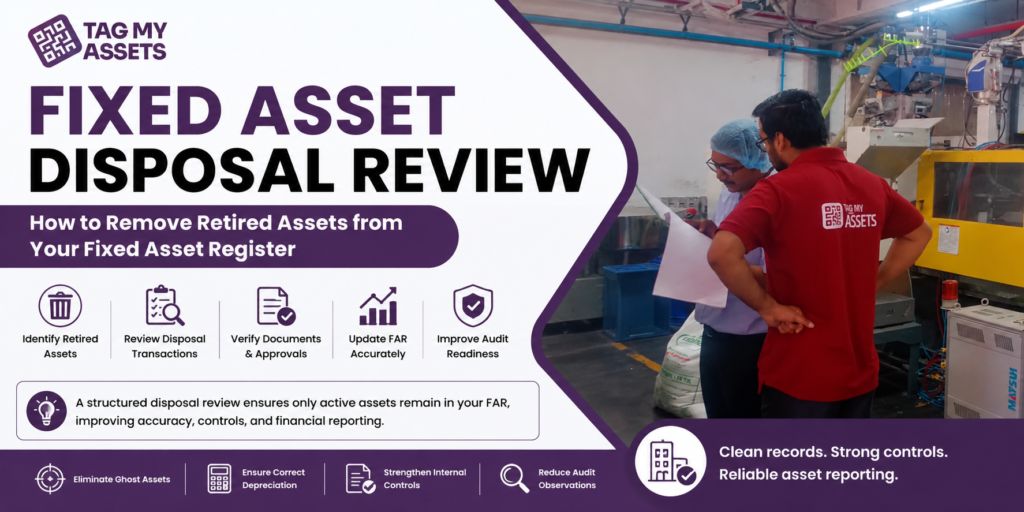
A structured Fixed Asset Disposal Review helps organisations identify retired assets, validate disposal transactions, update the Fixed Asset Register, and strengthen control over the complete lifecycle of fixed assets.
What Is a Fixed Asset Disposal Review?
A Fixed Asset Disposal Review is the process of examining whether assets that have been sold, scrapped, transferred, replaced, or retired have been appropriately removed from accounting records and supporting registers.
The objective is to ensure that:
- Assets no longer in use are removed from the FAR.
- Disposal transactions are supported by appropriate approvals.
- Accounting entries have been passed correctly.
- Gains or losses on disposal have been recognised appropriately.
- Supporting documentation is maintained.
- The Fixed Asset Register accurately reflects assets currently owned by the organisation.
In simple terms:
A disposal review ensures that assets leaving the organisation are removed from the books accurately and on time.
Why Fixed Asset Disposal Reviews Matter
Disposal reviews are often neglected because organisations assume that disposal transactions occur infrequently. In reality, even routine replacements and retirements can create significant discrepancies if not monitored properly.
Improve FAR Accuracy
Retired assets should not continue appearing in the Fixed Asset Register.
Prevent Ghost Assets
Many ghost assets arise because disposal entries were never recorded.
Ensure Correct Depreciation
Depreciation should cease once an asset has been derecognised.
Reduce Audit Observations
Auditors frequently question assets that appear in FAR but cannot be physically verified.
Strengthen Internal Controls
Formal disposal procedures improve governance and accountability.
Improve Management Reporting
Management decisions become more reliable when fixed asset records reflect operational realities.
Common Disposal Issues Identified During Reviews
Fixed asset disposal reviews often reveal issues that have accumulated over several years.
Assets Scrapped but Still Appearing in FAR
Organisations may physically dispose of assets without updating accounting records.
For example, old computers, office furniture, or machinery may have been discarded years ago but continue to appear in the FAR.
Sale Transactions Without Disposal Entries
Assets sold to third parties may not be removed from fixed asset schedules.
Missing Approvals
Disposal decisions may not be supported by documented management approvals.
Missing Supporting Documents
Sale invoices, scrap receipts, auction records, or destruction certificates may be unavailable.
Incorrect Classification
Assets transferred between locations may mistakenly be treated as disposals.
Duplicate Records
The same asset may continue under multiple asset codes despite retirement.
Fully Depreciated Assets Remaining in Use
Although not necessarily an error, organisations often fail to periodically reassess such assets.
Red Flags That Indicate Disposal Problems
The following warning signs may indicate weaknesses in disposal controls.
- Disposal registers are not maintained.
- Assets missing during physical verification remain active in FAR.
- Fully depreciated assets continue appearing without periodic review.
- Significant gains or losses on disposal lack supporting documentation.
- Multiple old assets remain recorded despite operational replacement.
- Disposal approvals cannot be located.
- Audit reports repeatedly highlight fixed asset observations.
- Scrap sale proceeds cannot be reconciled.
- Different departments maintain inconsistent disposal records.
- Management cannot readily explain major reductions in asset counts.
If one or more of these situations exists, a disposal review should be considered.
How to Conduct a Fixed Asset Disposal Review
A structured methodology ensures that disposal transactions are reviewed consistently and accurately.
Step 1: Obtain the Fixed Asset Register
Review the complete FAR, including:
- Asset descriptions.
- Asset codes.
- Asset locations.
- Original costs.
- Accumulated depreciation.
- Net book values.
- Disposal indicators.
- Responsible departments.
Understanding the composition of the FAR is the starting point of the review.
Step 2: Obtain the Disposal Register
Review records maintained for assets disposed of during the period.
Typical records include:
- Disposal registers.
- Scrap sale registers.
- Auction records.
- Management approvals.
- Insurance claim records.
- Write-off approvals.
Where no disposal register exists, organisations should reconstruct disposal transactions from available records.
Step 3: Identify Disposal Transactions During the Period
Prepare a list of assets that have been:
- Sold.
- Scrapped.
- Destroyed.
- Donated.
- Written off.
- Replaced.
- Retired from service.
Compare these transactions against the FAR.
Step 4: Review Supporting Documentation
Examine documentation supporting each disposal event.
This may include:
- Board or management approvals.
- Disposal authorisation forms.
- Sale invoices.
- Scrap receipts.
- Auction documentation.
- Insurance settlement records.
- Vendor acknowledgements.
- Asset transfer notes.
Incomplete documentation often highlights control deficiencies.
Step 5: Perform Physical Validation
Where practical, validate whether assets identified as disposed of have actually left the organisation.
Similarly, investigate assets missing during physical verification exercises to determine whether disposal entries should have been passed.
Physical verification frequently uncovers disposal transactions that were never formally recorded.
Step 6: Review Accounting Entries
Confirm that accounting entries relating to disposals have been passed correctly.
Review whether:
- Asset costs have been removed.
- Accumulated depreciation has been reversed appropriately.
- Gains or losses have been recognised.
- Disposal dates align with supporting evidence.
Errors at this stage can materially impact financial reporting.
Step 7: Update the Fixed Asset Register
Based on review findings, update the FAR to reflect current realities.
This may involve:
- Removing retired assets.
- Correcting disposal dates.
- Updating supporting references.
- Eliminating duplicate records.
- Strengthening disposal controls going forward.
An updated FAR forms the foundation for accurate financial reporting and future physical verification exercises.
Accounting and Audit Considerations
Disposal of fixed assets is not merely an operational activity. It has important accounting, taxation, and audit implications that organisations should address carefully.
Derecognition of Assets
Once an asset has been sold, scrapped, destroyed, or retired from use, it should generally be removed from the Fixed Asset Register and accounting records.
Failure to derecognise retired assets may overstate the carrying value of Property, Plant and Equipment (PPE).
Recognition of Gain or Loss
The difference between the asset’s carrying amount and the disposal proceeds may result in either:
- A gain on disposal, or
- A loss on disposal.
These amounts should be recognised appropriately in the financial statements.
Supporting Documentation
Auditors often seek evidence supporting disposal transactions. Organisations should maintain:
- Disposal approvals.
- Sale invoices.
- Auction records.
- Scrap receipts.
- Destruction certificates.
- Insurance claim settlements.
Timing of Accounting Entries
Disposal entries should be passed promptly rather than being deferred until year-end.
Delayed accounting treatment frequently results in audit observations.
Internal Financial Controls
Disposal activities should be incorporated into the organisation’s internal control framework through clearly defined responsibilities and approval mechanisms.
Best Practices for Managing Fixed Asset Disposals
Organisations can strengthen disposal controls by adopting the following practices.
Maintain a Disposal Register
Track all retired assets through a dedicated disposal register containing:
- Asset details.
- Disposal dates.
- Disposal methods.
- Approval references.
- Sale proceeds.
- Supporting documentation references.
Conduct Periodic Physical Verification
Regular verification exercises help identify assets that may have been retired without formal documentation.
Define an Approval Matrix
Clearly specify who can approve various categories of disposals.
For example:
- Department Head.
- Plant Head.
- Finance Controller.
- Chief Financial Officer.
- Board of Directors.
Depending on value thresholds.
Pass Timely Accounting Entries
Ensure disposal transactions are reflected in accounting records immediately after completion.
Review Fully Depreciated Assets
Fully depreciated assets should be reviewed periodically to determine whether they:
- Continue to be used,
- Require replacement, or
- Should be retired.
Reconcile Disposal Registers with FAR
Periodic reconciliation helps ensure that all retired assets have been appropriately removed from the books.
Document the Disposal Process
Establish written procedures covering:
- Identification.
- Approval.
- Documentation.
- Accounting treatment.
- FAR updates.
How Fixed Asset Consultants Help
Disposal reviews often involve coordination across multiple departments, locations, and record systems.
Many organisations struggle because information relating to disposals is scattered among operations teams, finance departments, stores personnel, and administrative functions.
Fixed asset consultants can assist organisations by:
- Reviewing the Fixed Asset Register.
- Evaluating disposal controls and processes.
- Identifying assets retired but still appearing in FAR.
- Reviewing disposal registers and supporting documentation.
- Performing physical verification exercises.
- Investigating discrepancies.
- Recommending corrective actions.
- Supporting management during statutory and internal audits.
- Assisting with FAR clean-up initiatives.
- Strengthening governance over the complete asset lifecycle.
Independent reviews often uncover disposal gaps that remain unnoticed during routine operations.
Conclusion
Fixed asset management does not end when an asset is acquired or capitalised.
Equally important is ensuring that assets leaving the organisation are removed from accounting records accurately and promptly.
A structured fixed asset disposal review helps organisations improve FAR accuracy, eliminate ghost assets, reduce audit observations, strengthen internal controls, and enhance confidence in financial reporting.
Rather than waiting for year-end audits to identify discrepancies, periodic disposal reviews enable organisations to maintain an accurate and reliable Fixed Asset Register throughout the asset lifecycle.
If your organisation has not reviewed its disposal processes in recent years, now may be the right time to determine whether retired assets continue to remain hidden within your FAR.
Frequently Asked Questions
What is a fixed asset disposal review?
A fixed asset disposal review is the process of examining whether retired assets have been appropriately removed from accounting records and the Fixed Asset Register.
Why are disposal reviews important?
They improve FAR accuracy, prevent ghost assets, ensure correct depreciation, and reduce audit observations.
How often should disposal reviews be conducted?
Organisations should review disposal transactions periodically, ideally alongside annual physical verification exercises and FAR reconciliations.
What documents support asset disposals?
Supporting documents may include disposal approvals, sale invoices, scrap receipts, auction records, insurance settlements, and destruction certificates.
Can disposal reviews help reduce audit observations?
Yes. Proper disposal reviews improve documentation, strengthen controls, and reduce discrepancies identified during audits.
Good Reads
- Asset Verification Services
- Ghost Assets: How to Detect and Remove Them from FAR
- CWIP Verification Explained: How to Identify Capital Work-in-Progress Ready for Capitalisation
- 7 Powerful Reasons Companies Need Fixed Asset Consulting Before a Statutory Audit
- Why Asset Management Software Fails Without Physical Verification and FAR Reconciliation
Recommended Reads
Ind AS 16 – Property, Plant and Equipment
Use while discussing derecognition and gain/loss recognition.
https://www.mca.gov.in/Ministry/pdf/INDAS16.pdf
ICAI Guidance on Audit Procedures Relating to Fixed Assets
Use while discussing audit evidence and disposal procedures.
https://www.icai.org/post/guidance-note-on-audit-of-property-plant-and-equipment
ICAI Guidance on Internal Financial Controls
Use under best practices and governance.
https://www.icai.org/post.html?post_id=11469
Call to Action
At TagMyAssets, we help organisations improve the accuracy of their Fixed Asset Registers through physical verification, FAR reconciliation, fixed asset disposal reviews, and consulting services. Our structured approach enables organisations to identify retired assets, strengthen disposal controls, improve audit readiness, and maintain confidence in fixed asset reporting across multiple locations.