
Most fixed asset records look accurate.
Until someone asks a simple question:
“Can you show me this asset?”
That is usually when the records and reality begin to part ways.
Some assets have moved to another floor, another plant, another city. Some were scrapped years ago but still sit in the register, quietly accumulating depreciation. Some exist in the register but cannot be found anywhere. Others sit in plain sight on the shop floor — and were somehow left out of the books entirely.
The real challenge is not maintaining a fixed asset register. Most organisations have one. Some have several.
The challenge is knowing whether you can trust it.
That trust — or the absence of it — shows up in audit observations, in CARO reporting, in insurance claims that get disputed, in capex decisions made on stale data, and in that uncomfortable moment during a statutory audit when the auditor picks ten assets at random and asks to see them.
So before the next audit season, here are four questions worth asking. Not to your ERP. To yourself.
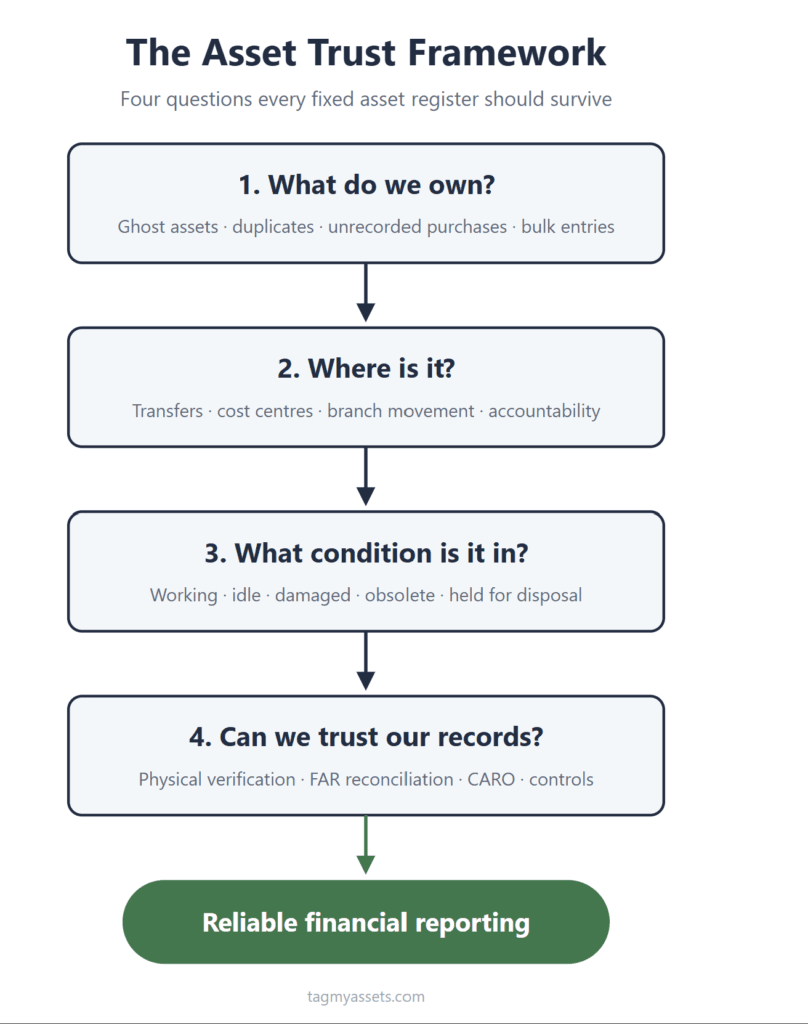
The Asset Trust Framework
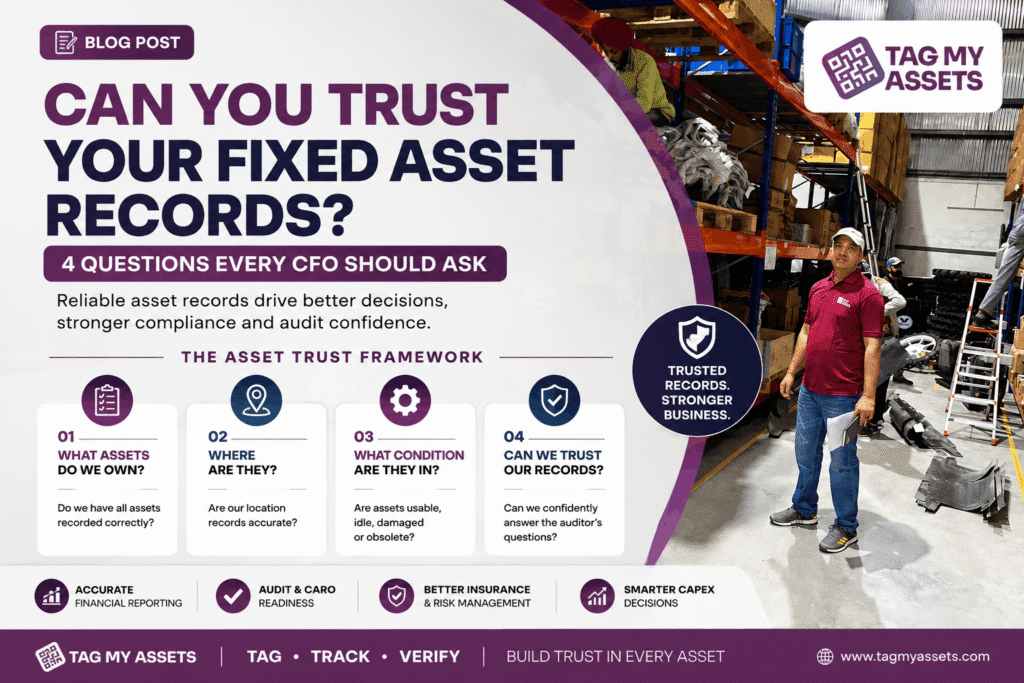
Every fixed asset register should be able to survive four questions:
1. What do we own?
2. Where is it?
3. What condition is it in?
4. Can we trust our records?
If any one of these draws a hesitant answer, the register is an assertion — not a record.
Question 1: What assets do we own?
This sounds like the easiest question of the four. It is often the hardest.
A fixed asset register is a historical document. It records what was purchased and capitalised, at what value, on what date. What it does not automatically record is what happened afterwards.
Over a few years, gaps accumulate in predictable ways:
Ghost assets. Assets that exist in the register but not in reality — scrapped, stolen, lost in a shift or a renovation, or written off physically but never removed from the books. They inflate the gross block, distort depreciation, and increase insurance premiums for assets that no longer exist. (We’ve written about ghost assets in detail — they are more common than most finance teams expect.)
Duplicate entries. The same machine capitalised twice — once from the vendor invoice, once from the installation bill. Or one asset split across multiple line items with no way to connect them.
Zombie assets. The reverse of ghosts: assets physically present and in use, but missing from the register. Often the result of assets received at site before the invoice reached accounts, or items purchased through a project budget and never capitalised individually.
Bulk entries. “Furniture & Fixtures — 1 Lot — ₹48,00,000.” One line, hundreds of physical items, and no way to verify any of them individually.
If your register contains line items nobody can physically point to, the answer to “what do we own?” is: not entirely sure.
Question 2: Where are they?
Assets move. Registers usually don’t.
An asset purchased for the Gurugram head office gets transferred to the Pune plant. A laptop assigned to an employee travels with them through two internal transfers and one resignation. A generator moves between project sites for years. In the register, each of these assets is still sitting exactly where it was capitalised.
Location errors feel harmless until they aren’t:
- Cost centre allocation goes wrong. Depreciation is charged to a department that no longer uses the asset, distorting product costing and profitability analysis.
- Physical verification becomes impossible to plan. If the register says an asset is in Location A and it is actually in Location C, the verification team marks it “not found” — creating a discrepancy that never needed to exist.
- Statutory and tax positions get complicated. Inter-state transfers, branch accounting, and asset-wise records for tax purposes all depend on knowing where an asset actually is.
- Accountability disappears. When no one knows which department holds an asset, no one is responsible for it. Unowned assets are the ones that go missing.
The question is not whether your assets have moved. Across any multi-location organisation, they have. The question is whether fixed asset records moved with them.
Question 3: What condition are they in?
Presence is not the same as usability.
A physical verification exercise that only asks “is the asset there?” answers half the question. An asset can be present and still be:
- Idle — installed, functional, but unused for months because the production line changed
- Damaged — physically present but not in working condition, awaiting a repair that may never be sanctioned
- Obsolete — working, but superseded by newer equipment; carried at book value with no realistic future use
- Cannibalised — stripped for spare parts to keep other machines running; present as a shell
- Held for disposal — already identified for scrap, but still depreciating in the books
Condition matters because accounting standards care about it. Impairment assessment, useful life review, and residual value estimates all assume someone actually knows the state of the asset — not just its existence. It matters commercially too: idle and obsolete assets tie up capital, occupy space, and hide inside the gross block where no one questions them.
A register that records existence but not condition tells you what you bought. It does not tell you what you have.
Question 4: Can we trust our fixed asset records?
This is where the first three questions converge.
A brief example from the field. In one reconciliation engagement, the client’s system listed 19,134 assets. First-pass physical verification could positively match 10,112 of them. Nothing dramatic had happened at this company — no theft, no negligence. The register had simply drifted from reality, a little every year, through unrecorded transfers, bulk entries that could not be matched one-to-one, and disposals that never left the books. The exercise also surfaced a value variance of over ₹10.5 lakh. Until someone physically checked, every one of those 19,134 line items looked equally reliable.
Ownership, location, and condition are facts on the ground. Your fixed asset records are the version of those facts that your financial statements, your auditors, and your regulators rely on. The distance between the two is the trust gap.
Closing it is not a one-time cleanup. It is a discipline, and it has a few well-established components:
Physical verification at reasonable intervals. Not because CARO 2020 asks whether it was done — though it does, and the auditor reports on it — but because physical verification is the only mechanism that tests the register against reality. A register that is never verified is an assertion, not a record.
Reconciliation, not just verification. Finding the assets is step one. FAR reconciliation — matching physical findings back to the register, investigating differences, and adjusting the books with proper approvals — is where the trust actually gets rebuilt. Verification without reconciliation produces a report. Reconciliation produces a reliable register.
Unique identification. Verification and reconciliation both depend on being able to say, with confidence, that this physical asset is that register line item. This is where asset tagging earns its place — not as an end in itself, but as the link between the floor and the books. Without unique identification, every verification cycle starts from zero.
Ongoing controls. Capitalisation discipline, transfer documentation, disposal approvals, and periodic internal audit coverage — so that the gap, once closed, does not quietly reopen.
None of this is exotic. CARO 2020’s fixed asset clauses essentially ask the auditor to report on whether these disciplines exist. Companies that can answer the four questions confidently tend to sail through those clauses. Companies that cannot tend to discover it in the audit report.
The real measure of asset management
Good fixed asset management is not about knowing how many assets you purchased. Purchase records are easy — every organisation has invoices.
It is about knowing what still exists. Where it is. What condition it is in. And whether your fixed asset records reflect that reality closely enough to be relied upon — by your CFO, your auditors, your insurers, and your board.
Having verified over 10 lakh assets across 1500+ locations in India, our field experience is fairly consistent on one point: the organisations with trustworthy registers are not the ones with the most sophisticated software. They are the ones that periodically ask these four questions — and act on the answers.
Most organisations already have a fixed asset register.
Far fewer have confidence in it.
So the next time an auditor picks a line item at random and asks —
“Can you show me this asset?”
— the quality of your asset management is whatever your answer turns out to be.
Want to test your own Fixed Asset Register?
Start with the four questions. No consultants, no software — just ask them in your next finance or internal audit meeting.
If your team can answer all four with confidence, your register is in better shape than most.
If not, your next physical verification may reveal more than expected.
FAQ
How often should fixed assets be physically verified?
CARO 2020 requires the auditor to report whether physical verification was conducted at reasonable intervals. In practice, many organisations verify high-value assets annually and complete full coverage over a two-to-three-year cycle, depending on asset volume, locations, and materiality.
What is the difference between physical verification and FAR reconciliation?
Physical verification establishes which assets exist, where, and in what condition. FAR reconciliation matches those findings back to the fixed asset register, investigates differences such as ghost or unrecorded assets, and supports the accounting adjustments needed to align the books with reality.
What are ghost assets?
Ghost assets are items that appear in the fixed asset register but no longer physically exist — typically because they were scrapped, lost, stolen, or disposed of without the register being updated. They overstate the asset base, distort depreciation, and can inflate insurance costs.
Why does asset tagging matter for register accuracy?
Tagging gives each asset a unique identity that links the physical item to its register entry. Without it, every verification exercise has to re-identify assets from scratch, and reconciliation between the floor and the books becomes slow and unreliable.