
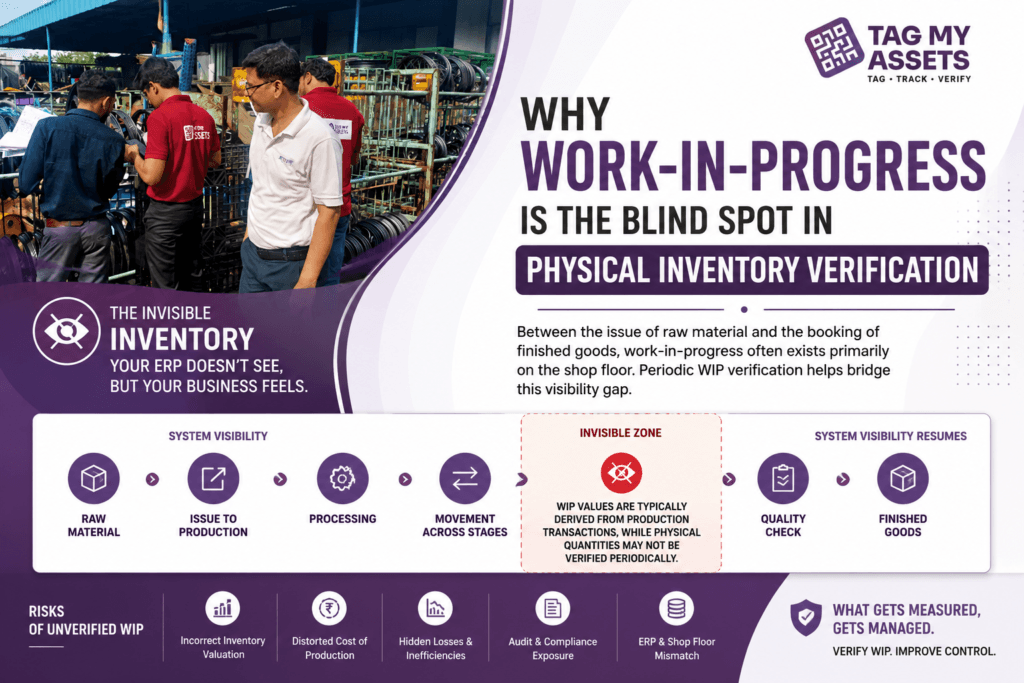
Work in progress verification is the physical counting and reconciliation of semi-finished goods on the shop floor — and in many organisations it is the weakest part of inventory control. Raw materials are counted at stores and finished goods are counted at the warehouse, but between the two, WIP is often represented in the ERP only as a derived value (issues minus finished goods bookings) rather than a physically verified quantity.
Most manufacturing companies know how much raw material they purchased and how much finished goods they dispatched. But ask one simple question: how much work in progress is physically lying on the shop floor today? In many organisations, answering that question with confidence is far more difficult than expected.
This article explains where the visibility gap comes from, what it can do to inventory valuation and production costing, and how periodic work in progress verification closes it.
Where the WIP Visibility Gap Comes From
The gap exists because most systems record material at only two points — the issue to production and the finished goods booking after quality clearance — while everything between those two events happens outside routine physical counting.
The typical flow looks like this: raw material is issued to production against an issue slip, the system reduces stores stock, and the material begins moving through processing stages, inter-department transfers, and quality checks. It is booked back into the system as finished goods only after final QC clearance. Between the issue slip and the FG booking — which can span days or weeks depending on the production cycle — the material exists only physically:
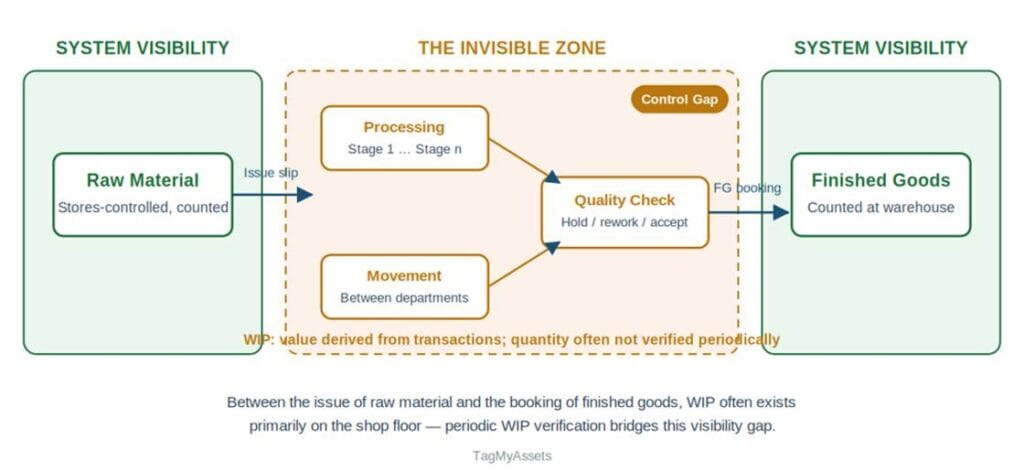
An ERP system records when raw material enters production and when finished goods are received. What happens in between is often the least visible part of the inventory lifecycle. We describe this stretch as the invisible inventory: material that the accounting system values but rarely sees. The WIP figure in the system is real as an accounting entry, but it is typically derived — what went in, minus what came out — rather than the result of a periodic physical count.
Why WIP Goes Uncounted
WIP tends to be excluded from routine physical verification because it is constantly moving, partially processed, spread across departments, and often has no single owner — stores considers it issued, and production considers it consumed.
- It is always moving. Unlike a bin of raw material, WIP changes form and location during the count itself. Counting it requires a cut-off — freezing movement or counting at shift change — which takes planning that routine stock counts rarely include.
- It is hard to measure. A semi-finished item may be countable in pieces at one stage and only estimable by weight, length, or batch at another. Without stage-wise units of measure, teams skip it.
- Ownership is unclear. Stores’ responsibility often ends at the issue slip. The warehouse’s responsibility begins at FG receipt. On many shop floors, no function is formally accountable for physically confirming what sits in between.
- The system provides a number anyway. Because the ERP always shows a WIP value, there is little visible pressure to verify it — the figure looks precise even when no one has confirmed it physically.
What the Gap Can Cause
Where work in progress verification is not performed periodically, material losses, production variances, and inventory discrepancies may remain undetected for longer than expected — and the effects flow directly into the financial statements.
- Inventory valuation distortion. WIP forms part of inventory under Ind AS 2 / AS 2. If the physical quantity differs from the derived book quantity, closing inventory — and therefore reported profit — carries the difference.
- Cost of production errors. Yield, scrap, and consumption variances hide inside an unverified WIP balance, which weakens product costing and pricing decisions built on it.
- ERP-versus-floor divergence. Finance relies on the system figure; production relies on what it sees on the floor. Without periodic reconciliation, the two can drift apart for entire reporting periods.
- Ageing WIP. Rejected, on-hold, and rework material can sit in the invisible zone indefinitely — still valued as good inventory in the books while it deteriorates physically.
- Audit questions. Auditors reviewing inventory verification coverage increasingly ask how WIP was addressed, not just RM and FG.
The Compliance Angle: CARO 2020 and Ind AS 2
CARO 2020 requires auditors to report whether physical verification of inventory has been conducted at reasonable intervals by management. Since work in progress forms part of inventory under applicable accounting standards, organisations should consider how WIP is addressed within their inventory verification process.
In practice, many inventory verification programmes cover raw materials, stores and spares, and finished goods thoroughly, while WIP is carried at book value without physical confirmation. Whether that coverage is adequate is a judgement for management and auditors in each company’s circumstances — but it is a question worth answering deliberately rather than by default.
How Periodic Work in Progress Verification Works in Practice
WIP verification is a planned exercise built on four elements: production stage mapping, a disciplined cut-off, stage-appropriate counting methods, and reconciliation of the physical result against the book WIP through the bill of materials.
1. Production stage mapping
Before anything is counted, the shop floor is mapped: where material can physically sit between issue and FG booking — machines, staging areas, QC hold zones, rework bays, inter-department transit. Each location becomes a count point. Unmapped locations are where discrepancies hide.
2. Cut-off discipline
WIP is counted against a freeze: movement is halted for the count window, or counting is timed at shift change when material is stationary. Issue slips and FG bookings around the cut-off time are listed so the count and the books refer to the same moment.
3. Stage-appropriate counting
Each stage gets a workable unit of measure — pieces, weight, length, or batch — agreed with production in advance. Where exact counts are impractical, structured estimation with documented methods is used, which is still far stronger than no verification at all. Barcode or RFID identification of batches and containers makes repeat cycles significantly faster.
4. Reconciliation through the BOM
The physical result is converted to input-material terms using the bill of materials and compared with the book WIP. Differences are classified — normal process loss, scrap not yet recorded, rework, or unexplained variance — and unexplained items are investigated. An ageing analysis flags WIP that has been sitting beyond the normal production cycle.
Frequency depends on the production cycle and materiality: quarterly or half-yearly full WIP counts with monthly reviews of ageing items is a common pattern; continuous-process industries need approaches designed around their specific flow.
How TagMyAssets Approaches WIP in Inventory Verification
Across 395+ projects and 1500+ locations, our inventory verification engagements are scoped to cover the full flow — raw material, stores and spares, work in progress, and finished goods — with WIP count points mapped jointly with production teams before the exercise begins. Where clients use barcode or RFID identification, WIP batches are tagged so subsequent cycles can be completed faster and compared over time.
If your inventory verification currently covers RM and FG but leaves WIP at book value, contact us to discuss how a WIP verification cycle can be added to your existing programme.
Frequently Asked Questions
What is work in progress verification?
Work in progress verification is the physical counting and reconciliation of semi-finished goods on the shop floor against the WIP balance in the books. It closes the visibility gap between the raw material issue and the finished goods booking, where the ERP typically carries a derived value rather than a physically confirmed quantity.
Why is WIP usually excluded from physical stock counts?
Because it is constantly moving, partially processed, spread across departments, and often has no single accountable owner. Counting it needs a planned cut-off and stage-appropriate units of measure, which routine stock counts are rarely designed for.
Does CARO 2020 require WIP to be physically verified?
CARO 2020 requires reporting on whether physical verification of inventory has been conducted at reasonable intervals by management. Since WIP forms part of inventory under applicable accounting standards, organisations should consider how WIP is addressed within their verification process; the adequacy of coverage is a judgement for management and auditors in each case.
How often should WIP be verified?
It depends on the production cycle and materiality of the WIP balance. A common pattern is a full WIP count quarterly or half-yearly, with monthly review of ageing and on-hold items. Continuous-process industries need approaches designed around their specific flow.
Can WIP be verified without stopping production?
Often, yes — by timing counts at shift changes when material is stationary, counting section by section with short local freezes, and using batch or container identification (barcode/RFID) so that moving material can be tracked rather than halted. A brief, well-planned cut-off is usually sufficient.