
Introduction: Why Lease Asset Tracking Is a Hidden Risk Area
Asset tagging for lease assets has become critical under Ind AS 116, as companies struggle to track Right-of-Use assets physically. Under Ind AS 116, companies must recognise ROU assets for leased items such as:
IT equipment
Machinery
Vehicles
Office infrastructure
A practical problem arises on the ground: ROU assets are recorded in the books but are often not physically traceable.
This leads to audit qualifications, FAR mismatches, difficulties with insurance claims, and inaccurate financial reporting.
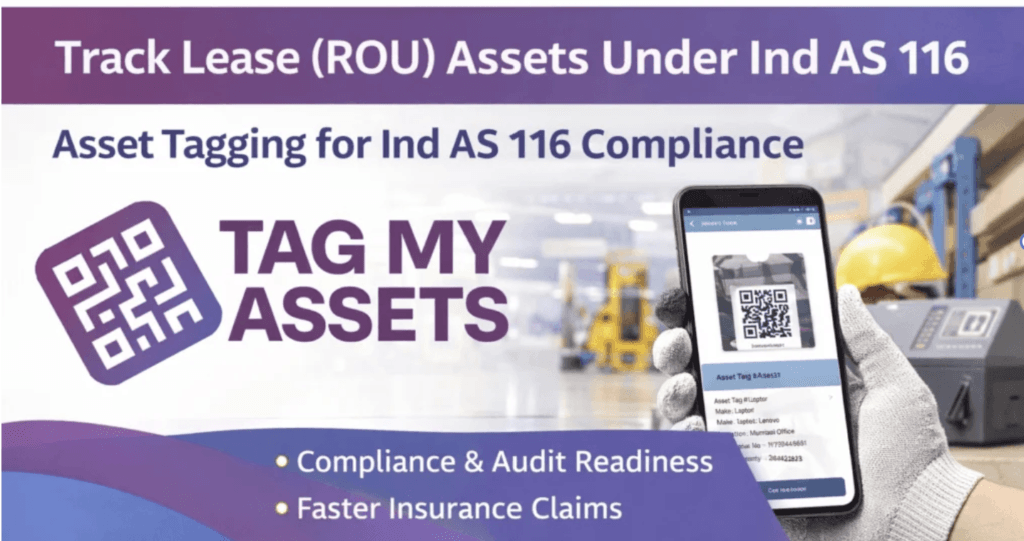
Asset tagging and structured digital capture are what close that gap.
What Are ROU Assets Under Ind AS 116?
An ROU asset represents the right to use a leased asset over a specific period. Common examples include leased laptops issued to employees, rented production machinery, and warehouse equipment held on lease.
Even though these assets are not owned, they must still be recorded, tracked and verified.
The Real Problem Companies Face
No physical identification. Lease assets are not tagged, so there is no traceability.
FAR versus physical mismatch. Assets exist in the books but cannot be located on the ground.
Multi-location movement. Assets shift between branches without any record of the transfer.
Ownership confusion. Owned and leased assets sit together with nothing to distinguish them.
Audit and compliance risk. ROU assets become difficult to verify during audit.
How Asset Tagging Solves ROU Asset Tracking
Unique identification. Each leased asset receives a QR or barcode tag linked to its record.
Separate classification. Owned and leased assets are clearly distinguished in the register.
Structured capture. Assets are scanned through a mobile application, recording location, department and photographs.
Accurate FAR reconciliation. Physical findings are matched against the records.
Audit-ready documentation. Verification under Ind AS 116 becomes straightforward to evidence.
How Asset Tagging Improves Ind AS 116 Compliance
Asset tagging helps companies track ROU assets accurately by assigning unique QR or barcode identifiers, which supports proper identification, location tracking and audit-ready documentation.
Why Companies Need Asset Tagging for Lease Assets
Companies need asset tagging for lease assets to improve visibility of ROU assets, reduce losses, maintain FAR accuracy, and support compliance with Ind AS 116 through structured tracking and verification.
Benefits for Large Companies
Asset tagging helps large organisations maintain control over ROU assets across multiple locations, supporting compliance, visibility and operational efficiency.
How Asset Tagging Supports Insurance Claims
Where an asset is damaged, lost or stolen, companies often struggle to substantiate an insurance claim.
Without tagging, there is no proof the asset existed, identification details are missing, ownership and lease status are unclear, and claims are delayed or rejected.
With tagging in place:
Proof of existence. The QR or barcode is linked to a database record.
Photographic and condition records. Images are captured at the time of verification.
Complete asset details. Serial number, model and location are recorded.
Faster claim processing. Surveyors receive structured data rather than a description.
Clear lease classification. Owned and leased assets are separately identified.
Companies with structured asset documentation generally find claim settlement smoother, because the supporting evidence already exists.
Real Business Benefits
Asset loss prevention. Reduces theft and misplacement, which matters most for movable leased assets.
Better lease management. Lease tenure can be tracked, helping avoid penalties and overpayments.
Financial accuracy. A clean FAR supports better audit outcomes.
Operational control. Location visibility improves utilisation decisions.
Faster audits. Verification takes less effort when every asset carries an identity.
Insurance readiness. Claim documentation is prepared in advance rather than assembled afterwards.
Practical Implementation Approach
Step 1: Asset identification (floor to sheet). Physically identify all lease assets on site.
Step 2: FAR mapping (sheet to floor). Work from the register and locate each recorded asset.
Step 3: Asset tagging. Apply QR or barcode tags, marking leased assets separately.
Step 4: Digital capture. Scan, photograph and record location through the mobile application.
Step 5: Reconciliation and reporting. Prepare audit-ready reports from the captured data.
Field Example
A company operating across four locations engaged us to tag and verify approximately 1,600 IT assets. The assets were untracked, losses were recurring, and the position was difficult to evidence at audit.
After tagging, the assets were identifiable and mapped location-wise, which made subsequent verification and claim documentation considerably simpler.
Common Mistakes to Avoid
Mixing owned and leased assets in the same records
Leaving low-value leased assets untagged
Failing to record asset transfers between locations
Relying on spreadsheets rather than structured capture
Not updating the FAR after verification
Why Asset Tagging Matters for Ind AS 116
It supports accurate reporting, physical verification, audit readiness and insurance documentation — closing the gap between what the books say and what exists on the ground.
Frequently Asked Questions
How do you track ROU assets under Ind AS 116?
Through asset tagging, with QR or barcode identifiers linked to a structured digital record.
Is asset tagging mandatory for leased assets?
It is not mandatory. It is, however, the practical means by which most companies evidence the existence and location of ROU assets at audit.
Can leased assets be included in the FAR?
ROU assets recognised under Ind AS 116 must be recorded and tracked. Many companies maintain them within the asset register but flagged separately from owned assets.
How does asset tagging help with insurance claims?
It provides proof of existence, photographic records and structured asset data, which shortens the documentation stage of a claim.
Conclusion
Tracking lease assets under Ind AS 116 is not only a compliance exercise. It is about control, visibility, risk management and financial accuracy.
With asset tagging and structured digital capture, companies can evidence their ROU assets, reduce confusion between owned and leased items, and make audits considerably less demanding.