
Introduction: The Hidden Risk in Portable Assets
In today’s fast-moving business environment, companies are investing heavily in high-value portable assets such as laptops, tools, handheld devices, and specialized equipment. Unlike fixed assets, these items are constantly on the move—assigned to employees, shifted across locations, or used in the field.
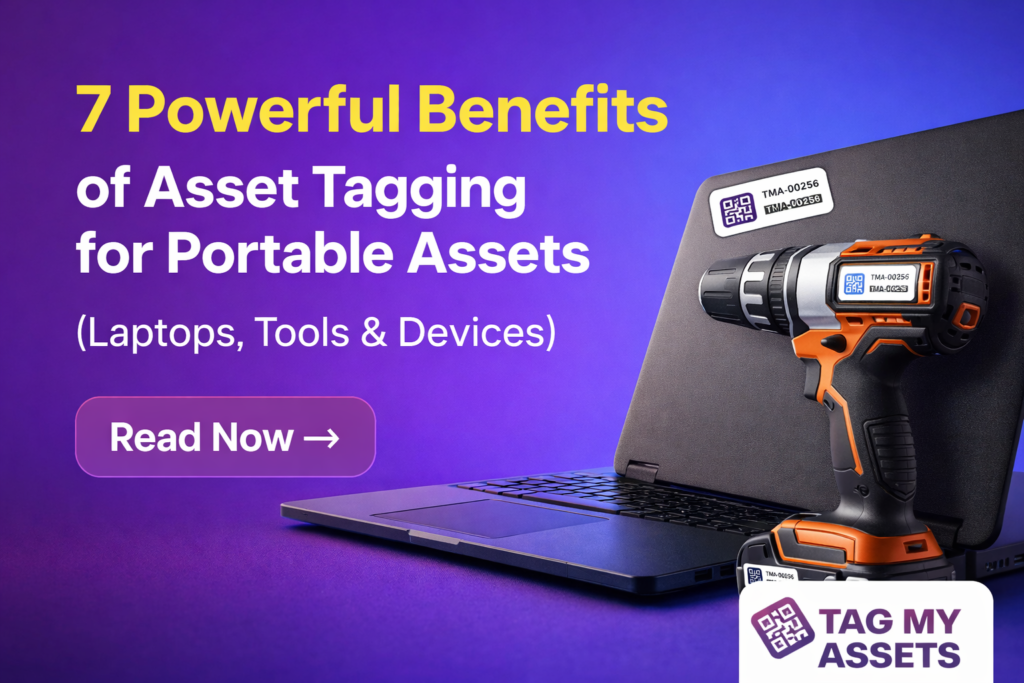
Asset tagging for portable assets is becoming essential for businesses managing laptops, tools, and devices across multiple locations.
And that’s exactly where the problem begins.
- Laptops issued to employees are not returned
- Tools move between departments without tracking
- Devices go missing during audits
- No clarity on “who has what”
This leads to financial loss, audit complications, and weak internal controls.
The solution?
👉 Asset tagging for portable assets
When implemented correctly, asset tagging transforms chaos into control—bringing visibility, accountability, and accuracy into your asset management system.
What Are High-Value Portable Assets?
Portable assets are assets that are not fixed to a location and can easily be moved or assigned.
Common Examples:
- Laptops and desktops
- Tablets and mobile devices
- POS machines and scanners
- Medical equipment
- Cameras and AV devices
- Tools and maintenance equipment
- IT peripherals (routers, printers, etc.)
These assets typically have:
- High monetary value
- Frequent movement
- Employee-level ownership
- Higher risk of loss or theft
👉 This makes them critical from both financial and audit perspectives
Why Portable Assets Are Difficult to Manage
Managing portable assets is significantly more complex than managing fixed assets.
🔴 Key Challenges:
1. No Fixed Location
Unlike machinery or furniture, portable assets don’t stay in one place.
2. Employee Dependency
Assets are assigned to individuals, increasing risk of:
- Misplacement
- Unauthorized transfer
- Non-return after exit
3. High Movement Frequency
Assets move across:
- Departments
- Branches
- Project sites
4. Audit Challenges
During audits:
- Assets are “not found”
- Physical verification becomes difficult
- Reliance on email confirmations increases
5. Theft & Misuse Risk
Small size + high value = high vulnerability
What is Asset Tagging for Portable Assets?
Asset tagging is the process of assigning a unique identification tag to each asset, enabling easy tracking, verification, and management.
For portable assets, this becomes even more critical.
How It Works:
- Each asset gets a unique QR or RFID tag
- Tag is linked to:
- Asset details
- Employee
- Location
- Data is captured using a mobile app
- Real-time tracking and audit trails are maintained
7 Powerful Ways Asset Tagging Protects Portable Assets
1. Ensures Complete Asset Visibility
With asset tagging, every asset is uniquely identified.
You can instantly know:
- Where the asset is
- Who is using it
- When it was last verified
👉 No more “missing assets” confusion
2. Builds Employee Accountability
When assets are mapped to employees:
- Responsibility becomes clear
- Unauthorized transfers reduce
- Return tracking becomes easy
This is especially useful for:
- Laptops
- Field devices
- Company-issued tools
3. Simplifies Physical Verification
Traditional audits struggle with portable assets.
With tagging:
- Assets can be scanned using mobile app
- Verification becomes quick and accurate
- Audit time reduces significantly
👉 This is a major advantage during statutory audits and internal audits
4. Reduces Asset Loss & Theft
Tagged assets are:
- Harder to misuse
- Easier to trace
- Discouraging for theft
👉 Even if lost, tagged assets can be tracked and identified
5. Enables Real-Time Tracking (RFID Advantage)
For advanced use cases:
- RFID tags can be used
- Handheld devices can scan multiple assets instantly
👉 This is ideal for:
- Warehouses
- Manufacturing units
- High-security environments
6. Improves FAR Accuracy
Fixed Asset Register (FAR) often has:
- Duplicate entries
- Missing assets
- Incorrect locations
Asset tagging helps:
- Clean and validate FAR
- Map assets correctly
- Identify discrepancies
7. Supports Insurance & Compliance
Tagged assets:
- Help in insurance claims
- Provide proof of existence
- Strengthen compliance under audit frameworks
Best Tagging Methods for Portable Assets
Choosing the right tagging method is crucial.
🔹 QR Code Tags (Most Recommended)
- Cost-effective
- Easy to implement
- Scannable via mobile app
- Ideal for laptops, tools, devices
👉 Commonly used with:
- Polyester labels
- PVC overlay for durability
🔹 RFID Tags (Advanced Use)
- Contactless scanning
- Bulk scanning capability
- Higher cost
👉 Suitable for:
- Large-scale operations
- High-value environments
🔹 Tamper-Proof Tags
- Designed to break on removal
- Prevents asset swapping
👉 Ideal for:
- Sensitive equipment
- IT assets
Real Audit Scenario: Portable Assets with Employees
In many real-world cases, companies face this issue:
👉 Assets are with employees working remotely or in different locations.
Typical Challenges:
- Physical verification not possible
- No clarity on asset existence
- Audit delays
Practical Solution:
- Tag assets wherever possible
- Use mobile app for verification
- Take email confirmation from employees
- Maintain audit trail
👉 This approach ensures:
- Audit compliance
- Reduced “Not Found” cases
- Better reporting accuracy
Floor to Sheet vs Sheet to Floor (Critical Strategy)
This is where most companies go wrong.
🔹 Floor to Sheet Method
Used when:
- FAR is unreliable
- No proper asset records exist
Process:
- Identify assets physically
- Tag them
- Create FAR from scratch
🔹 Sheet to Floor Method
Used when:
- FAR is available and reliable
Process:
- Take FAR list
- Verify assets physically
- Tag and reconcile
👉 Choosing the right method is critical for success
Why Companies Need Portable Asset Tagging Today
Modern businesses are evolving rapidly.
Key Reasons:
- Remote workforce is increasing
- Multi-location operations are common
- Asset mobility is higher than ever
- Compliance requirements are stricter
Without asset tagging:
- Control is lost
- Audits become painful
- Financial leakage increases
How TagMyAssets Solves This Problem
At TagMyAssets, we specialize in:
- End-to-end asset tagging solutions
- Mobile app-based verification
- FAR reconciliation
- Customized tagging strategies
Our Approach:
- Understand asset category
- Choose correct tag type
- Implement tagging + verification
- Provide detailed reports
Conclusion: From Chaos to Control
High-value portable assets are among the most vulnerable assets in any organization.
Without proper tracking:
- They get lost
- Misused
- Or simply disappear from records
👉 Asset tagging is not just a process—it is a control mechanism
By implementing a structured asset tagging system, companies can:
- Improve accountability
- Strengthen audits
- Reduce losses
- Achieve complete visibility
In conclusion, asset tagging for portable assets is not just a tracking tool but a complete control system for modern businesses.
Frequently Asked Questions
1. What is asset tagging for portable assets?
It is the process of assigning unique tags (QR/RFID) to movable assets like laptops and tools to track and manage them efficiently.
2. Which tagging method is best for laptops?
QR code-based polyester tags with PVC overlay are most effective for laptops.
3. Can portable assets be tracked in real-time?
Yes, using RFID technology and handheld scanners.
4. What is the biggest benefit of asset tagging?
Improved visibility and accountability of assets.
5. How does asset tagging help in audits?
It simplifies physical verification and reduces “not found” discrepancies.
Good Reads
Support compliance under audit frameworks as required under the Companies Act guidelines issued by MCA.