
Introduction
Asset tagging & physical verification has become critical for Indian organisations managing thousands—sometimes lakhs—of fixed assets across plants, warehouses, offices, retail outlets and hospitals.
This is where mobile‑based asset tagging and physical verification becomes critical.
This guide explains what asset tagging is, how physical verification works, why mobile applications outperform traditional methods, and how organisations can achieve audit‑ready, cloud‑based asset control using modern technology. Many organizations rely on asset verification services India to maintain accurate financial and physical records.
What is Asset Tagging?
Asset tagging is the process of assigning a unique identification tag (QR code, barcode, RFID, or NFC) to every fixed asset of an organisation. Each tag is mapped to detailed asset information such as:
- Asset name and category
- Location and department
- Make, model, and serial number
- Capitalisation value and date
- Asset condition and usage status
Once tagged, the asset becomes digitally traceable, verifiable, and auditable. Implementing asset tagging and physical verification ensures that your company remains compliant with audit standards while maintaining an accurate Fixed Asset Register (FAR).
What is Physical Verification of Fixed Assets?
Physical verification is the process of physically checking the existence, location, and condition of assets and matching them with the Fixed Asset Register (FAR).Using barcode scanners and RFID technology makes the reconciliation of the Fixed Asset Register (FAR) much faster during the audit trail process.
A proper verification answers four critical questions:
- Does the asset physically exist?
- Is it located where records say it is?
- Is it usable, idle, damaged, or scrapped?
- Is it correctly recorded in the books?
Auditors, CFOs, and management rely on this exercise for statutory audits, internal controls, insurance validation, and capital expenditure planning.
Why Traditional Excel & Paper-Based Asset Verification Fails
Many organisations still depend on manual methods. These create serious risks:
- ❌ Duplicate asset records
- ❌ Missing or ghost assets
- ❌ No photographic or location evidence
- ❌ Manual reconciliation errors
- ❌ Delayed audit closures
- ❌ No real‑time visibility for management
Excel is a recording tool, not a verification system.
Mobile-Based Asset Tagging & Verification: The Modern Approach
Asset Tagging & Physical Verification Using Mobile App
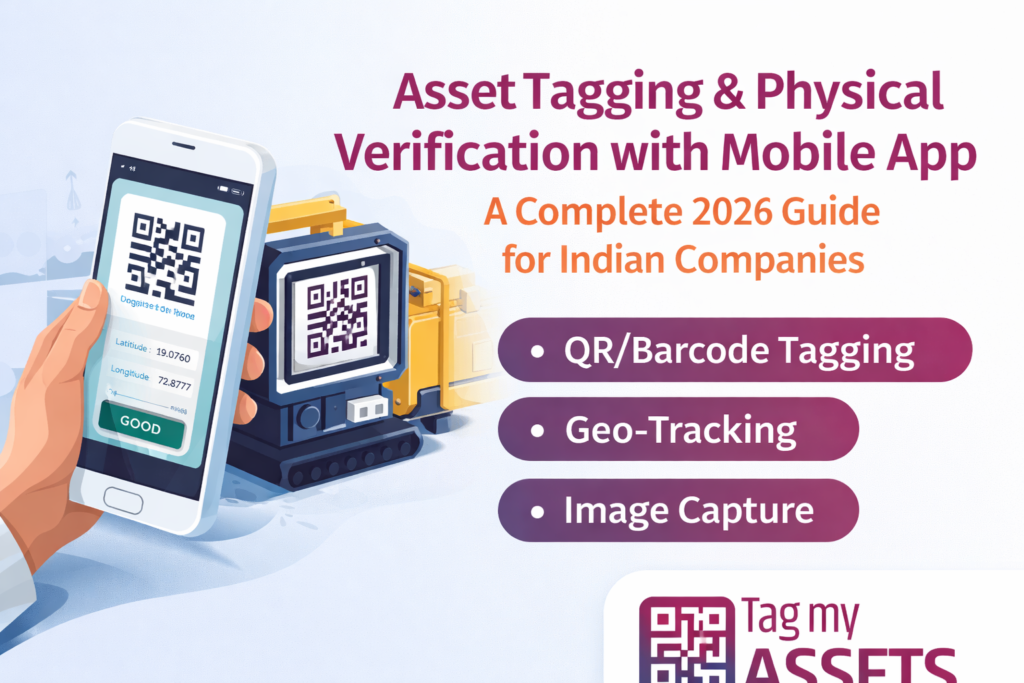
A mobile‑based system replaces registers and handheld devices with smartphones. The verification team uses a mobile application to:
- Scan QR / barcode tags
- Capture live asset photographs
- Record asset condition (working, idle, damaged)
- Capture GPS latitude & longitude automatically
- Sync data instantly to the cloud
Each scan creates a time‑stamped, geo‑tagged audit trail.
Role of QR Codes, Barcodes & RFID in Asset Tagging
QR Codes
- Cost‑effective
- Easy to scan using any smartphone
- Ideal for offices, plants, hospitals, and retail
Barcodes
- Widely used
- Suitable for inventory and high‑volume assets
RFID
- Useful for bulk movement tracking
- Higher cost
- Requires specialised readers
For most Indian organisations, QR‑based tagging with mobile scanning provides the best balance of cost, scalability, and audit reliability.
Importance of Geo‑Tagging (Latitude & Longitude)
Geo‑tagging adds location intelligence to asset verification.
Benefits include:
- Proof of on‑site verification
- Identification of unauthorised asset movement
- Validation for multi‑location organisations
- Strong audit and insurance evidence
Latitude and longitude data ensures verification is not desk‑based.
Image-Based Asset Verification: A Game Changer
Photographic evidence transforms asset audits.
Images help:
- Auditors validate existence remotely
- Management assess asset condition
- Resolve disputes on missing or damaged assets
- Support insurance and statutory claims
A mobile app that captures multiple images per asset creates unquestionable verification credibility.
Cloud-Based Reconciliation & FAR Creation
Modern asset verification systems directly reconcile:
- Book records vs physical assets
- Excess assets
- Missing assets
- Unused or idle assets
Outputs generated automatically:
- Updated Fixed Asset Register (FAR)
- Location‑wise asset reports
- Department‑wise reconciliation
- Audit‑ready annexures
No manual consolidation. No Excel dependency.
Industry Use Cases
Manufacturing Companies
- Plant‑wise asset verification
- Machine tagging
- Tool and equipment tracking
- Capex control
Retail Chains
- Scan‑based verification
- Store‑wise asset mapping
- Rapid verification cycles
Hospitals & Laboratories
- Medical equipment tagging
- Safety‑critical asset tracking
- Regulatory documentation
Why TagMyAssets’ Approach is Different
Unlike traditional vendors, TagMyAssets provides:
- ✔ Asset tagging + physical verification
- ✔ In‑house tag printing software
- ✔ Mobile application (no handheld devices)
- ✔ Image capture & asset condition logging
- ✔ GPS‑based geo‑tagging
- ✔ Cloud‑based reconciliation & reporting
- ✔ Software deployment post‑verification
This ensures organisations don’t just verify once, but manage assets continuously.
fixed asset verification best practices
fixed asset verification best practices
This guide explains how asset tagging physical verification using a mobile app helps Indian companies improve audit accuracy and asset control.
Frequently Asked Questions (FAQs)
Is asset tagging mandatory in India?
While not legally mandatory, asset tagging is strongly recommended for audit compliance, internal control, and insurance purposes.
How long does physical asset verification take?
Timelines depend on asset volume, locations, and asset type. Mobile‑based systems significantly reduce project duration.
Can verification be done without RFID or handheld devices?
Yes. QR‑based tagging using smartphones is highly effective and widely adopted.
Is geo‑tagging acceptable for audits?
Yes. Geo‑tagged and image‑based verification provides strong audit evidence.
Why is asset tagging and physical verification important for audits?
Asset tagging and physical verification provide a digital trail that proves the existence of assets, which is a mandatory requirement for statutory auditors in India.
How often should we conduct asset tagging and physical verification?
Most companies perform asset tagging and physical verification annually, though high-value electronics may require quarterly checks via mobile apps.
Conclusion
Asset tagging and physical verification are no longer clerical activities. They are technology‑driven control mechanisms.
Organisations adopting mobile‑based, cloud‑enabled asset verification gain:
- Higher audit confidence
- Real‑time asset visibility
- Faster reconciliation
- Lower compliance risk
This is the future of asset management in India. Mobile-based asset tagging & physical verification helps organisations achieve faster audits, better asset visibility, and long-term compliance.
Next Blogs in this Series:
- Blog 2: Asset Tagging Software vs Manual Asset Tagging
- Blog 3: Mobile-Based Asset Verification Without Handheld Devices
- Blog 4: Asset Tagging & Verification for Manufacturing Companies
- Blog 5: Scan-Based Inventory & Asset Verification for Retail Chains
