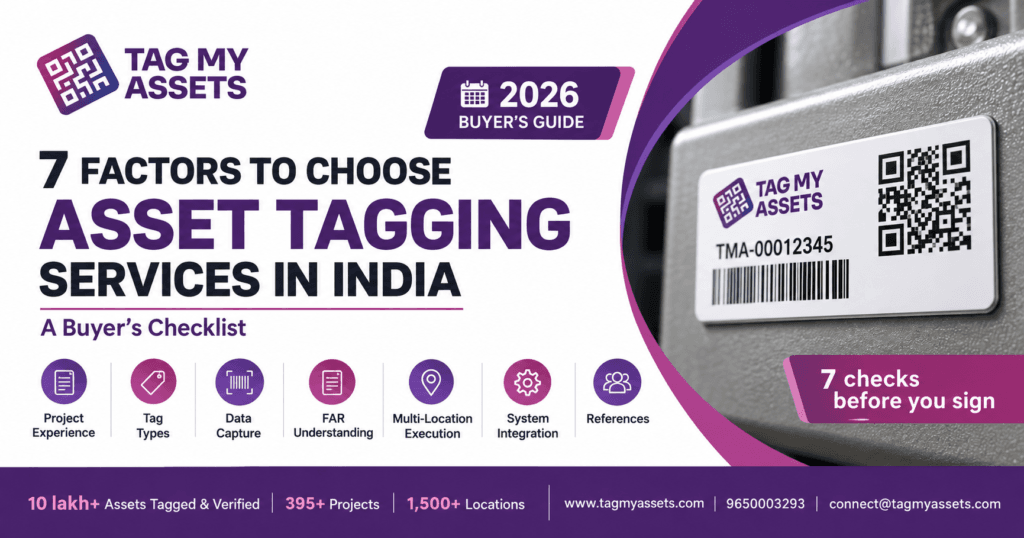
Choosing asset tagging services in India is a decision that shapes the accuracy of your Fixed Asset Register for years after the labels go on.
Many companies treat asset tagging as printing QR codes or RFID tags. In practice, a poorly executed tagging project leaves inaccurate asset records, audit observations and differences between the register and the floor.
The real challenge is not tagging assets. It is choosing the right asset tagging service provider in India. This guide sets out seven factors to check before you appoint one.
Companies looking for asset tagging services in India often underestimate how much depends on vendor selection.
1. Experience with Large and Multi-Location Projects
Not every vendor can run a project across many sites. Before finalising, ask:
- Have they handled projects of 10,000 or 100,000+ assets?
- Have they worked in your industry, such as manufacturing, retail or corporate offices?
- Can they show how a comparable project was planned and staffed?
A vendor with real project exposure plans the site schedule in advance and knows where on-ground errors usually occur.
2. Knowledge of Tag Types: QR, RFID and Metal
- QR code tags: cost-effective for most general assets.
- RFID tags: faster scanning where large volumes are verified repeatedly.
- On-metal and stainless steel tags: for metal surfaces, heat or outdoor exposure.
A good vendor recommends a tag for each asset category rather than one type for everything. Red flag: a vendor pushing a single tag type across the whole asset base.
3. How Verification Data Is Captured
Tagging is only useful if the data captured on site is structured. Check whether the vendor:
- records each asset on a mobile application rather than paper sheets
- captures a photo and location for every tagged asset
- delivers the data in an exportable format mapped to your Fixed Asset Register
Without structured capture, the audit trail is lost and the tags lose most of their value.
4. Understanding of the Fixed Asset Register
Asset tagging is not only a physical activity. It depends on FAR structure, asset classification and the evidence the auditor will look for under CARO 2020. A capable vendor will review and standardise the FAR, map each tag to the correct register line, and identify duplicates, missing items and assets found on site but not recorded.
Red flag: a vendor that talks only about labels and not about data accuracy.
5. Execution Across Locations
If assets sit across plants, warehouses or retail stores, execution becomes the main risk. Ask about team size, how teams are deployed to each site, and the location-wise timeline. Also ask who affixes tags on assets mounted above normal working height, since some sites need the client’s maintenance staff for this.
6. Integration With Your Existing Systems
Tagging data should not live in isolation. Check whether the vendor can hand over data in formats that flow into your ERP or asset register: asset IDs, locations, tag numbers, and discrepancy reports mapped to your FAR structure.
7. Reputation and Reference Checks
Before finalising, review the vendor’s project history and ask for references from projects similar to yours in scale and industry. A vendor with demonstrated multi-location execution is a safer choice for pan-India rollouts.
Common Mistakes When Choosing Asset Tagging Services
- Choosing a vendor on lowest price alone
- Ignoring FAR quality
- Not defining the tagging scope clearly
- Underestimating the asset count
These usually show up later as cost overruns, delays and asset records that do not match the register.
Good Vendor vs Poor Vendor: Quick Comparison
| Factor | Good Vendor | Poor Vendor |
|---|---|---|
| Approach | Tagging, verification and reconciliation | Tagging only |
| Tag selection | By asset category | One type for all |
| Data capture | App-based, with photo and location | Paper sheets |
| FAR handling | Mapped and reconciled | Ignored |
| Execution | Location-wise plan | Unplanned |
Checklist Before Finalising a Vendor
- FAR reviewed before tagging starts
- Tag type fixed for each asset category
- Scope covers tagging, verification and reconciliation
- Data format for the FAR agreed in advance
- Location-wise timeline defined
How TagMyAssets Works
TagMyAssets is a service provider that operates its own verification applications. Our work covers QR, barcode and RFID asset tagging, physical verification of fixed assets, FAR reconciliation, and app-based data capture during verification.
We have tagged and verified 10 lakh+ assets across 1,500+ locations in India, in sectors including manufacturing, retail, pharma and diagnostic laboratories, and corporate offices.
Conclusion
Choosing an asset tagging service provider is not only a procurement decision. It affects the accuracy of your asset records and how well they stand up at audit. Selecting the right asset tagging services in India starts with the seven checks above.
FAQs
What should I check before hiring an asset tagging company?
Project experience, tag knowledge, how data is captured, FAR understanding and execution capacity across locations.
Is RFID better than QR for all assets?
No. RFID suits bulk scanning where assets are verified often. QR is more cost-effective for most general assets.
How long does an asset tagging project take?
It depends on asset count, number of locations and asset type. Ask the vendor for a location-wise schedule before signing.
How to choose asset tagging services in India?
Check project experience, the right mix of QR and RFID tags, app-based data capture and FAR understanding. The scope should cover verification and reconciliation, not only tags.
What is the importance of asset tagging services?
Tagging links each physical asset to its line in the Fixed Asset Register, which makes physical verification repeatable and gives the auditor evidence to test.

