
Asset tagging vs ERP data is the main reason why many companies still fail fixed asset audits.Many companies believe that having an ERP system means their asset data is accurate.
But during audits, a different reality emerges.
👉 Assets missing
👉 Location mismatches
👉 Incorrect records
👉 Audit delays
So the real question is:
👉 Why do companies still fail fixed asset audits despite using ERP systems?
The answer lies in the gap between ERP data and physical asset reality.
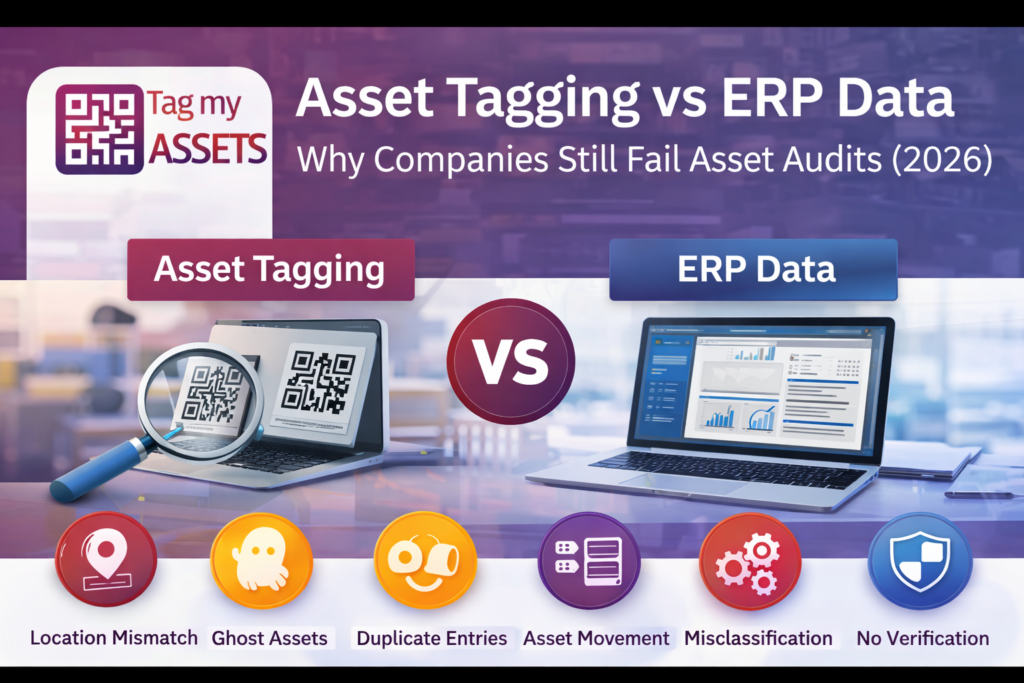
The gap between asset tagging vs ERP data creates major audit challenges for companies.
Understanding asset tagging vs ERP data helps improve asset accuracy and audit readiness.
Companies must address asset tagging vs ERP data differences to avoid financial risks.
What Is ERP-Based Asset Management?
ERP systems store:
- asset master data
- purchase records
- depreciation details
- location mapping (in theory)
👉 But ERP is only as accurate as the data entered into it.
What Is Asset Tagging and Physical Verification?
Asset tagging involves:
- physically identifying assets
- assigning QR/barcode tags
- mapping location and department
- verifying existence
👉 It connects records with reality
Asset Tagging vs ERP Data: The Core Difference
| ERP Data | Asset Tagging |
|---|---|
| System-based | Physical verification |
| Depends on entries | Depends on actual existence |
| Static data | Real-time validation |
| No ground check | On-ground confirmation |
👉 ERP shows what should exist
👉 Asset tagging shows what actually exists
7 Reasons Companies Fail Fixed Asset Audits
1. ERP Data Is Not Updated in Real Time
Assets are:
- transferred
- relocated
- reassigned
But ERP updates are often delayed.
👉 Result: Location mismatch
2. No Physical Verification of Assets
ERP assumes assets exist.
But without verification:
- missing assets go unnoticed
- ghost assets remain in records
👉 Result: Audit discrepancies
3. Duplicate or Incorrect Asset Entries
Common issues:
- same asset recorded multiple times
- incorrect descriptions
- merged entries
👉 Result: Confusion during audit
4. Asset Movement Is Not Tracked
Assets frequently move between:
- departments
- plants
- locations
Without tagging:
👉 No tracking of movement
5. Lack of Asset-Level Identification
ERP identifies assets by:
- codes
- descriptions
But physically:
👉 Assets look similar
👉 Result: Wrong asset mapping
6. FAR and ERP Data Mismatch
FAR may:
- not match ERP
- not match physical assets
👉 Result: reconciliation issues
7. Overdependence on System Data
Companies assume:
👉 “If it is in ERP, it must exist”
This is the biggest mistake.
👉 ERP is a recording system, not a verification system
Real Audit Scenario
During audits, companies often face:
- assets in ERP but not physically available
- assets on ground but not in ERP
- location mismatches
- incorrect asset classification
👉 These lead to audit observations and delays
Why ERP Alone Is Not Enough
ERP lacks:
- physical validation
- real-time tracking
- asset-level identification
👉 Without asset tagging, ERP becomes incomplete
How Asset Tagging Solves This Problem
Asset tagging ensures:
- every asset is physically verified
- QR/barcode links asset to system
- location and custodian mapping
- real-time traceability
👉 It bridges the gap between ERP and reality
Best Practice: Combine ERP + Asset Tagging
The right approach:
👉 ERP for records
👉 Asset tagging for verification
Together they provide:
- accurate asset data
- audit readiness
- better control
- improved financial reporting
About TagMyAssets
At TagMyAssets, we help companies bridge the gap between ERP data and physical assets through structured asset tagging, verification, and FAR reconciliation. Our approach ensures audit-ready asset records and complete asset visibility across locations.
Conclusion
The difference between ERP data and physical reality is the main reason companies fail fixed asset audits.
👉 ERP alone is not enough
Companies that combine ERP with asset tagging:
- reduce audit failures
- improve accuracy
- strengthen control
- avoid financial risks
👉 Asset tagging is not optional — it is essential for audit success, ICAI guidlines.
FAQs
1. Why do companies fail asset audits despite ERP?
Because ERP data is not physically verified.
2. Is ERP enough for asset management?
No, ERP needs asset tagging for validation.
3. What is the role of asset tagging?
To verify, track, and identify assets physically.
4. Can asset tagging integrate with ERP?
Yes, it improves ERP data accuracy.
5. How does tagging improve audits?
By reducing mismatches and improving traceability.
