
Many organizations implementing asset management systems face an important decision: Should asset tagging be done internally (DIY) or outsourced to professional asset tagging services?
While DIY asset tagging may initially appear cheaper, companies often underestimate the time, manpower, data errors, and operational risks involved in tagging thousands of assets across locations.
Professional asset tagging services bring experience, structured processes, specialized tagging materials, and asset verification expertise, ensuring that organizations build a reliable and audit-ready Fixed Asset Register (FAR).
This article compares DIY asset tagging vs professional asset tagging services, focusing on cost, operational risks, and long-term ROI.
When businesses evaluate DIY Asset Tagging vs Professional Asset Tagging Services, the decision usually depends on cost, operational risks, and long-term ROI. Understanding the differences between DIY Asset Tagging vs Professional Asset Tagging Services helps organizations choose the right strategy for building a reliable and accurate asset register.
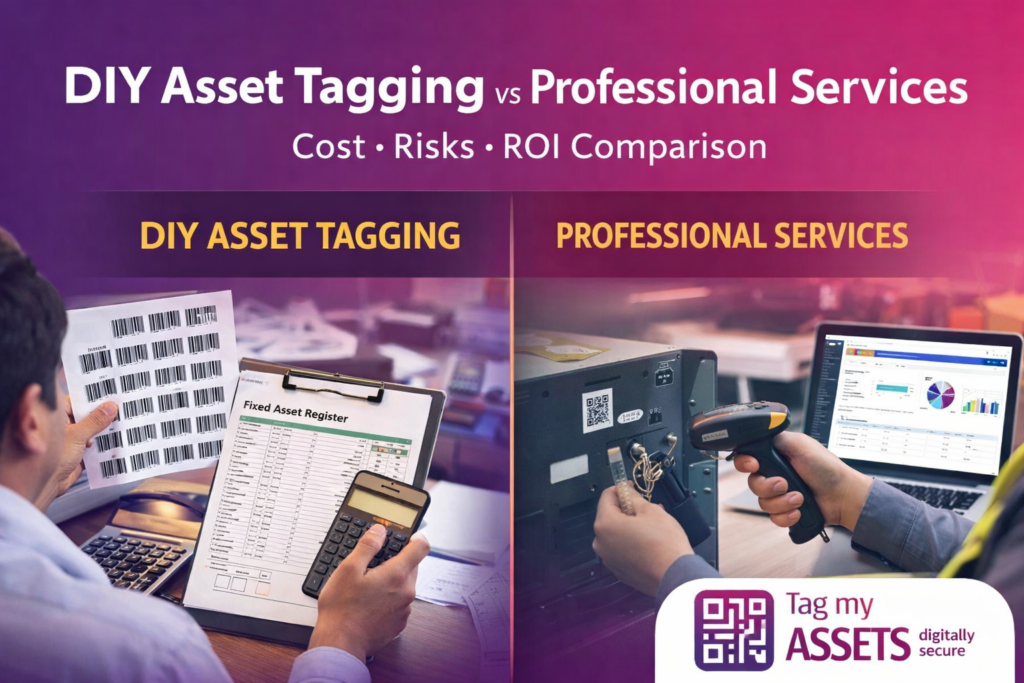
What is DIY Asset Tagging?
DIY asset tagging means that the company’s internal staff performs the asset tagging exercise without external specialists.
Typical DIY asset tagging activities include:
- Printing asset labels internally
- Assigning employees to locate and tag assets
- Creating a manual asset register in Excel
- Updating asset details manually
- Verifying assets across departments
Although this approach may seem economical, internal teams often lack standardized processes and asset tagging expertise, which can result in inconsistent asset data.
What are Professional Asset Tagging Services?
Professional asset tagging services involve specialized companies conducting physical verification, tagging, and reconciliation of assets using standardized methodologies.
For example, companies offering Fixed Asset Tagging Services typically provide:
- Physical verification of assets
- QR code / barcode / RFID tagging
- Asset photography and geo-location mapping
- FAR reconciliation
- Asset classification and coding
- Cloud dashboard or structured asset database
Organizations working with experienced providers like TagMyAssets often benefit from faster execution and highly accurate asset records.
👉 Internal linking suggestion:
Learn more about Fixed Asset Tagging Services here:
https://tagmyassets.com/fixed-asset-tagging-services/
5 Major Cost Differences Between DIY Vs Professional Asset Tagging
1. Hidden Manpower Costs
DIY asset tagging requires internal staff to:
- Identify assets
- Tag them physically
- Record details in spreadsheets
- Verify discrepancies
This often leads to significant employee time consumption, especially for organizations with thousands of assets across multiple departments or locations.
Professional asset tagging teams complete projects much faster using trained manpower.
2. Incorrect Asset Identification
Untrained teams frequently make mistakes such as:
- Tagging non-capital items
- Missing movable assets
- Tagging duplicate assets
- Incorrect asset descriptions
Professional services follow standard asset classification methodologies, reducing errors.
3. Poor Tag Durability
DIY tagging often uses low-quality printed labels that:
- Fade over time
- Peel off easily
- Become unreadable
Professional tagging companies use:
- Polyester labels
- Anodized aluminium tags
- Metal tags for industrial environments
These ensure long-term asset traceability.
4. Data Entry Errors
DIY projects frequently face problems like:
- Duplicate asset codes
- Missing asset details
- Incorrect location mapping
Professional asset tagging services use structured digital data capture systems, reducing human error.
5. Lack of Asset Reconciliation
DIY tagging usually focuses only on labeling assets, not reconciling them with the Fixed Asset Register (FAR).
Professional asset tagging services typically perform:
- FAR reconciliation
- Identification of ghost assets
- Identification of missing assets
This ensures clean and audit-ready asset records.
4 Major Risks of DIY Asset Tagging
1. Incomplete Asset Coverage
DIY projects often miss assets located in:
- Remote branches
- Warehouses
- Employee workstations
- Field locations
This results in inaccurate asset registers.
2. Asset Misclassification
Assets may be wrongly classified as:
- Consumables
- Furniture
- IT equipment
Misclassification impacts financial reporting and depreciation accuracy.
3. Operational Disruptions
Internal teams performing tagging may interrupt normal operations such as:
- Production activities
- IT infrastructure access
- Office workflows
Professional asset tagging teams plan structured tagging schedules to minimize disruptions.
4. Weak Audit Trail
DIY tagging often lacks:
- Photo documentation
- Geo-location verification
- Asset movement tracking
Professional systems maintain complete audit trails for compliance and internal controls.
ROI Comparison: DIY vs Professional Asset Tagging
DIY Asset Tagging vs Professional Asset Tagging Services: Key Differences
| Factor | DIY Asset Tagging | Professional Asset Tagging |
|---|---|---|
| Initial Cost | Lower | Moderate |
| Manpower Time | High | Minimal internal involvement |
| Data Accuracy | Medium | Very High |
| Asset Traceability | Limited | Strong |
| Audit Readiness | Weak | Strong |
| Long Term ROI | Low | High |
Organizations often discover that DIY tagging becomes expensive over time due to repeated corrections and incomplete data.
When DIY Asset Tagging May Work
DIY asset tagging may be feasible for organizations that have:
- Fewer than 300 assets
- Single office location
- Non-critical asset environments
In such cases, simple barcode labels and Excel asset registers may be sufficient.
DIY Asset Tagging vs Professional Asset Tagging Services – Final Comparison
Choosing between DIY Asset Tagging vs Professional Asset Tagging Services depends on the scale of assets, accuracy requirements, and audit compliance needs. Companies with thousands of assets generally benefit from professional asset tagging services.
Organizations comparing DIY Asset Tagging vs Professional Asset Tagging Services should evaluate cost, operational risks, and long-term asset management benefits.
When Professional Asset Tagging Services Are Recommended
Professional asset tagging services are ideal when organizations have:
- Multiple locations
- Thousands of assets
- Complex IT or manufacturing environments
- Compliance and audit requirements
Companies in sectors like manufacturing, hospitals, retail chains, IT offices, and warehouses particularly benefit from professional asset tagging.
Many companies evaluating DIY Asset Tagging vs Professional Asset Tagging Services focus on long-term asset visibility, audit readiness, and operational efficiency.
Read about Inventory Verification Services here:
https://tagmyassets.com/inventory-verification-services/
How TagMyAssets Helps Organizations Implement Reliable Asset Tagging
TagMyAssets provides end-to-end fixed asset tagging and verification solutions across India.
Services include:
- Physical asset verification
- QR code / barcode tagging
- Asset database creation
- FAR reconciliation
- Mobile app-based asset scanning
- Asset tracking dashboards
These solutions help organizations build reliable asset registers, prevent asset leakage, and strengthen financial controls.
When comparing DIY Asset Tagging vs Professional Asset Tagging Services, companies must consider not only cost but also accuracy, scalability, and long-term asset visibility.
Learn more about TagMyAssets Asset Management Solutions:
https://tagmyassets.com/fixed-asset-management/
Conclusion
Although DIY asset tagging may appear cost-effective initially, organizations often face hidden costs, operational risks, and inaccurate asset records.
Professional asset tagging services provide structured processes, accurate data capture, and long-term asset traceability, delivering significantly higher ROI.
For organizations managing large asset bases, multi-location operations, or compliance requirements, investing in professional asset tagging services is often the most reliable and scalable solution.
when comparing DIY Asset Tagging vs Professional Asset Tagging Services, organizations must evaluate not only the upfront cost but also the operational risks and long-term benefits. Professional asset tagging services often deliver higher accuracy, faster execution, and better ROI for companies managing large asset bases.
Asset verification also supports strong internal controls recommended in financial reporting frameworks discussed by ICAI.
Organizations implementing asset tagging often align their practices with ISO 55000 asset management standards.
FAQ for DIY Asset Tagging vs Professional Asset Tagging Services
Is DIY asset tagging cheaper than professional asset tagging?
DIY tagging may have lower initial costs, but hidden costs such as employee time, tagging errors, and incomplete asset records often make it more expensive in the long run.
What type of tags are used in professional asset tagging?
Professional asset tagging services use durable tags such as polyester labels, anodized aluminium tags, and RFID tags, depending on the environment and asset type.
How long does a professional asset tagging project take?
The timeline depends on the number of assets and locations. Typically, 5,000–10,000 assets can be tagged within a few days by an experienced asset tagging team.
Can asset tagging help during audits?
Yes. Proper asset tagging improves Fixed Asset Register accuracy, audit readiness, and asset traceability, which simplifies internal and statutory audits.
Why Companies Compare DIY Asset Tagging vs Professional Asset Tagging Services?
Many organizations evaluating asset management strategies often compare DIY Asset Tagging vs Professional Asset Tagging Services to understand which approach provides better operational efficiency and asset visibility.
