
“In today’s high-stakes corporate environment, Asset Tagging Services in India have become the backbone of regulatory compliance and operational efficiency. As businesses scale, maintaining an accurate Fixed Asset Register (FAR) is no longer just a best practice—it is a statutory necessity. Whether you are navigating the complexities of asset tagging for the first time or looking to upgrade to advanced RFID tracking, understanding how these Asset Tagging Services in India integrate with modern audit requirements is the first step toward safeguarding your company’s physical wealth.”
Whether you are a CFO at a Mumbai-based MNC or a Plant Head in a manufacturing hub like Pune or Gurugram, the challenge remains the same: How do we ensure that every physical asset on the floor matches the entry in our Fixed Asset Register (FAR)?
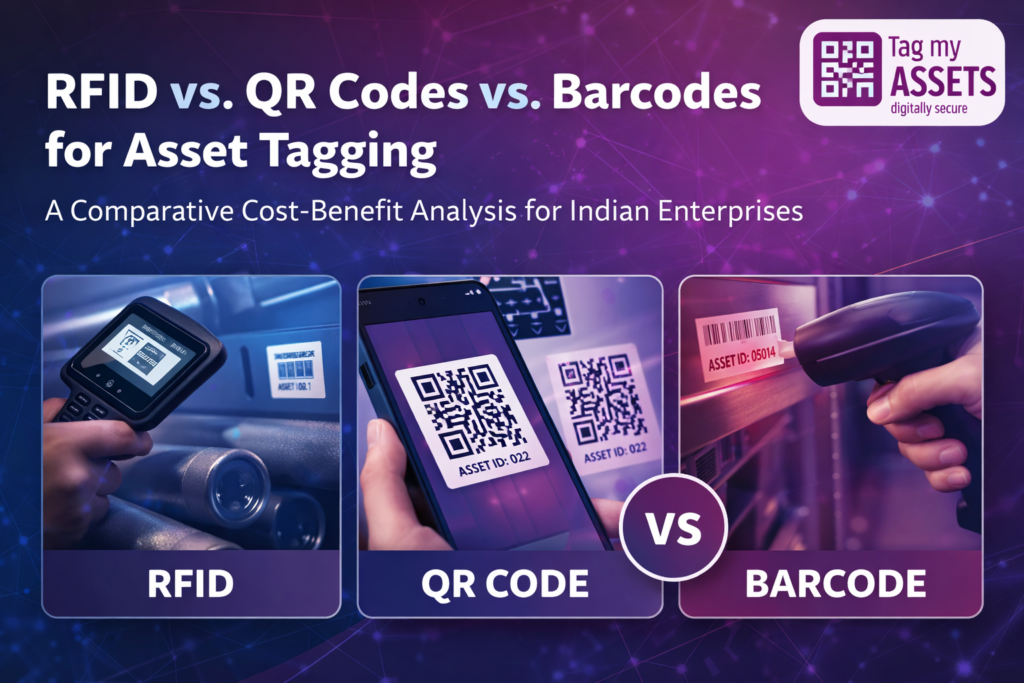
This comprehensive guide explores the comparative cost-benefit analysis of RFID, QR Codes, and Barcodes, helping you choose the right technology to ensure CARO 2020 compliance and operational efficiency.
1. The Critical Need for Modern Asset Tagging in India
The era of manual excel-based tracking is over. Indian enterprises today operate across multiple locations, making physical fixed asset verification a logistical nightmare.
Why Manual Systems Fail:
- The Ghost Asset Problem: Assets that have been disposed, scrapped or transferred often remain in the FAR because the accounting entry was never passed. Without asset tagging, insurance and depreciation continue to be carried on assets that no longer exist.
- Human Error: Serial numbers recorded by hand from worn, oily or obscured plates are prone to transcription error, and a wrong serial number can persist undetected through several audit cycles.
- Audit Delays: Statutory auditors now demand digital proof of verification. Manual systems cannot provide the timestamped, geo-located evidence required for a clean audit report.
Professional asset tagging shortens the verification cycle because assets can be identified and matched to the register without manual searching. The actual duration follows asset count, asset type and team size rather than a fixed calendar.
2. Barcode Asset Tagging: The Legacy Solution
Barcode tagging was the first step in the evolution of asset identification. These are one-dimensional (1D) codes that represent data through varying widths of parallel lines.
Technical Performance
Barcodes require a direct “line-of-sight” between the scanner and the tag. In an industrial environment, this is often a disadvantage. If a barcode is covered in dust, grease, or is partially scratched, the laser scanner will fail to read it.
Cost vs. Efficiency in the Indian Context
While the cost of a barcode label is minimal (often less than ₹5), the total cost of ownership is high. Because each asset must be manually located and scanned individually, the labor cost for fixed asset verification remains high.
- Best Suited For: Small retail shops or offices with fewer than 500 low-value assets.
- Why it’s fading: It lacks the “Smart” capabilities of QR and the speed of RFID.
3. QR Code Asset Tagging: The Modern Industry Standard
For the majority of mid-to-large scale Indian enterprises, QR Code Asset Tagging has become the go-to solution. A QR (Quick Response) code is a two-dimensional matrix that can store significantly more data—including URLs, serial numbers, and maintenance logs.
Why QR Codes Win in 2026:
- Smartphone Compatibility: One of the biggest advantages of QR codes in India is that every field auditor already carries a high-powered scanner in their pocket—their smartphone. By using the TagMyAssets mobile app, staff can verify assets without purchasing expensive dedicated hardware.
- Dynamic Data: Unlike barcodes, a Dynamic QR Code can be linked to a cloud-based asset management system. When you scan the tag, you don’t just see a number; you see the asset’s purchase date, warranty status, and last service date.
- Error Correction: QR codes have built-in “Reed-Solomon” error correction, so a partially damaged tag often remains readable where a barcode would not. This is vital for Asset Tagging Services in India, where environmental conditions can be harsh.
Implementation Strategy
For an IT company in Bengaluru or a hospital chain in Delhi, QR codes provide the perfect balance of cost and data depth. They are highly effective for tracking “portable” assets like laptops, medical equipment, and office furniture.
4. RFID Asset Tracking: The Gold Standard for Automation
RFID (Radio Frequency Identification) is the pinnacle of fixed asset tracking. Unlike Barcodes or QR codes, RFID does not require line-of-sight. It uses radio waves to capture data from a distance.
The Mechanics of RFID:
- Passive RFID Tags: These tags do not have a battery. They “wake up” when they receive a signal from an RFID reader.
- Bulk Scanning: Because RFID does not need line of sight, a reader can capture many tags in a single pass without each asset being located and handled individually. Read performance depends on tag type, surface material, density and reader range.
The ROI of RFID in India
While the initial investment in RFID Asset Tracking is higher (due to the cost of tags and handheld readers), the return on investment (ROI) is realized through the massive reduction in “man-days” required for audit.
Where the saving comes from: RFID reduces the man-days required for a verification cycle, because bulk scanning removes the need to locate and scan each asset individually. The scale of the saving depends on asset density, surface types and location access, so it should be estimated against the specific site rather than assumed from a general figure.
5. Fixed Asset Verification & CARO 2020 Compliance
For any Indian company, the primary driver for Asset Tagging Services is regulatory compliance. The Companies Auditor’s Report Order (CARO) 2020 has made it mandatory for auditors to report on the physical verification of fixed assets.
How Tagging Ensures Compliance:
- Clause 3(i)(a)(A): Requires proper records showing full particulars, including quantitative details and the situation of Property, Plant, and Equipment (PPE). Digital tags provide this “situation” (location) data accurately.
- Clause 3(i)(b): Requires physical verification at reasonable intervals. Professional asset tagging allows you to perform “rolling audits” every quarter rather than a stressful annual audit.
- GST Reconciliation: By tagging assets at the time of procurement, companies can better track “Input Tax Credit” on capital goods, ensuring there is no mismatch during GST audits.
6. Detailed Cost Analysis: India-Specific Estimates
Choosing the right technology requires a deep dive into the budget. Below is an estimated cost breakdown for the Indian market in 2026.
| Cost Component | Barcode | QR Code (Premium) | RFID (On-Metal) |
| Tag Cost (per unit) | ₹2 – ₹8 | ₹2 – ₹15 | ₹10- ₹200 |
| Hardware Requirement | Laser Scanners | Smartphones | RFID Handhelds |
| Hardware Cost | Low None (BYOD) | Capital cost per unit, | scoped per project |
| Software/Cloud Fee | Basic | Moderate | Enterprise |
| Tagging Labor | High | Moderate | Low |
Note: Prices vary based on the substrate material (Polyester, Polycarbonate, or Anodized Aluminum).
7. Strategic Implementation: The “Hybrid” Approach
At TagMyAssets, we often recommend a Hybrid Asset Management Strategy for our clients across India. Why use expensive RFID on a chair when a QR code will suffice?
The Ideal Hybrid Map:
- High-Value/Hard-to-Reach Assets (RFID): Servers, heavy machinery, overhead cranes, and medical imaging equipment.
- Highly Mobile/IT Assets (QR Codes): Laptops, tablets, projectors, and lab equipment.
- Low-Value/Static Assets (Barcodes/QR): Office furniture, workstations, and pantry equipment.
This approach optimizes your budget while ensuring that your most critical assets are tracked with the highest level of automation.
8. Overcoming Challenges in the Indian Industrial Environment
Indian manufacturing plants present unique challenges for fixed asset tracking:
- Metal Interference: RFID signals can be blocked by metal. We solve this by using specialized “On-Metal” RFID tags that use the metal surface as an antenna to increase read range.
- Extreme Heat: In regions like Rajasthan or Central India, shed temperatures run high enough to defeat ordinary adhesive. We specify thermally stable adhesives and tag materials for those conditions.
- Chemical Exposure: In pharmaceutical and chemical plants, tags must withstand washdowns. We provide IP68-rated tags that are resistant to chemical corrosion.
9. What Happens to the Data After Tagging
Technology is only as good as the data it produces. Tagging creates the identity; the value comes from what is done with the capture afterwards.
Verification record: Every asset scanned with its location, department, custodian, condition and a photograph, captured at the point of scan.
Reconciliation output: Physical findings matched against the FAR, with each variance classified — not found, found but unrecorded, location mismatch, condition issue.
Register your finance team can use: The reconciled register goes back into whatever your company already maintains — ERP, asset module or a structured spreadsheet. We do not replace your books or compute depreciation.
10. Conclusion: Choosing Your Asset Tagging Partner
Choosing a tagging approach is an operational decision as much as a technical one, and it helps to work with a partner who understands the conditions Indian sites actually present. TagMyAssets provides end-to-end Asset Tagging Services in India, from initial FAR reconciliation to the physical application of tags and final audit reporting.
Don’t wait for your next statutory audit to find out your records are incomplete. Secure your assets, streamline your compliance, and automate your future.
Summary Checklist for CFOs:
- [ ] Conduct a “Ghost Asset” health check.
- [ ] Evaluate if your current FAR meets CARO 2020 standards.
- [ ] Determine if QR or RFID fits your operational scale.
- [ ] Contact a professional fixed asset verification service provider.
Ready to transform your asset management? Our experts at TagMyAssets are ready to help you navigate the complexities of RFID and QR implementation.
Contact Us Today:
- Website: https://tagmyassets.com
- Email: connect@tagmyassets.com
- Phone: +91 96500 03293
- Locations: Delhi NCR, Mumbai, Pune, Bengaluru, and PAN India.