
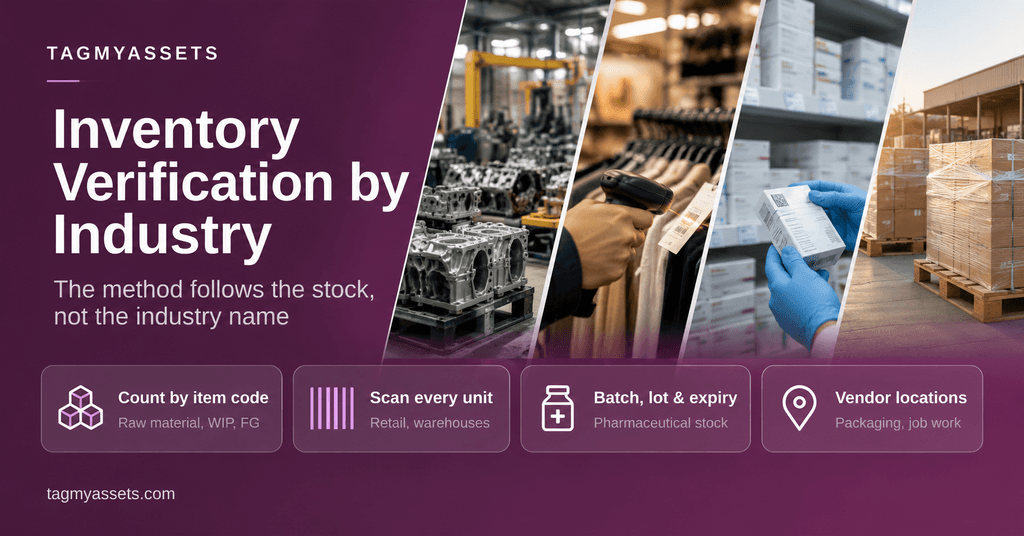
Inventory verification by industry is not one exercise repeated in different buildings. The way stock is counted depends on how it is coded, what has to be recorded besides the quantity, and whether the stock can stop moving long enough to be counted. A pharmaceutical store, an apparel outlet and a factory’s raw material yard each need a different count method, even though the output in every case is the same: a physical count reconciled to the books.
This is why a verification firm asks for a site visit, or a sample of the stock data, before it quotes. The request is sometimes read as a sign that the firm has not worked in that industry before. It is the opposite. The visit is how the count method is chosen, and the method is what decides how many people go on site, for how long, and what the report will contain.
Three Questions That Decide the Count Method
- Does the stock carry a scannable code? A barcode or 2D code on each unit means the count can be scanned. Loose or uncoded stock has to be counted against an item code.
- What has to be captured besides the quantity? Some counts need only item and quantity. Others need batch or lot number, manufacturing date and expiry, or size and colour, because the books carry stock at that level.
- Can the stock stop moving? Stock movement should ideally be paused during the count. Where a full freeze is not practical, clear written instructions, designated responsibility and documented receipts, issues and transfers are needed to maintain an accurate cut-off and avoid double counting or omissions. Retail counts are therefore often scheduled overnight or on a closed day.
The answers to these three questions, more than the name of the industry, decide which of the four methods below applies.
Method 1: Count Against the Item Code
Typical of: manufacturing raw material, work in progress and finished goods; engineering components; stores and spares.
Most stock in a manufacturing plant carries no scannable code. Raw material sits in bags, coils or bins; components sit in trays; work in progress sits on the shop floor between operations. Here the verifier selects the location and sub-location, searches the item code, and enters the counted quantity directly. The skill in this method is identification: telling two similar components apart, knowing the unit of measure the books use, and agreeing with the stores team how part-used and part-processed stock will be counted before the count starts.
Method 2: Scan Every Unit
Typical of: retail stores, apparel and footwear, warehouses and distribution centres holding barcoded stock.
Where every unit carries a barcode, each item is scanned and the count is taken from the scans. The constraint is time: retail counts usually have to finish between closing and opening. Counting on mobile devices rather than handheld scanners tethered to a laptop matters here, because one person can scan, count and record, so more people can work the floor at once. During a retail inventory verification engagement, over 100,000 inventory units were verified in a single night, with 50 auditors scanning on mobile devices.
Method 3: Scan and Capture Batch, Lot and Expiry
Typical of: pharmaceutical stock, and any stock held in the books at batch level.
A quantity alone is not enough when the books record stock by batch. Two cartons of the same product with different lot numbers or expiry dates are two different lines in the stock record, and the count has to match them line by line. On a recent pharmaceutical verification, the 2D code printed on each pack to industry standard carried the lot number and expiry date, so a single scan captured the item, the lot and the expiry together. Where the code does not carry these details, they have to be read from the pack and entered, which changes both the time per unit and the team size.
Batch-level capture also makes it possible to report near-expiry and expired stock separately from the quantity variance, which is often the finding management needs most.
Method 4: Verify Stock Held at Vendor Locations
Typical of: packaging material, job-work stock and consignment stock lying with suppliers or processors.
Some of a company’s inventory never sits on its own premises. Packaging material is a common case: cartons, labels and films are often stored at the vendor who prints or converts them, and drawn down as needed. A recent enquiry to verify packaging material at vendor locations shows what has to be settled before such a count can be quoted:
- Unit of measure: is the stock recorded in pieces, bundles, cartons, rolls or kilograms, and does the vendor record it the same way?
- Segregation: is the company’s stock kept apart from the vendor’s other customers’ material?
- Cut-off: how will material in transit or under printing on the count date be treated?
- Access: has the vendor agreed to the count date, and who from the vendor will be present?
The Four Methods at a Glance
| Stock type | Code on the stock | What is captured | Count method |
|---|---|---|---|
| Raw material, WIP, finished goods, components | Usually none | Item code, quantity, location | Count against item code |
| Retail and warehouse stock | Barcode on each unit | Item, quantity per scan | Scan every unit |
| Pharmaceutical and batch-tracked stock | 2D code or printed batch details | Item, lot or batch, expiry, quantity | Scan and capture batch data |
| Packaging and job-work stock at vendors | Varies | Item, unit of measure, quantity, vendor | Count at vendor location with agreed cut-off |
What a Site Visit Settles Before the Count
A pre-count visit, or a review of the stock data and a few photographs where a visit is not practical, answers the questions that decide the method and the team:
- how the stock is coded, and whether the codes can be scanned
- which fields the books carry: item only, or batch, lot and expiry as well
- the units of measure in use, and where they differ between the books and the floor
- the layout: locations, racks, bins and areas that are hard to reach
- the count window, instructions to pause stock movement where possible, and the cut-off and movement-recording controls if operations continue
Without these answers, a quotation is a guess at the method, and a wrong guess shows up on the night of the count as the wrong team size or a field nobody planned to capture.
Inventory Verification by Industry: Where Experience Matters
Experience across industries is what makes the right questions obvious: that a pharmaceutical count needs batch-level matching, that work in progress needs an agreed basis before anyone counts it, that vendor-held stock needs a cut-off for material in transit. TagMyAssets has carried out inventory counts across retail stores, warehouses, manufacturing units, apparel, engineering components and pharmaceutical stock. The common thread is not the industry; it is choosing the count method before the count, and running inventory verification on our own counting applications built for both coded and uncoded stock.
For the full process, including cut-off control and what the auditor tests under SA 501, see our guide to physical verification of inventory. For scope, team size and count windows, see our inventory verification services.
Frequently Asked Questions
Why does inventory verification differ by industry?
Because the stock differs. Whether units carry a scannable code, whether the books record batch and expiry, and whether stock movement can be paused or must be controlled during the count all change the method, the team size and the time needed.
Why does a verification firm ask for a site visit before quoting?
To choose the count method. The visit shows how stock is coded, what must be captured, the units of measure, the layout and the count window, which together decide the team and the schedule.
How is pharmaceutical inventory verified?
At batch level. Each line is matched by item, lot or batch number and expiry. Where the code on the pack carries these details, one scan captures them; otherwise they are read from the pack and entered.
Can inventory held at a vendor’s premises be verified?
Yes, with the vendor’s agreement. The unit of measure, segregation from other customers’ stock, the treatment of material in transit and the count date need to be agreed before the count.
Planning an inventory count? Contact TagMyAssets with the type of stock, the number of locations and your preferred count window, and we will come back with a method, team size and schedule.
Reference: The Institute of Chartered Accountants of India (SA 501, Audit Evidence: Specific Considerations for Selected Items).

