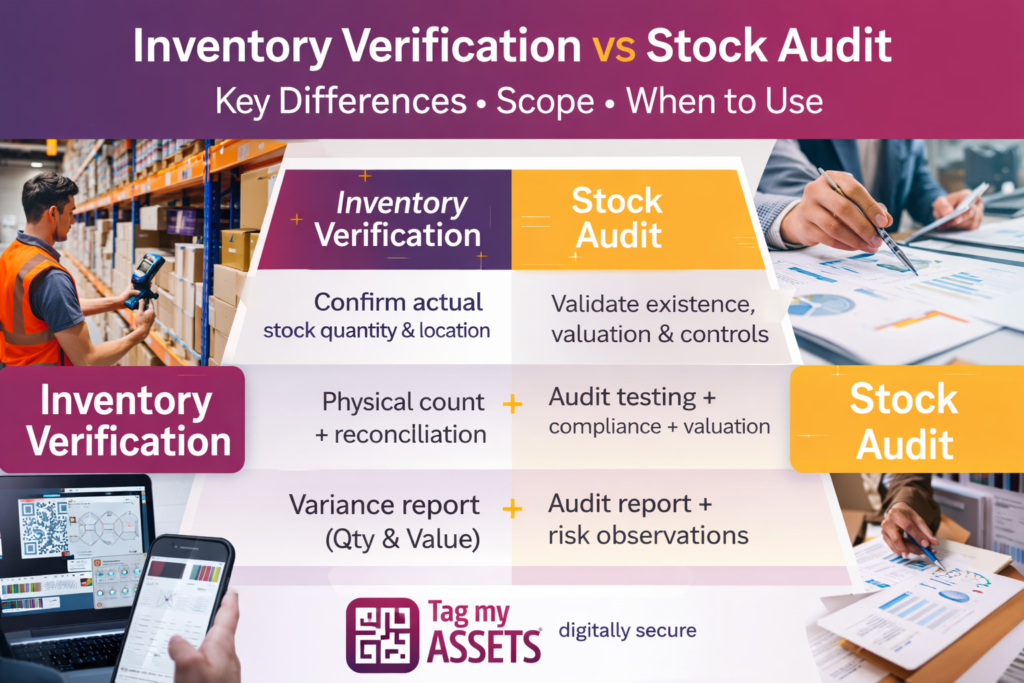
Inventory verification and stock audit are often used interchangeably, but in practice they serve different purposes. Businesses—especially retail chains, warehouses, and manufacturing plants—need clarity on what is required, when to do it, and what output/report is expected.
Inventory verification vs stock audit is a common confusion for businesses, but the two serve different audit and control objectives.
This guide explains the difference between inventory verification vs stock audit, their scope, key objectives, and how companies can maintain clean and audit-ready inventory records across locations.
At TagMyAssets, we conduct structured inventory verification and reconciliation using barcode/QR scanning and location-wise data capture to help clients achieve accuracy, control, and faster audits.
What is Inventory Verification?
Inventory verification is the process of physically checking stock quantities and conditions and reconciling them with ERP/stock registers.
It is mainly used to:
Confirm actual stock availability
Identify shortages, excess, wrong placement
Improve inventory accuracy
Support reconciliation and clean-up
Inventory verification is commonly conducted during:
A stock audit is an audit procedure performed to validate inventory values and controls, usually for financial reporting, lenders, insurance, statutory purposes, or internal assurance.
It focuses on:
Checking inventory existence
Testing valuation
Reviewing controls
Identifying risk of fraud, pilferage, slow-moving stock
Ensuring correct reporting in financial statements
Stock audit is often conducted for:
Banks / lenders (working capital funding)
Statutory audit support
Investor reporting
Risk-based internal audit
🔍 Inventory Verification vs Stock Audit (Key Differences)
Here is a clear comparison:
Basis
Inventory Verification
Stock Audit
Objective
Confirm actual stock quantity & location
Validate existence, valuation & controls
Focus
Physical count + reconciliation
Audit testing + compliance + valuation
Output
Variance report (Qty/Value) + reconciliation
Audit report + risk observations
Frequency
More frequent (monthly/quarterly/year-end)
Usually annual / lender-driven
Team
Operational + verification team
Auditor / assurance team
Scope
Location-wise and SKU-wise counting
Control check + financial impact assessment
Tools
Barcode/QR scanning + ERP extracts
Audit checklists + sampling + valuation review
✅ Simple Understanding: Inventory Verification = “How much stock is really there?” Stock Audit = “Is stock correctly reported and controlled?”
📌 When Should You Do Inventory Verification?
Inventory verification is recommended when:
✅ Your stock records are not clean ✅ Frequent movement causes mismatch (issue/receipt/transfers) ✅ You run multiple warehouses or stores ✅ You want location-wise control and accountability ✅ You need fast and accurate closing for audit ✅ You want to prevent pilferage and wrong replenishment decisions
📌 When is Stock Audit Required?
Stock audit is required when:
✅ Bank/lender demands stock audit report ✅ Statutory audit requires deeper assurance ✅ Company wants internal control review ✅ There is high risk of fraud/pilferage ✅ Large value inventories impact financial reporting ✅ Valuation method needs validation (FIFO/Weighted Avg)
✅ Inventory Verification for Retail Chains vs Manufacturing
Inventory verification and stock audit practices align with guidance issued by the Institute of Chartered Accountants of India (ICAI) – https://www.icai.org/
🧾 Why Companies Need Both (Verification + Audit)
Many companies mistakenly rely only on a stock audit, but without strong inventory verification processes, even a good audit report may not prevent:
Stock mismatches
Wrong production planning
Under/overstocking
Pilferage not detected
Poor audit readiness
✅ Best practice: Do regular inventory verification → keep stock clean → make stock audit smoother and faster.
✅ How TagMyAssets Helps in Inventory Verification
At TagMyAssets, we use a structured and technology-driven approach:
✅ Location tagging (warehouse/store mapping) ✅ Barcode/QR-based counting via mobile app ✅ Photo capture and audit trail ✅ SKU-level validation (description/unit/packing) ✅ Variance reporting with reconciliation support ✅ Multi-location consolidated reporting
Inventory verification and stock audit serve different purposes, but both are critical for businesses handling large or multi-location inventories. A well-planned inventory verification ensures accurate stock records, faster audits, and stronger internal control. Stock audit strengthens reporting and compliance through testing, valuation checks, and risk observations.
Choosing between inventory verification vs stock audit depends on audit scope, reporting requirements, and regulatory needs.This article on inventory verification vs stock audit helps you choose the right approach for your business.
In summary, inventory verification vs stock audit is not a choice of one over the other, but about selecting the right process based on audit scope, risk, and reporting needs.
If you want accurate and audit-ready inventory records with barcode/QR-based verification, TagMyAssets can support your end-to-end inventory verification and reconciliation.
1) What is the main difference between inventory verification and stock audit?
Inventory verification checks actual stock quantity and location, while stock audit validates existence, valuation, and internal controls for reporting.
2) Can inventory verification replace stock audit?
No. Inventory verification improves accuracy, but stock audit is an assurance activity focusing on valuation and audit testing.
3) Is inventory verification required every month?
Many companies do monthly or quarterly verification depending on stock movement, value, and number of locations.
4) Do you provide reconciliation after inventory verification?
Yes. TagMyAssets provides variance reports and supports reconciliation with ERP/stock records.
5) Can barcode/QR tools be used in inventory verification?
Yes. Barcode/QR-based counting improves speed, accuracy, and traceability—especially in multi-location and high-SKU businesses.
6) Which is better for retail chains—stock audit or inventory verification?
Retail chains benefit more from frequent inventory verification, with periodic stock audit for control and valuation assurance.
7) Which is better: inventory verification vs stock audit? Inventory verification confirms physical stock accuracy, while stock audit evaluates valuation, compliance, and controls. Both serve different purposes.
We work with the latest technology available for helping organizations of all sizes manage and maintain their assets including fleets, facilities, consumables, equipment, property and infrastructure efficiently and cost-effectively.