
🟣 Introduction
Passive vs active RFID tags is one of the most searched topics when businesses evaluate RFID solutions for asset tracking. Understanding the difference between these two technologies is essential to choose the right system for your operational needs.
For complete RFID implementation, read RFID asset tagging in India .
Passive vs active RFID tags are widely used across industries for different purposes. While passive RFID tags are cost-effective and suitable for large-scale asset tagging, active RFID tags provide advanced tracking capabilities for high-value assets. Businesses must evaluate their specific requirements before selecting the appropriate RFID technology.
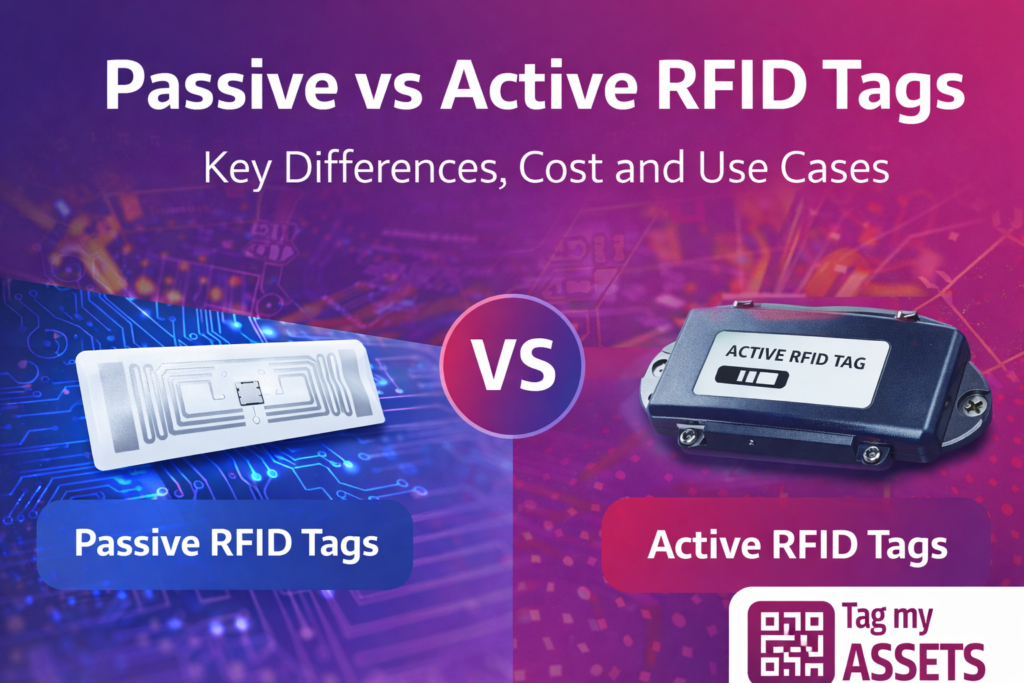
🟣 What are passive RFID tags
Passive RFID tags do not have an internal power source. They are powered by signals from the RFID reader.
Key features:
- No battery required
- Lower cost
- Shorter read range
- Long lifespan
🟣 What are active RFID tags
Active RFID tags come with an internal battery and can transmit signals independently.
Key features:
- Battery-powered
- Longer read range
- Higher cost
- Real-time tracking capability
🟣 Passive vs active RFID tags: Key differences
| Feature | Passive RFID Tags | Active RFID Tags |
|---|---|---|
| Power source | No battery | Battery powered |
| Read range | Short | Long |
| Cost | Lower | Higher |
| Maintenance | Low | Moderate |
| Use case | Asset tagging | Real-time tracking |
🟣 When should you use passive RFID tags
Use passive RFID tags when:
- Budget is limited
- Large number of assets
- Basic asset tracking required
- Long-term use without maintenance
Passive vs active RFID tags comparison helps businesses understand the advantages and limitations of each technology. Selecting the right RFID tag ensures better performance, cost efficiency, and long-term asset visibility.
For tag selection comparison, visit hard RFID tags vs soft RFID labels .
🟣 When should you use active RFID tags
Use active RFID tags when:
- Real-time tracking is needed
- Assets are high value
- Long-range tracking is required
- Movement tracking is critical
🟣 Cost comparison
Passive vs active RFID tags cost varies significantly:
- Passive tags: Low cost per unit
- Active tags: Higher cost due to battery and features
👉 Selection depends on ROI and business requirements. For industrial use cases, read RFID tags for metal assets .
Passive vs active RFID tags comparison helps organizations optimize their asset tracking strategy by balancing cost, performance, and operational efficiency.
🟣 Conclusion
Passive vs active RFID tags selection depends on your tracking needs, budget, and asset value. Choosing the right type ensures efficient asset management and better operational control. For more technical understanding, refer to RFID technology overview.
🟣 FAQ
What is the main difference between passive and active RFID tags?
Passive tags do not have a battery, while active tags are battery-powered.
Which RFID tag has longer range?
Active RFID tags have longer read range.
Are passive RFID tags cheaper?
Yes, they are more cost-effective than active tags.
Which RFID tag is better for asset tracking?
It depends on your use case and tracking requirements.
For global RFID standards and implementation guidelines, refer to GS1 RFID standards .