
Physical Asset Verification in India – Complete 2026 Guide
Looking for physical asset verification services in India?
If your Fixed Asset Register (FAR) does not match actual assets on ground, it can lead to audit risks, incorrect depreciation, and financial inaccuracies.
This guide covers the seven verification methods and where each one fits. For the full process — scope, cut-off, regulatory framework, common findings and what a verification report contains — see our complete guide to fixed asset verification.
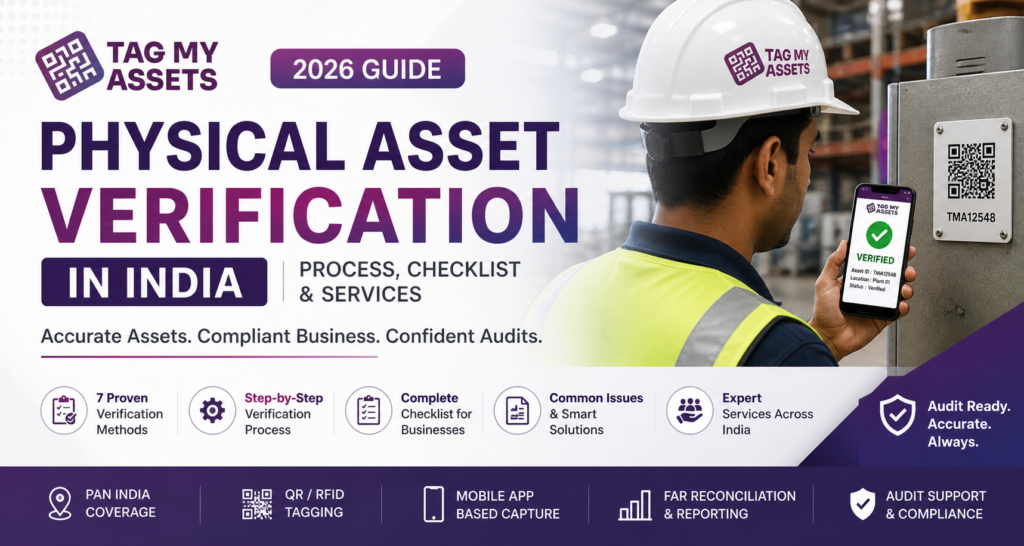
🧠 What is Physical Asset Verification?
Physical asset verification is the process of identifying, verifying, and reconciling fixed assets with the company’s FAR.
It ensures:
- Assets in books = Assets on ground
- Correct asset valuation
- Accurate depreciation
🎯 Why Physical Asset Verification is Critical in 2026
1. Audit Compliance (CARO / Companies Act)
CARO 2020 requires the auditor to report on whether management has physically verified property, plant and equipment at reasonable intervals.
2. Identifying Ghost Assets
Assets in books but not physically available.
3. Identification of Excess Assets
Assets on ground but missing in FAR.
4. Accurate Depreciation & Financial Reporting
👉 Also read:
Impact of Physical Asset Verification on Depreciation
The Seven Verification Methods and Where Each Fits
1. Floor-to-Sheet Verification
- Start from the physical asset
- Trace it back to the FAR
✔ Best for messy FAR data — tests completeness
2. Sheet-to-Floor Verification
- Start from the FAR
- Locate each asset physically
✔ Works only if FAR is clean— tests existence
3. QR Code Asset Tagging
- Unique identification
- Cost-effective
4. RFID-Based Verification
- Faster scanning
- Suitable for large-scale operations
5. Barcode-Based Tracking
- Basic but effective
6. Mobile App-Based Data Capture
- Real-time updates
- Image + location capture
7. Hybrid Verification Approach
- Combination of methods based on asset type
⚙️ Step-by-Step Asset Verification Process
Step 1: FAR Analysis
Step 2: Asset Classification
(Taggable / Non-Taggable / Countable)
Step 3: Physical Verification Execution
(Floor-to-Sheet preferred for large setups)
Step 4: Asset Tagging (QR / RFID)
Step 5: Data Capture via Mobile App
Step 6: FAR Reconciliation
Step 7: Audit-Ready Reporting
✅ Asset Verification Checklist (Must Follow)
✔ Updated FAR available
✔ Asset location mapping done
✔ Tagging feasibility checked
✔ Internal coordination ready
✔ Verification methodology decided
📊 Industries Using Physical Asset Verification
- Retail chains with multiple stores
- Manufacturing plants
- Warehouses & logistics companies
- Hospitals and laboratories
- Corporate offices
📈 Benefits of Asset Verification
- Improves asset accuracy
- Reduces audit risks
- Ensures correct depreciation
- Enhances asset tracking
- Prevents financial misstatements
🏢 Why Choose TagMyAssets
- Pan India presence
- Expertise in large-scale projects
- Mobile app-based tracking
- RFID & QR capability
- Audit-ready reporting
⚠️ Common Problems Companies Face
- Poor FAR structure
- Multiple locations
- Non-taggable assets
- Parent-child asset confusion
- No unique identification
🚀 Physical Asset Verification Services in India
TagMyAssets provides end-to-end physical asset verification services:
✔ PAN India execution
✔ QR & RFID tagging
✔ FAR reconciliation
✔ Audit support
✔ Mobile app-based tracking
Executed across 1,500+ locations
💰 Cost of Physical Asset Verification
Cost depends on:
- Asset count
- Locations
- Tagging type (QR / RFID)
- FAR complexity
👉 Typically includes:
- Manpower
- Tag cost
- Travel
- Reporting
Frequently Asked Questions
What is physical asset verification?
Physical asset verification is the process of physically locating each asset recorded in the Fixed Asset Register, confirming its condition and location, and reconciling what was found against the books. The output is a verified asset list and an exception report of the differences.How long does asset verification take?
It depends on asset count, number of locations, site access and the state of the existing register. A single-location count of a few hundred assets is a matter of days; a multi-location rollout is sequenced city-wise and planned around site availability.
RFID vs QR – which is better?
Neither is better in general. QR costs less, needs no reader hardware and suits offices, IT assets and furniture. RFID allows bulk scanning without line of sight and suits plants and warehouses with high asset volumes. Most projects use both, with the mix decided at the survey stage.
Is asset verification mandatory?
CARO 2020 requires the auditor to report whether management has physically verified Property, Plant and Equipment at reasonable intervals and whether material discrepancies were properly dealt with. The verification itself is management’s responsibility; the auditor reports on it.
📞 Ready to Fix Your FAR?
If your asset records are inaccurate or audit is approaching:
👉 Get professional physical asset verification services today
TagMyAssets delivers:
- Accurate FAR
- Audit-ready reporting
- Pan India execution