
Introduction
Many companies believe that asset tagging starts on the ground — but the reality is very different.
Asset tagging actually begins with your Fixed Asset Register (FAR).
If your FAR is incomplete, inaccurate, or outdated, your entire asset tagging project can:
- Get delayed
- Result in duplicate tagging
- Create reconciliation issues
- Fail during audits
That’s why pre-tagging data cleanup is one of the most critical steps before starting any asset tagging project.
In this guide, we explain how to prepare your FAR before asset tagging, with practical steps based on real audit experience.
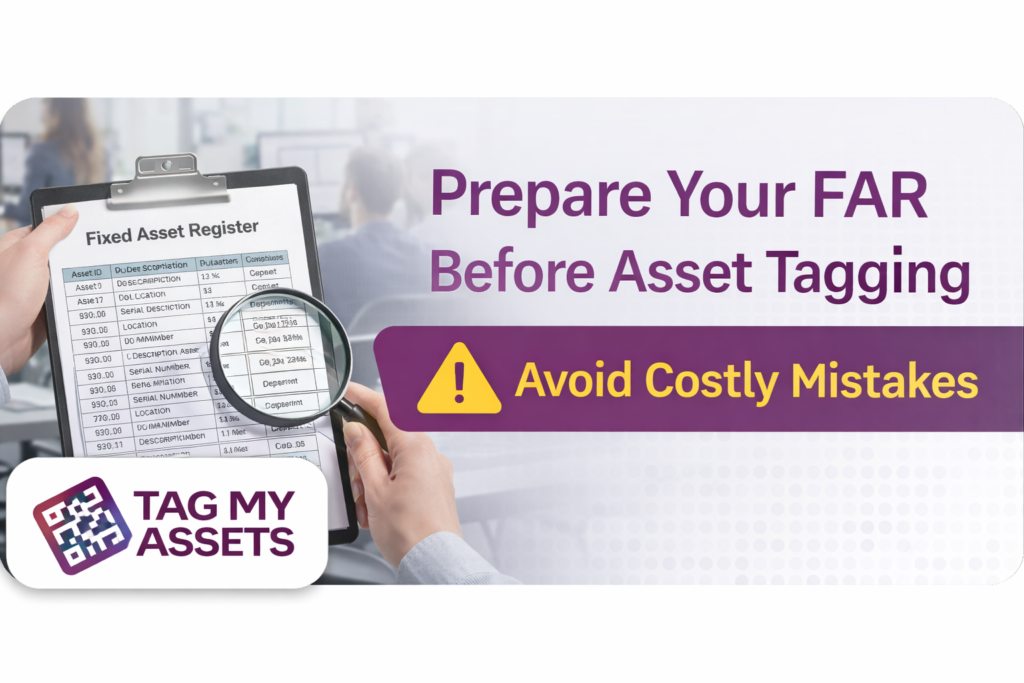
What is Pre-Tagging Data Cleanup?
Pre-tagging data cleanup is the process of reviewing, correcting, and standardizing your Fixed Asset Register (FAR) before starting physical asset tagging.
It ensures that:
- Each asset is uniquely identifiable
- Locations are accurate
- Duplicates are removed
- Data is ready for tagging and scanning
Without this step, even the best tagging team cannot deliver accurate results.
Why FAR Preparation is Critical Before Asset Tagging
Poor FAR quality leads to serious operational and audit issues:
🚨 Common Problems Without FAR Cleanup:
- Duplicate QR codes on same assets
- Missing assets during verification
- Wrong location mapping
- Confusion between countable vs taggable assets
- Delays in project execution
- Major gaps during FAR reconciliation
👉 In real projects, a large share of FAR data is incorrect or incomplete before cleanup. Many companies have not reviewed or worked on their register in ten or fifteen years, so descriptions, locations and classifications have drifted from reality over that whole period.
11 Essential Pre-Tagging Data Cleanup Steps
1. Remove Duplicate Asset Entries
Duplicate entries are the most common issue in FAR.
✔ Identify assets with:
- Same serial numbers
- Same descriptions
- Same invoice references
👉 Keep one clean record per asset.
2. Standardize Asset Naming Convention
Avoid vague names like:
- “Machine”
- “Equipment”
- “Item”
✔ Use structured naming:
- “Dell Laptop – Finance Dept”
- “CNC Machine – Plant 2”
3. Verify Asset Locations
Location mismatch is a major audit issue.
✔ Ensure each asset has:
- Plant / Branch
- Floor / Department
- Exact physical location
4. Classify Assets Properly (Taggable vs Countable)
Not all assets should be tagged.
✔ Taggable Assets:
- Machines
- Computers
- Furniture
✔ Countable Assets:
- Chairs
- Pallets
- Small tools
👉 This step alone can reduce project cost significantly.
5. Update Missing Asset Details
Ensure FAR includes:
- Asset description
- Make & model
- Serial number
- Department
- User (if applicable)
Missing data leads to confusion during tagging.
6. Clean Old / Scrapped Assets
Remove:
- Disposed assets
- Scrapped items
- Sold equipment
👉 These create false mismatches during verification.
7. Map Assets with Unique Identification Fields
Each asset should have:
- Asset ID
- Serial number
- Tag ID (to be assigned later)
This prevents duplication during tagging.
8. Align FAR with Physical Reality (Initial Review)
Before tagging starts, conduct a quick:
- Sheet-to-floor check
OR - Floor-to-sheet validation
👉 This reduces surprises during execution.
9. Group Assets by Location for Execution Planning
Organize FAR location-wise:
- Plant 1
- Plant 2
- Warehouse
- Corporate Office
This helps in:
✔ Faster tagging
✔ Better team deployment
10. Prepare Tagging Scope Clearly
Define:
- Total assets
- Taggable assets
- Countable assets
👉 Avoid overestimation (common issue in large FARs).
11. Create a Data Freeze Before Tagging Starts
Once cleanup is done:
✔ Freeze the FAR
✔ Avoid frequent changes
✔ Share final data with tagging team
👉 This ensures smooth execution and reconciliation.
What Happens If You Skip FAR Cleanup?
Skipping this step can lead to:
- ❌ Duplicate tagging
- ❌ Missing asset records
- ❌ Audit qualifications
- ❌ Cost overruns
- ❌ Delayed project timelines
In many cases, companies end up redoing the entire exercise.
How TagMyAssets Handles Pre-Tagging Data Cleanup
At TagMyAssets, we don’t just tag assets — we prepare your data for success.
✔ Our Approach:
- FAR data structuring and cleanup
- Taggable vs countable classification
- Location mapping before execution
- Mobile-based validation during tagging
- Real-time reconciliation reports
We follow:
- Sheet-to-Floor approach (when FAR exists)
- Floor-to-Sheet approach (when FAR is unreliable)
👉 This ensures audit-ready asset data.
Pro Tip (From Real Projects)
In large companies, FAR often includes:
- Pallets
- Bins
- Trolleys
- Consumables
👉 These inflate asset counts and increase tagging cost unnecessarily.
Always clean and classify before tagging.
FAQs – Pre-Tagging Data Cleanup
1. Is FAR cleanup mandatory before asset tagging?
Yes. Without cleanup, tagging results will be inaccurate and unreliable.
2. How long does FAR cleanup take?
Depends on data size, but typically:
- Small companies: 2–5 days
- Large enterprises: 1–3 weeks
3. Can asset tagging be done without FAR?
Yes, using a floor-to-sheet approach, but it requires more effort and planning.
4. What is the biggest mistake companies make?
Not differentiating between taggable and countable assets.
5. Who should handle FAR cleanup?
Ideally, a professional agency with both:
- Data expertise
- Ground execution experience
Conclusion
Asset tagging success depends heavily on how well your FAR is prepared.
A clean, structured FAR ensures:
- Faster execution
- Accurate tagging
- Smooth reconciliation
- Audit readiness
👉 Before starting your next asset tagging project, make sure your FAR is Audit ready.
Need Help with FAR Cleanup & Asset Tagging?
If you’re planning an asset tagging project, let TagMyAssets handle everything — from data cleanup to final reconciliation.
🔗 Explore our services:
- https://tagmyassets.com/fixed-asset-tagging-services/
- https://tagmyassets.com/fixed-asset-management/
- https://tagmyassets.com/inventory-verification-services/
Accounting standards for fixed assets in India”