
Why leading organisations are moving beyond RFID-only verification to a three-layer model: RFID, QR-based scanning, and human inspection
“RFID can tell you that an asset exists. Only physical verification can tell you whether that asset is useful.”
RFID asset verification has become the preferred method for organisations managing large asset bases — and for good reason. Your RFID scanner can detect 847 assets in under 40 minutes. Every tag is readable. Every asset shows up on the system. On paper, the verification is complete.
But here is a question worth asking before you sign off: that air conditioner in the third-floor server room — is it actually running? That generator at the factory gate — when was it last tested? That laptop tagged to an employee who left two years ago — where is it, really?
RFID asset verification confirmed their presence. It cannot confirm anything else.
This is one of the most important gaps in fixed asset management that organisations rarely address until an auditor raises it — or until the Fixed Asset Register becomes so unreliable that depreciation calculations, insurance claims, and capital planning decisions are all built on inaccurate data.
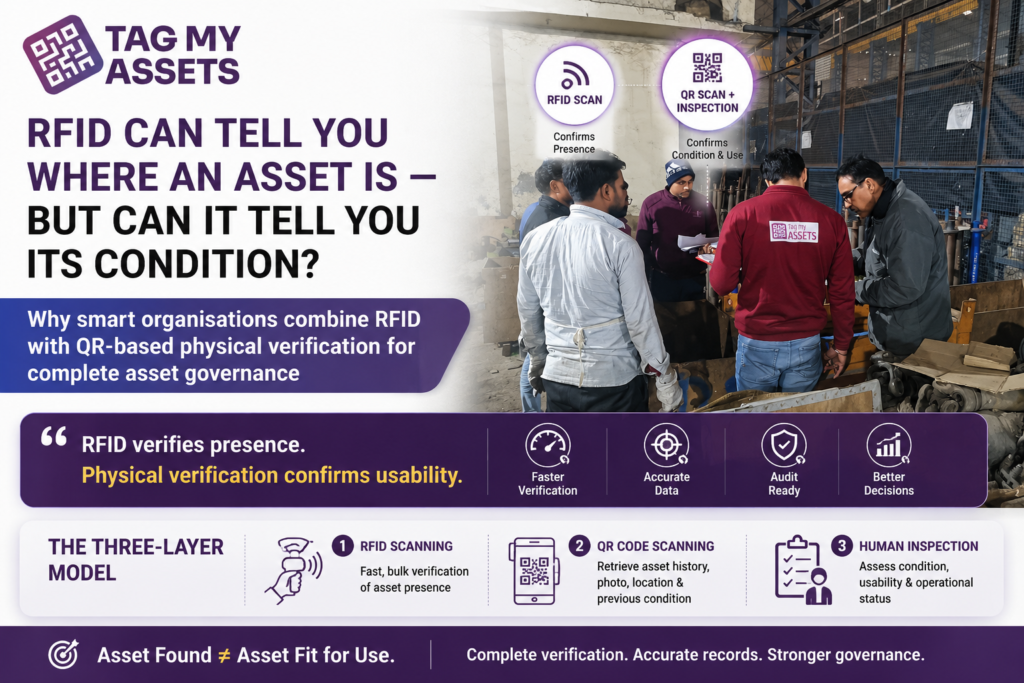
What RFID Asset Verification Does Brilliantly
There is no question that RFID asset verification technology has transformed fixed asset verification. Before RFID, a team would physically walk up to each asset, scan a barcode, and log the result — a process that could take days or weeks across a large facility.
With RFID, a single reader can detect hundreds of tagged assets within minutes, even without direct line of sight. For organisations with large asset bases spread across warehouses, production floors, or multi-storey offices, this speed is genuinely transformative.
RFID asset verification is highly effective at answering one question: Is the asset physically present at this location?
For frequent location verification cycles — monthly, half-yearly, or annual — RFID scanning is the right tool. It quickly confirms that assets have not moved unexpectedly, flags assets that are missing from their registered locations, and keeps location data current in the Fixed Asset Register without requiring a full physical exercise every time.
This is exactly how RFID asset verification should be used — as a rapid, high-frequency presence check.
The Blind Spot: What RFID Cannot Tell You
RFID asset verification detects a tag. It does not inspect an asset.
When the reader picks up a signal from an asset tag, the system records: asset found, location confirmed. What it cannot record is any of the following:
- Is the asset functional or broken?
- Is it currently in use or sitting idle for months?
- Is it under repair, partially dismantled, or awaiting disposal?
- Has it deteriorated to the point where it should be written off?
- Is it a ghost asset — physically present but practically worthless?
A tagged air conditioner that has not cooled a room in years is still an asset on your books. A generator that failed during the last power outage and was never repaired still shows up in every RFID scan. A machine that is partially dismantled for spare parts appears as a complete, verified asset.
This is not a flaw in RFID. It is simply a limitation that organisations need to plan for — and one that has direct consequences under CARO 2020, which requires companies to confirm that fixed assets have been physically verified and that any material discrepancies have been properly addressed. A verification exercise that only confirms presence is not sufficient for that level of assurance.
From the Field: What RFID Misses
During a recent fixed asset verification assignment, our team conducted an RFID scan across a large commercial facility. The scan confirmed the presence of several air-conditioning units across multiple floors — all tags readable, all locations matching the register.
However, when the physical inspection team followed up, they found that a number of those units were non-functional and had been awaiting replacement for over a year. Maintenance had tagged them as out-of-service internally, but the Fixed Asset Register had not been updated. The assets were still being depreciated at full value.
Had the organisation relied solely on RFID verification, these assets would have continued to appear as active, functional assets on the books — affecting depreciation accuracy, insurance valuation, and capital planning.
This is the gap that physical verification closes.
The Three Questions Every Verification Must Answer
A complete fixed asset verification exercise must answer three distinct questions:
1. Is the asset physically present? RFID handles this efficiently and at scale.
2. What is the current condition of the asset? This requires human judgement and physical inspection — RFID alone cannot answer this.
3. Is the asset actively being used by the organisation? Again, this requires a trained verifier to assess utilisation, not just confirm presence.
Most organisations using RFID asset verification alone are only answering the first question. The second and third require a fundamentally different approach.
Technology Can Detect Assets. People Assess Assets.
This is the principle that separates a presence audit from a genuine asset governance exercise.
Consider a generator at a manufacturing plant:
- RFID detects the asset tag and confirms its registered location.
- QR code scanning retrieves the asset’s full history — purchase date, last verification, previous condition rating, maintenance remarks.
- The verifier physically inspects the generator, starts it if possible, checks for visible damage or deterioration, and records the current condition.
No technology, however sophisticated, can replace that final step. The verifier brings contextual judgement that a scanner cannot — the ability to distinguish between an asset that is present and one that is genuinely fit for use.
This three-layer model — RFID for speed, QR for data retrieval and documentation, human inspection for condition assessment — is the foundation of effective asset governance.
The Right Model: RFID + QR Code + Human Inspection
The most effective asset verification methodology combines all three layers — and it starts at the point of tagging.
When an asset is tagged, it receives both an RFID tag and a QR code. This is not redundancy. Each serves a different function in the verification lifecycle.
At the time of tagging, the QR code is scanned using TagMyAssets’s verification software. This scan captures:
- A photograph of the asset at its installed location
- GPS coordinates confirming the exact location
- Asset condition at the time of tagging
- Any remarks from the verification team
This creates a verified baseline record — not just a database entry, but a documented, time-stamped, location-confirmed record of the asset as it actually exists on day one.
For ongoing location verification, RFID scanning handles the frequent cycles. Regular RFID scans quickly confirm that assets are where they should be and flag any that have moved or gone missing.
For condition-based verification, the frequency should be determined by the organisation’s risk profile, asset criticality, and audit requirements — not a fixed universal schedule. High-value or operationally critical assets may need condition assessment more frequently. Lower-risk assets may follow a longer cycle. The key is that condition verification is planned, documented, and not left entirely to RFID presence checks.
Understanding Asset Condition Ratings
One of the most practical outputs of a physical verification exercise is a standardised condition rating for each asset. This gives finance teams, auditors, and management a clear, consistent basis for depreciation reviews, write-off decisions, and capital planning.
A typical condition classification used in professional verification exercises:
| Condition Rating | Meaning |
|---|---|
| Excellent | Fully operational, no visible wear, performing as intended |
| Good | Operational with normal wear; no immediate action required |
| Average | Functional but showing signs of deterioration; requires monitoring |
| Poor | Significant deterioration; requires repair or early replacement planning |
| Non-Functional | Not usable in current state; awaiting repair or disposal |
| Obsolete | Physically present but no longer required or relevant to operations |
These ratings, captured at the point of QR scan and verified by the inspection team, feed directly into the Fixed Asset Register — giving organisations a live, condition-aware asset record rather than a static list of tag detections.
What This Looks Like in Practice
| Verification Layer | Method | Frequency | What It Captures |
|---|---|---|---|
| Presence check | RFID scanning | Frequent — monthly, half-yearly, or annual | Location, tag readability |
| Condition and documentation | QR code scan + verifier assessment | Based on risk profile and asset criticality | Image, GPS, condition rating, usage status, remarks |
| Initial baseline | QR scan at time of tagging | One-time at tagging | Photograph, coordinates, opening condition |
The frequency of QR-based physical verification is not a fixed rule — it should reflect what the organisation’s assets actually need. What matters is that condition assessment is treated as a structured, recurring activity rather than something that happens only when RFID throws up a discrepancy.
The Financial and Compliance Consequences of Getting This Wrong
Organisations that rely on RFID alone for fixed asset verification face risks that go well beyond an audit observation.
Inaccurate depreciation: Assets that are non-functional or obsolete continue to be depreciated, distorting financial statements under Ind AS 16 and Schedule II of the Companies Act 2013.
Ghost assets on the books: Assets that exist on paper but not in usable form inflate the gross block, affecting net worth, loan covenants, and investor reporting.
Poor capital allocation: If leadership cannot distinguish between assets that are available and assets that are operational, capital investment decisions are made on incomplete information.
CARO 2020 exposure: Statutory auditors are required to report on whether fixed assets have been physically verified by management at reasonable intervals, and whether material discrepancies have been properly dealt with. RFID presence data alone does not constitute physical verification in the spirit of this requirement.
“Asset Found” Is Not the Same as “Asset Fit for Use”
“An asset detected by RFID is not necessarily an asset fit for use.”
This is the most important distinction in fixed asset management — and the one that separates organisations with genuine asset governance from those with asset tracking that only looks complete.
RFID asset verification tells you the asset is there. It takes a trained verifier — supported by QR-based scanning software that captures image, location, and condition — to tell you what the asset is actually worth to the organisation today.
The goal of fixed asset verification is not to confirm the existence of tags. It is to give management and auditors an accurate, defensible picture of what the organisation owns, where it is, what condition it is in, and whether it is being used.
Technology makes verification faster and more systematic. But asset governance still requires human judgement at its core — and always will.
TagMyAssets provides end-to-end fixed asset verification services across India, combining RFID asset verification technology with QR-based physical inspection and trained field teams to deliver complete, audit-ready asset records. Whether you are planning a verification exercise, approaching a statutory audit, or looking to clean up your Fixed Asset Register, contact our team to understand the right approach for your organisation.