
When to invest in asset tagging is a critical decision for CFOs looking to improve asset control and reduce costs. Many companies delay asset tagging because they see it as a cost center rather than a strategic investment.
But the real question is not “Should we do asset tagging?”
👉 It is “When is the RIGHT time to invest in asset tagging?”
This guide provides a CFO-level decision framework to help you identify the right timing based on business signals, financial impact, and operational gaps.
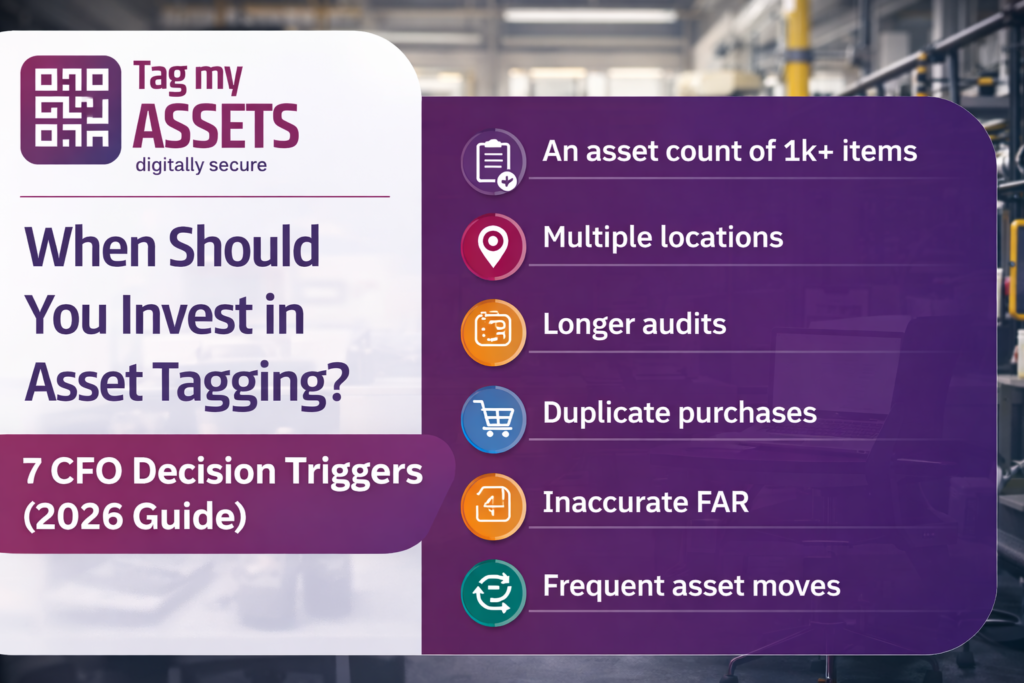
Why Knowing When to Invest in Asset Tagging Matters
Investing too late leads to:
- uncontrolled asset losses
- duplicate purchases
- inaccurate Fixed Asset Register (FAR)
- longer audit cycles
- poor asset utilization
Investing at the right time ensures:
- strong asset control
- audit readiness
- cost savings
- better capital allocation
7 CFO-Level Decision Triggers for Asset Tagging
1. When Asset Count Crosses 1,000–2,000 Items
If your company has:
- IT assets (laptops, desktops, printers)
- plant & machinery
- furniture & fixtures
- tools & equipment
👉 Manual tracking becomes unreliable.
Why this matters:
Beyond this scale, Excel-based tracking starts failing.
Decision Signal:
If your team struggles to locate assets quickly → you need tagging
This guide explains when to invest in asset tagging based on real business scenarios and financial signals.
2. When You Operate Across Multiple Locations
Companies with:
- multiple plants
- warehouses
- retail stores
- offices across cities
face a major challenge:
👉 Asset visibility across locations
Common issues:
- assets shown in one location but physically elsewhere
- no tracking of inter-location transfers
- duplication of assets
Decision Signal:
If you cannot answer “Where is this asset right now?” → invest in tagging
Understanding when to invest in asset tagging helps companies avoid losses and improve efficiency.
3. When Audit Time Is Increasing Every Year
If your audit team:
- spends weeks identifying assets
- depends on manual lists
- struggles with mismatches
👉 your asset control system is weak
Impact:
- higher audit cost
- operational disruption
- delayed financial closure
Decision Signal:
If audits are taking longer than expected → tagging will reduce effort by 40–60%
If you are unsure when to invest in asset tagging, these decision triggers will guide you.
4. When Duplicate Purchases Are Happening
One of the biggest hidden losses:
👉 Buying assets that already exist
Why it happens:
- no centralized visibility
- no asset tracking
- poor department-level control
Example:
- laptops purchased while idle ones exist
- tools reordered unnecessarily
- furniture duplicated
Decision Signal:
If procurement is happening without asset visibility → tagging is required
5. When FAR Is Inaccurate or Unreliable
If your Fixed Asset Register has:
- duplicate descriptions
- missing assets
- outdated records
- incorrect locations
👉 financial reporting risk increases
Impact:
- audit observations
- incorrect depreciation
- compliance issues
Decision Signal:
If FAR cannot be trusted → asset tagging + verification is necessary
6. When Asset Movement Is Frequent
Industries like:
- manufacturing
- logistics
- retail
- hospitals
have constant asset movement.
Challenges:
- assets shifted without record
- no tracking of custodian
- loss of accountability
Decision Signal:
If assets move frequently → tagging ensures control and traceability
7. When You Are Planning Expansion or ERP Implementation
Before:
- opening new plants
- expanding operations
- implementing ERP systems
👉 asset data must be clean and structured
Why this matters:
Garbage data in ERP = long-term inefficiency
Decision Signal:
If you are scaling → tagging should be done BEFORE expansion
Bonus: Financial Signals That Indicate Immediate Need
CFOs should act immediately if:
- unexplained asset differences appear in audit
- insurance claims become difficult
- asset write-offs increase
- capex budget is rising without clarity
- asset verification is pending for years
How to Decide: Quick CFO Checklist
Ask these 5 questions:
- Can we locate any asset within 2 minutes?
- Is our FAR 100% accurate?
- Are audits smooth and fast?
- Do we avoid duplicate purchases?
- Do we have visibility across locations?
👉 If 3 or more answers are NO → invest in asset tagging now
About TagMyAssets
At TagMyAssets, we help organizations across India implement structured asset tagging, physical verification, and FAR reconciliation using our mobile-based QR system. Our approach focuses on improving asset visibility, audit efficiency, and financial control across multiple locations. We combine on-ground expertise with technology to deliver accurate, audit-ready asset data.
What Happens If You Delay Asset Tagging
Delays lead to:
- higher long-term cost
- asset leakage
- poor decision-making
- audit inefficiencies
- loss of control
👉 The cost of NOT doing asset tagging is always higher.
Conclusion
Asset tagging is not a one-time activity — it is a control system for managing business assets.
The right time to invest is when:
- your asset base grows
- visibility reduces
- audits become complex
- financial control weakens
Companies that invest early gain:
- better control
- lower costs
- faster audits
- stronger financial discipline
As per global asset management practices defined in asset management standards
FAQs
1. What is the right time to implement asset tagging?
When asset count increases, audits become complex, or asset visibility reduces.
2. Is asset tagging necessary for small companies?
Not always. But once assets scale beyond manageable levels, it becomes essential.
3. Does asset tagging reduce cost?
Yes, by preventing duplicate purchases and improving utilization.
4. How long does asset tagging take?
Depends on asset count and locations, but typically a few weeks for mid-sized companies.
5. Can asset tagging be integrated with ERP?
Yes, tagging improves data quality and supports ERP implementation.
