
RFID tagging is a wireless technology that uses radio waves to identify and track assets without requiring line-of-sight scanning. Unlike barcodes, an RFID reader can capture multiple tags at once, which makes it a strong fit for high-volume, bulk-scanning environments.
At TagMyAssets, we help organisations across India adopt RFID-based tagging and verification that produces the evidence base statutory audit actually requires, alongside accurate, reconciled asset records.
What Is RFID Tagging for Asset and Inventory Management?
RFID uses radio waves to identify and manage assets automatically. Because it doesn’t require line-of-sight scanning, it’s faster and more reliable than barcodes for bulk operations. The system has three core components: a software platform that stores and analyses data, an RFID tag attached to each asset, and an RFID reader that scans multiple tags at once without physical contact.
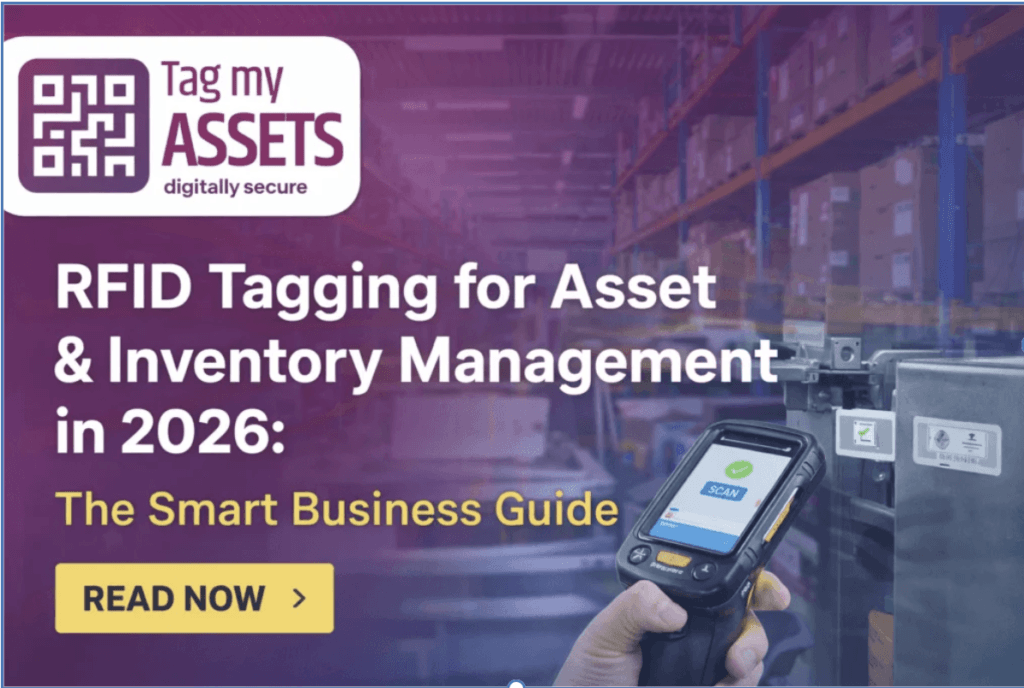
How RFID Asset Tagging Works
- Strategic installation — tags are affixed to assets ranging from heavy machinery and IT servers to office furniture and logistics pallets.
- Digital mapping — each unique tag ID is linked to asset code, location, department, warranty and AMC details.
- Automated scanning — readers capture data without needing to physically locate or handle each asset individually.
- Cloud sync — captured data flows into a central dashboard for monitoring and reporting.
RFID vs QR Code vs Barcode
| Feature | RFID | QR code | Barcode |
|---|---|---|---|
| Line of sight required | No | Yes | Yes |
| Bulk scanning | Yes, multiple tags at once | One at a time | One at a time |
| Typical durability | Higher, including on-metal options | Moderate | Lower |
| Setup and tag cost | Higher per tag | Lower per tag | Lowest per tag |
QR codes work well for low-volume, easily-accessible assets. RFID earns its higher tag cost where line-of-sight scanning genuinely is the bottleneck — dense racking, high asset volumes, or enclosures where reading tags one at a time isn’t practical.
What RFID Actually Changes
Bulk scanning without line of sight means physical verification of a large asset base takes meaningfully less time than a barcode or manual count, since one reader pass can capture many tags rather than one team member locating and scanning each one individually. This gives clearer, more current asset location visibility, reducing the odds of assets going untracked or moved without a record. Automated capture also removes a layer of manual data-entry error compared with paper-based counts. And RFID’s tamper-resistant, automated logging supports the kind of audit trail that CARO 2020 and statutory audit work draws on, without claiming to change the audit requirement itself — that responsibility remains management’s.
Industry Applications
- Manufacturing — tool tracking and work-in-progress monitoring.
- Corporate and IT — laptops, servers and furniture tracked across multiple offices.
- Logistics — bin-level tracking and stock reconciliation.
Why Choose TagMyAssets
We handle end-to-end execution, from site survey to final handover, and work alongside your existing ERP (SAP, Oracle, Tally and others) rather than replacing it. We provide PAN-India coverage and specialise in on-metal tags for environments where standard RFID tags read poorly due to metallic interference.
Cost and Payback
Passive RFID tags typically run ₹10–200 per tag depending on type, with on-metal and specialised tags at the upper end. Passive tags carry no battery and can last many years, which is why the tag itself is usually a one-time cost rather than a recurring one. Payback depends heavily on asset volume, labour cost, and how much manual counting or loss the current process involves — there’s no single timeline that applies across every organisation, so we work this out with each client against their actual numbers rather than quoting a general figure. For the full tag and project cost build-up, see our RFID tagging cost in India guide.
Common Implementation Challenges
Hardware interference. Metal and liquids can interfere with radio waves. We use specialised on-metal tags and test read accuracy in the actual environment before rollout, rather than assuming standard tags will perform.
Integration with existing systems. Connecting RFID data with an established ERP can be complex. We deliver data as structured files formatted for upload, handled by your team or your ERP vendor.
Tag durability. Assets in harsh environments — construction, chemical plants, outdoor installations — need tags rated for extreme temperature, moisture or chemical exposure, selected for the specific site rather than a generic default.
Best Practices for Tag Placement
- Update the asset record immediately when an item moves, so the register stays a reliable source of truth rather than drifting from physical reality.
- Position tags to face the expected reader path where possible, for consistent signal reception.
- Test the actual read range for each asset type during the pilot phase rather than assuming a standard range applies everywhere.
Frequently Asked Questions
Is RFID too expensive for mid-sized firms?
Tag costs range from ₹10–200 depending on type. Whether the investment pays for itself in labour savings and loss prevention depends on your asset volume and current process — that’s worth working out against your own numbers rather than assuming a fixed answer.
How long do the tags last?
Passive RFID tags have no battery and typically last many years, making them a one-time cost for most assets rather than a recurring one.
Can it integrate with our mobile app or existing tracking system?
Verification data is delivered as structured files for upload into your accounting or ERP system, handled by your team or ERP vendor.
Get in touch: Call +91 96500 03293 or email connect@tagmyassets.com.