
Asset tagging for educational institutions begins with a problem of scale. A single school campus can hold several thousand identifiable assets — desktops and laptops, smart boards and projectors, laboratory instruments, library systems, networking equipment, and classroom and office furniture.
Assets move constantly. Projectors shift between classrooms, computers are reassigned, laboratory equipment is relocated for practical sessions. Most of those movements never reach the asset register. What remains is a record of what the institution bought, not what it currently holds or where.
Asset tagging is what closes that gap. Every item gets a unique physical identity, mapped to a line in the register, so it can be identified on sight, traced to its recorded location, and reconciled during verification.
TagMyAssets has completed 395+ projects across 1,500+ locations in India, covering 10 lakh+ assets tagged.
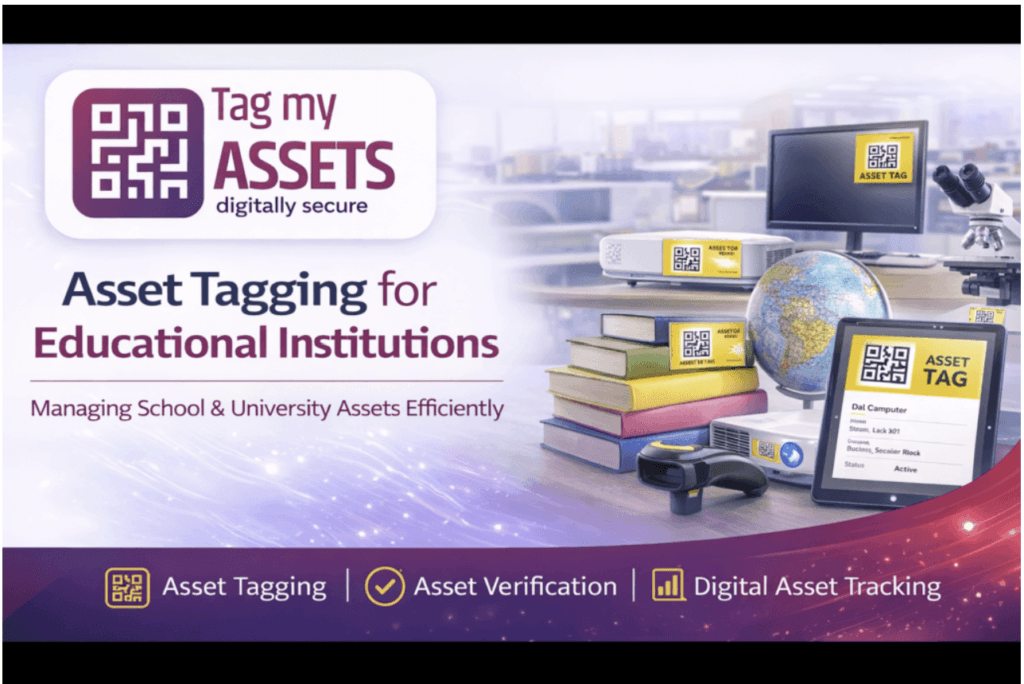
What Asset Tagging for Educational Institutions Involves
Asset tagging is the process of affixing a unique identification tag to each asset and linking that tag to a specific line in the institution’s asset register.
Institutions typically use:
- QR code tags — the common choice for classroom and IT equipment. Scannable on any smartphone, and able to carry more data than a barcode of the same size. See how QR and barcode based asset tagging works in practice.
- Barcode labels — suited to furniture, library systems and equipment that stays in one room.
- RFID tags — used where items circulate constantly, or where close-range scanning is impractical.
Scanning the tag brings up the asset record, which typically holds:
- Asset ID
- Asset description
- Serial number
- Department, room or campus
- Purchase details
- Condition at last verification
No separate hardware is needed for QR or barcode — a standard smartphone is enough. RFID is the exception, and needs a reader.
What Educational Institutions Typically Tag
Coverage usually runs across five groups:
IT and teaching equipment — desktops, laptops, tablets, smart boards, projectors, printers and scanners.
Laboratory instruments — science and computer laboratory equipment, including items on annual calibration cycles.
Library assets — issue systems, reading room equipment and digital resource terminals.
Networking and facility equipment — switches, routers, servers, UPS units, generators and security systems.
Furniture and administrative equipment — classroom, hostel, staff room and office furniture.
Why Institutional Asset Records Have to Hold Up
Educational institutions are not covered by CARO 2020. Schools and colleges are generally run as societies, public trusts or Section 8 companies rather than ordinary companies, and government schools sit under state financial rules altogether.
The underlying obligation does not change with registration type. Every institution is required to maintain proper books of account, and every institution holds assets that someone else’s money paid for — a grant, a fee, a donation, a state budget line. There is always a stakeholder entitled to ask where those assets are.
Who asks differs. It might be the funding department seeking utilisation certification, trustees reviewing the annual accounts, an accreditation peer team documenting laboratory and library facilities, or the Accountant General on a departmental audit.
The question they ask is the same one, and it is not answerable from a spreadsheet: does this line in the register correspond to something that physically exists, in the location recorded against it? An asset register that cannot be tied to identifiable items on the ground does not survive that question — whichever stakeholder is asking.
How Asset Tagging Runs on a Campus
Step 1 — Register review
The existing asset register is reviewed before any field work. Duplicate entries, bulk lines covering many physical items, and incomplete descriptions are identified first, so tagging is applied to a clean base rather than an inherited one.
tSep 2 — Asset classification
Not every line in a fixed asset register can be physically tagged. Assets are classified into three groups before field work:
Taggable — individually identifiable assets that can physically carry a tag. Most of the register.
Countable — items verified by count rather than individually tagged, where tagging each unit is impractical or units are not individually distinguishable.
Non-auditable — register lines with no physically verifiable form: civil structures, electrical wiring and installations, software licences and other intangibles. These cannot be tagged or counted and are mapped notionally instead.
Identifying the non-auditable portion up front is what stops the reconciliation appearing to show a shortfall when those items were never physically verifiable in the first place.
Step 3 — Physical verification
Each asset is physically located and its existence, room and condition confirmed. See physical verification of assets for how this stage runs.
Step 4 — Tagging
QR, barcode or RFID tags are affixed and mapped to the corresponding register line. Tag material is chosen per asset type — laboratory surfaces, hostel furniture and IT equipment do not hold the same label.
Step 5 — Data capture
Asset ID, description, serial number, room, campus and condition are captured on site, along with a photograph.
Step 6 — Register reconciliation
Field findings are matched line by line against the register. Items in the books with nothing behind them, items on site that were never recorded, and location mismatches are classified and documented in a report the auditor or the management committee can work from.
What Tagging Changes in Practice
Equipment becomes locatable. A tagged item can be matched to its recorded room rather than found by asking three departments.
The register becomes reconcilable. Each tag maps to a register line, so discrepancies are classified rather than estimated.
Verification stops restarting. Without unique tags, every cycle repeats the same matching problem — vague register descriptions mapped by hand to physical items. Tags turn it into a scan.
Idle equipment surfaces. Working items sitting unused in a store room tend to appear during verification, which sometimes avoids a repeat purchase from the same budget head.
Best Practices for Campus Asset Tagging
Verify before you tag. Establish what actually exists across departments first. Tagging a register you have not tested only preserves its errors.
Break down bulk entries. “Classroom furniture — one lot” cannot be verified. Bulk lines need splitting into taggable units before field work starts.
Number by location, not just by type. A scheme that encodes campus, block and room makes the following year’s verification navigable.
Match tag material to the surface. Laboratory benches, hostel furniture and IT casings each behave differently with adhesive labels.
Schedule around the academic calendar. Access to classrooms, labs and hostels is far easier outside teaching hours, and field work is quicker when rooms are empty.
Brief the department heads. Tags only stay useful if staff record movements. A short walkthrough per department is usually enough.
Verify at regular intervals. Periodic verification keeps the register current and gives whoever is asking a documented programme to look at.
How TagMyAssets Works with Educational Institutions
Asset tagging for educational institutions is field work, not software. Our role is the on-ground layer: tagging, physical verification and register reconciliation. We do not supply or replace your ERP, accounting package or student information system — we produce the physical evidence base they should be reconciled against.
What a campus engagement covers:
- Pan-India field execution teams
- Physical verification of assets across departments, blocks and campuses, before tagging
- QR code, barcode or RFID tagging matched to asset type and surface
- Bulk-entry breakdown and register cleanup
- Asset data capture with photographic record
- Reconciliation report with variances classified for management review
Learn more about our fixed asset tagging services.
Conclusion
Campus assets move, and registers do not follow them on their own.That is the gap asset tagging for educational institutions is there to close.. Tagging gives every item an identity that survives between verification cycles, so the register can be reconciled against what is actually in the rooms, discrepancies can be classified rather than guessed at, and the institution can answer the question its stakeholders eventually ask.
Timelines depend on asset volume and the number of campuses involved — we confirm a schedule after reviewing your register.
FAQs
What is asset tagging for educational institutions?
It is the process of affixing a unique identification tag — QR code, barcode or RFID — to each institutional asset and linking it to a specific line in the asset register.
Do schools need physical verification of assets?
Schools are not covered by CARO 2020, but every institution is required to maintain proper books of account and remains accountable to grant departments, trustees, accreditation bodies or government auditors for the assets it holds. Verification is how the register is tied to what physically exists.
Which assets can be tagged in an educational institution?
Computers and laptops, smart boards and projectors, laboratory instruments, library systems, networking and facility equipment, and classroom, hostel and office furniture.
Can schools use QR codes instead of RFID?
For most campus assets, yes. QR tags cost less, scan on any smartphone, and suit equipment that stays in a known room. RFID earns its cost where items circulate constantly or where scanning each tag individually is impractical. Many institutions tag the bulk of assets with QR and use RFID only for a small high-movement group.
How long does a campus asset tagging project take?
It depends on asset volume, the number of blocks and campuses, and the state of the existing register. Bulk entries that need breaking down add time at the start.
When is the best time to verify campus assets?
Outside teaching hours. Access to classrooms, laboratories and hostels is easier and field work moves faster when rooms are empty.