
Why Companies Still Fail Fixed Asset Audits (Even With an ERP)
Most finance teams assume their ERP system keeps asset records accurate. After all, every purchase is logged, every depreciation entry is posted, and every location is mapped in the system.
Then the auditors arrive.
Suddenly, assets listed in the system are nowhere to be found. Assets sitting on the shop floor don’t appear in any record. Locations are wrong. Classifications don’t match. What looked like clean data turns out to be a gap between what the system says and what actually exists.
This is the core problem: ERP records what was entered. Asset tagging verifies what is actually there.
No matter how well-configured your ERP is, it cannot physically confirm that an asset exists, is in the right location, or is still in use. That requires a separate process — and most companies skip it until an audit forces the issue.
This article breaks down why that gap exists, what it costs, and how to close it.
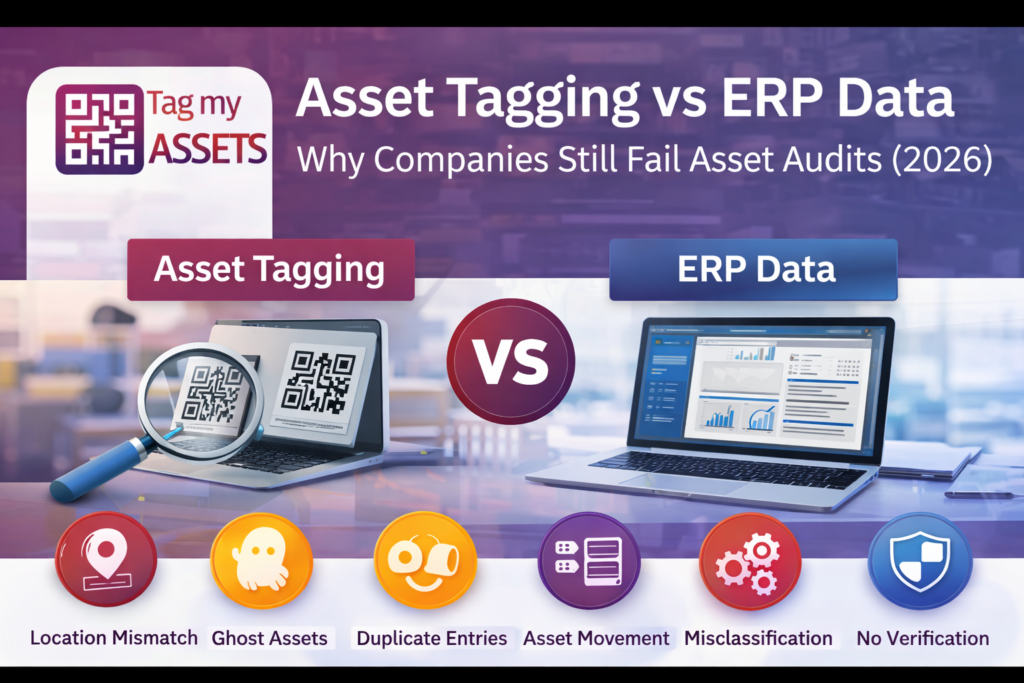
The gap between asset tagging vs ERP data creates major audit challenges for companies.
Companies must address asset tagging vs ERP data differences to avoid financial risks.
What Is ERP-Based Asset Management?
ERP systems store:
- asset master data
- purchase records
- depreciation details
- location mapping (in theory)
👉 But ERP is only as accurate as the data entered into it.
What Is Asset Tagging and Physical Verification?
Asset tagging involves:
- physically identifying assets
- assigning QR/barcode tags
- mapping location and department
- verifying existence
👉 It connects records with reality
Asset Tagging vs ERP Data: Why Software Alone Is Not Enough
Many companies underestimate the impact of Asset Tagging vs ERP Data mismatches until a statutory audit or physical verification exercise is conducted.
Understanding Asset Tagging vs ERP Data differences helps organizations improve asset accuracy and FAR reliability.
The Asset Tagging vs ERP Data gap becomes even more visible during ERP migration projects and fixed asset audits.
Reducing Asset Tagging vs ERP Data discrepancies should be a key objective of every asset management program.
ERP and Asset Tagging: Two Different Things Doing Two Different Jobs
A common misconception is that ERP asset management and physical asset tagging are alternatives — that a good ERP makes tagging unnecessary. They are not alternatives. They serve fundamentally different purposes.
ERP manages records. Asset tagging validates reality.
Your ERP captures purchase orders, depreciation schedules, asset codes, and location assignments. It is excellent at what it does — organizing financial and operational data in one place. But it has one critical limitation: it only knows what someone told it. Every entry depends on a human updating the system accurately and on time. When that doesn’t happen — and in large organizations, it often doesn’t — the records drift away from reality.
Asset tagging works the other way around. Instead of starting with a system entry, it starts with the physical asset. Each asset gets a unique QR code or barcode tag. That tag is scanned to confirm the asset exists, record its exact location, identify its custodian, and link it back to the system record. The verification flows from the ground up, not from the system down.
| ERP Data | Asset Tagging | |
|---|---|---|
| Starting point | System entry | Physical asset |
| Depends on | Accurate data input | On-ground verification |
| Reflects | What was recorded | What actually exists |
| Updates | When someone enters data | When assets are scanned |
| Audit role | Provides the record | Confirms the record |
The gap between these two is where audit problems live. An asset can appear perfectly in your ERP — correct description, correct location, correct value — and simply not exist on the ground. Without tagging, no one knows until an auditor asks to see it.
Used together, ERP and asset tagging create a closed loop: the system holds the record, the tag confirms the reality, and any mismatch is flagged before it becomes an audit observation.
👉 ERP shows what should exist
👉 Asset tagging shows what actually exists
7 Reasons Companies Fail Fixed Asset Audits
1. ERP Updates Lag Behind Physical Reality
Assets get transferred, relocated, and reassigned constantly. But ERP entries often happen days or weeks later — if at all. By audit time, the system shows an asset in Mumbai when it moved to Pune six months ago. Location mismatches are one of the most common audit observations, and delayed data entry is almost always the root cause.
2. Ghost Assets Stay on the Books
Without periodic physical verification, assets that are lost, scrapped, or stolen remain capitalized in the system. These ghost assets inflate your Fixed Asset Register, distort depreciation calculations, and raise immediate red flags during statutory audits.
3. Duplicate and Incorrect Entries Accumulate Over Time
The same asset gets entered twice during a system migration. A description is copied incorrectly. Two assets are merged into one record. These errors seem minor individually but create serious reconciliation problems at scale — especially in organizations with thousands of assets across multiple locations.
4. Asset Movement Goes Untracked
Assets move between departments, plants, and sites regularly. Without a tagging system that records each transfer, there is no reliable trail. The ERP may show the original location indefinitely, making it impossible to trace where an asset actually is during an audit.
5. Similar Assets Get Mixed Up
ERP identifies assets by codes and descriptions. On the ground, assets often look identical — same model, same specifications, different asset IDs. Without physical tags, auditors cannot confirm which specific asset they are looking at, leading to incorrect mapping and mismatched records.
6. FAR and ERP Records Are Never Reconciled
Many organizations treat the Fixed Asset Register and ERP asset data as separate documents that are rarely compared. Over time, additions, disposals, and reclassifications in one system are not reflected in the other. By audit time, the two records can be significantly out of sync.
7. Teams Trust the System Too Much
The most common mistake is assuming that if an asset is in the ERP, it must exist. ERP is a recording system — it captures what was entered, not what is physically present. Relying on system data without periodic ground-level verification is what turns small data errors into major audit failures.
Real Audit Scenario
During audits, companies often face:
- assets in ERP but not physically available
- assets on ground but not in ERP
- location mismatches
- incorrect asset classification
👉 These lead to audit observations and delays
Why ERP Alone Is Not Enough
ERP lacks:
- physical validation
- real-time tracking
- asset-level identification
👉 Without asset tagging, ERP becomes incomplete
How Asset Tagging Solves This Problem
Asset tagging ensures:
- every asset is physically verified
- QR/barcode links asset to system
- location and custodian mapping
- real-time traceability
👉 It bridges the gap between ERP and reality
Why Asset Management Software Alone Does Not Solve Asset Control Problems
Many organizations invest in asset management software expecting it to automatically provide accurate asset records and audit-ready data.
However, software implementation is only one part of the process.
Most asset management software vendors are technology companies that focus on software deployment, user training, and system configuration. While the software may be implemented successfully, the underlying asset data often remains inaccurate.
Common challenges faced after software implementation include:
• Assets physically available but not recorded in the system
• Assets recorded in the software but not found during verification
• Duplicate asset records
• Incorrect asset locations
• Missing asset tags
• Incomplete Fixed Asset Register (FAR)
• Unreconciled asset additions and disposals
As a result, companies may have a fully operational asset management system but still face audit observations, reconciliation issues, and inaccurate asset records.
A successful asset management software implementation requires:
- Physical Verification of Assets
- Asset Tagging (QR Code, Barcode, or RFID)
- FAR Cleaning and Standardization
- Asset-to-System Mapping
- FAR Reconciliation
- Location Mapping
- Audit-Ready Documentation
This is where firms specializing in asset verification and FAR reconciliation play a critical role.
At TagMyAssets, we help organizations bridge the gap between software implementation and actual asset control by combining technology with physical verification, asset tagging, and reconciliation expertise. The result is an accurate, audit-ready asset database that can be effectively managed through any asset management software platform.
Cost of ERP Data Errors During Asset Audits
The financial impact of inaccurate ERP asset records can be significant.
Common consequences include:
- Audit qualifications and management observations
- Incorrect depreciation calculations
- Duplicate capitalisation of assets
- Ghost assets remaining in books
- Insurance claim complications
- Asset losses going unnoticed
- Increased audit time and professional costs
For large organizations with multiple locations, even a small percentage of inaccurate asset records can result in substantial financial exposure. Regular asset tagging and physical verification help minimize these risks.
ERP Migration Projects and Asset Data Challenges
Many organizations discover asset data issues during ERP migration projects.
When moving from one ERP system to another, historical asset records are transferred into the new system. If the old data contains errors, those errors are also carried forward.
Common issues identified during ERP migration include:
- Duplicate asset records
- Missing asset descriptions
- Incorrect locations
- Wrong asset categories
- Assets physically unavailable but still capitalized
Conducting asset tagging and FAR reconciliation before ERP migration significantly improves data quality and reduces implementation risks.
Best Practice: Combine ERP + Asset Tagging
The right approach:
👉 ERP for records
👉 Asset tagging for verification
Together they provide:
- accurate asset data
- audit readiness
- better control
- improved financial reporting
About TagMyAssets
At TagMyAssets, we help companies bridge the gap between ERP data and physical assets through structured asset tagging, verification, and FAR reconciliation. Our approach ensures audit-ready asset records and complete asset visibility across locations.
Conclusion Asset Tagging vs ERP Data
The Gap Is Fixable — But Only If You Acknowledge It
ERP systems are valuable. They bring structure, consistency, and financial discipline to asset management. But they were never designed to replace physical verification — and treating them as if they were is what causes most fixed asset audit failures.
The organizations that consistently pass audits cleanly are not necessarily the ones with the most sophisticated software. They are the ones that understand where their system ends and where ground-level verification needs to begin. They tag their assets. They reconcile their FAR regularly. They don’t wait for an auditor to tell them something is missing.
The cost of closing this gap is manageable. The cost of ignoring it — audit qualifications, ghost assets, incorrect depreciation, insurance complications, and the time lost untangling years of bad data — is significantly higher.
If your last physical verification was more than a year ago, or if your FAR has never been reconciled against your ERP, that gap is already growing. The right time to address it is before your next audit, not during it.
FAQs
1. Why do companies fail asset audits despite ERP?
Because ERP data is not physically verified.
2. Is ERP enough for asset management?
No, ERP needs asset tagging for validation.
3. What is the role of asset tagging?
To verify, track, and identify assets physically.
4. Can asset tagging integrate with ERP?
Yes, it improves ERP data accuracy.
5. How does tagging improve audits?
By reducing mismatches and improving traceability.
6. Is asset tagging mandatory for fixed asset audits?
Asset tagging is not specifically mandated under every law, but it is considered a best practice for maintaining accurate fixed asset records and supporting audit verification procedures.
7. What is the difference between FAR and ERP asset records?
FAR contains detailed fixed asset information used for accounting and audit purposes, while ERP records are operational system records. Both should be reconciled periodically.
8. How often should physical verification of assets be conducted?
Most organizations perform physical verification annually, while large enterprises may conduct verification on a rolling or risk-based basis.