
9 Powerful Benefits, Process, Costs and Audit Advantages
2026 Guide for Indian Businesses
Organizations often maintain thousands of fixed assets across plants, offices, warehouses, hospitals, retail stores, and manufacturing facilities. On paper, asset records may appear accurate — but physical verification frequently reveals a different reality: missing assets, duplicate records, disposed assets still in the FAR, and assets transferred without updates.
These discrepancies increase audit risks, reduce Fixed Asset Register (FAR) reliability, and create complications during statutory audits, internal audits, ERP migrations, and compliance reviews. Under Ind AS 16 (Property, Plant and Equipment), companies are required to maintain accurate records of assets including cost, accumulated depreciation, and carrying amounts — making FAR accuracy a regulatory expectation, not just an operational preference.
This is where RFID Fixed Asset Verification is transforming how organizations verify assets, improve FAR accuracy, and strengthen audit readiness.
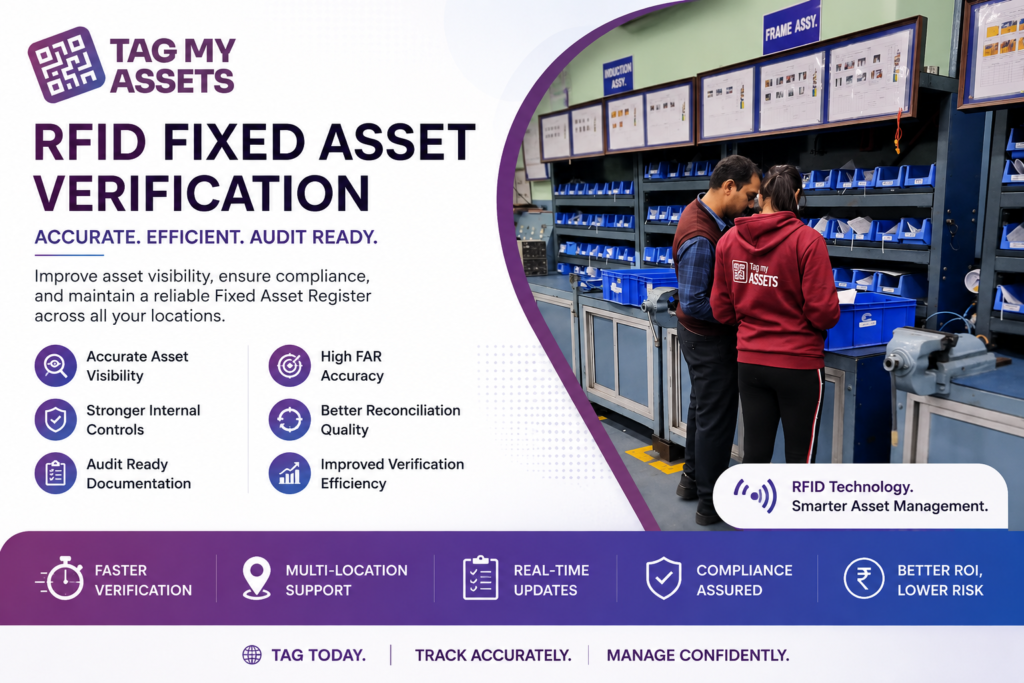
What is RFID Fixed Asset Verification?
RFID Fixed Asset Verification is the process of physically verifying fixed assets using RFID (Radio Frequency Identification) tags and readers to compare actual assets with records maintained in the Fixed Asset Register (FAR).
Each tagged asset contains a unique identification code. During verification, RFID readers capture asset information which is reconciled against FAR data — flagging discrepancies for resolution.
The process helps organizations:
- Identify missing assets
- Detect duplicate entries
- Improve FAR accuracy
- Reduce ghost assets
- Verify asset locations
- Improve audit readiness
- Strengthen asset tracking processes
Commonly used across: manufacturing plants, retail chains, hospitals, educational institutions, warehouses, corporate offices, banks, and logistics operations.
Why Traditional Fixed Asset Verification Often Fails
Many organizations continue using spreadsheets, manual records, or barcode-only systems. Over time, these create compounding inaccuracies:
| Problem | Business Impact |
| Assets shifted without updates | Wrong FAR location |
| Disposed assets remain in FAR | Overstated asset records and depreciation |
| Duplicate asset entries | Reporting inaccuracies |
| Missing assets | Audit observations and qualifications |
| Inconsistent asset naming | Reconciliation difficulties |
| No tagging mechanism | Slow, error-prone verification |
RFID vs Barcode vs Manual Verification
| Factor | Manual | Barcode | RFID |
| Verification Speed | Slow | Moderate | Fast |
| Line-of-sight Required | Yes | Yes | No |
| Multiple Asset Scan | No | No | Yes |
| Human Dependency | High | Moderate | Lower |
| Audit Accuracy | Moderate | High | Very High |
| Large Facility Coverage | Difficult | Moderate | Efficient |
9 Powerful Benefits of RFID Fixed Asset Verification
1. Faster Verification and Reduced Human Error
Manual verification is labour-intensive and prone to missed entries or duplicate recording. RFID standardizes the capture process and significantly reduces dependency on manual data entry. Where a manual verification cycle across several locations runs into weeks of fieldwork, RFID verification is substantially faster, because assets are read in bulk rather than identified one at a time. The actual duration depends on asset volume, layout and tag readability.
2. Improves FAR Reconciliation Accuracy
One of the most important advantages of RFID verification is stronger Fixed Asset Register reconciliation. The process follows a clear chain: Actual Asset → RFID Scan → FAR Record → Exception Identification. This structured flow reduces mismatches and strengthens financial reporting accuracy — particularly important for organizations subject to Ind AS 16 compliance.
3. Reduces Ghost Assets
Ghost assets are items that appear in the FAR but no longer physically exist — scrapped machinery, lost laptops, disposed furniture, or duplicate entries created during system migrations. These inflate gross block values, distort depreciation calculations, and attract audit observations. RFID verification systematically surfaces these discrepancies.
4. Better Audit Readiness and Compliance Support
Statutory auditors examine asset existence, location, condition, and identification as part of obtaining sufficient appropriate audit evidence under SA 500, and in designing responses to assessed risks under SA 330. RFID verification creates structured, timestamped records that directly support this process — reducing the risk of audit qualifications and management letter observations.
RFID-generated verification records support:
- Internal audits
- Statutory audits under Companies Act 2013
- Compliance reviews under SEBI disclosure norms (for listed entities)
- Ind AS 16 / Schedule II asset record requirements
5. Supports ERP Migration Projects
Organizations migrating to SAP, Oracle, or other ERP platforms require clean, validated asset master data. Incorrect asset records carried into a new ERP create compounding errors — wrong depreciation calculations, misallocated costs, and FAR mismatches from day one. RFID verification before migration ensures the asset master is accurate, classified correctly, and aligned with physical reality.
6. Improves Multi-Location Asset Management
For organizations operating retail chains, hospital networks, bank branches, or manufacturing plants across multiple cities, asset verification processes are difficult to standardize. RFID enables consistent verification methodology across all locations, producing comparable outputs that can be consolidated at the entity level for reporting.
7. Enables Better Asset Movement Accountability
Assets frequently move between departments, floors, or facilities without formal documentation. Over time this creates FAR location errors and makes periodic verification harder. RFID tagging — combined with a gate reader or periodic scan — creates a record of asset movement, improving accountability and reducing the gap between physical location and FAR data. This is particularly valuable in hospital and IT asset environments where equipment moves frequently.
8. Creates More Structured and Auditable Asset Records
RFID verification produces structured data outputs — verified asset lists, exception reports, location maps, and reconciliation summaries — that serve as primary documentation for future audits. Organizations that have completed RFID-based verification find subsequent annual verifications faster, because the baseline data quality is already high and the exceptions are incremental rather than systemic.
9. May Reduce Verification Costs Over Time
Initial implementation requires investment in tags, readers, and project execution. However, recurring annual verification costs typically reduce because fieldwork is faster, manual reconciliation effort is lower, and exception volumes shrink as FAR quality improves over successive cycles. Year-two verification is usually less expensive than year one, because the fieldwork is faster against an existing tagged base and the exception volume is smaller once the register has been reconciled once.
Step-by-Step RFID Fixed Asset Verification Process
Successful RFID projects depend on planning, asset classification, and reconciliation — not only tagging.
Step 1: FAR Cleanup and Asset Classification
Before any tagging begins, the existing FAR must be cleaned and assets classified into four categories:
- Taggable Assets — assets that can receive and retain an RFID tag
- Non-Taggable Assets — assets where tagging is impractical (e.g., civil structures)
- Countable Assets — assets verified by count rather than individual tag (e.g., chairs)
- Non-Auditable Assets — assets excluded from scope with documented reasons
Poor FAR quality at this stage is the most common cause of RFID project failure.
Step 2: RFID Tag Selection
| Asset Type | RFID Tag Type | Reason |
| Metal machinery | Anti-metal RFID | Standard tags lose signal on metal surfaces |
| Furniture | Standard RFID | Cost-effective, easy placement |
| IT assets | Compact RFID | Fits in tight spaces, durable |
| Outdoor assets | Hard RFID | Weather and UV resistant |
Step 3: RFID Tagging
Each asset receives a unique RFID tag mapped to its FAR record. Placement matters — tags should be positioned for consistent reader access and should not be obstructed by asset structure or nearby metal. Tags are linked to asset codes in the verification system before scanning begins.
Step 4: RFID Scanning During Physical Verification
RFID readers scan tagged assets during physical walkthrough. Typical data captured per asset: Asset ID, physical location at time of scan, and verification timestamp. Handheld readers are used for standard verification; fixed portal readers can be deployed at exits for movement tracking.
Step 5: Physical Verification and Exception Reporting
Each scanned asset is validated against FAR records. Exceptions are categorised:
- Missing Assets — in FAR but not scanned
- Additional Assets — scanned but not in FAR
- Duplicate Assets — multiple FAR entries for one physical asset
- Wrong Location Assets — FAR location differs from scan location
Step 6: FAR Reconciliation
Verification data is reconciled with FAR records. Each exception is investigated and resolved — assets are written off, relocated in the FAR, or added as new entries. The reconciled output becomes the updated FAR baseline.
Step 7: Final Reporting and Audit Documentation
Final deliverables typically include: verification summary by location, reconciliation status report, exception list with resolution actions, and supporting documentation suitable for audit file inclusion.
Real-World Example: ulti-Plant Auto Components Manufacturer
| Anonymised engagement — auto components manufacturer Scope: three plants and a corporate office, approximately 9,200 fixed assets in the register. The company had been verifying manually on a spreadsheet once every two years, with each cycle taking six to eight weeks across all locations. What the exercise found: FAR cleanup reduced the active asset count to 8,400, with 800 assets identified as no longer physically present and written off. Scrapped machinery was still carried in the register, and assets relocated between plants had not been updated. How it was executed: On-metal RFID tags on machinery, standard tags on furniture and IT assets. Physical verification across all locations was completed in nine working days. Deliverables: a reconciled Fixed Asset Register with exceptions listed location-wise, used by the company as the validated asset master for its subsequent SAP migration. |
7 Reasons RFID Asset Verification Projects Fail in India
1. Poor FAR Quality Before Tagging
Incorrect or outdated asset descriptions reduce matching accuracy and make reconciliation unreliable.
2. Wrong RFID Tag Selection
Standard tags placed on metal machinery lose signal. Metallic environments require anti-metal tags — skipping this step leads to poor scan rates and incomplete verification.
3. Lack of Asset Naming Standards
When the same asset type appears as “AC Unit”, “Air Conditioner”, and “Split AC” across different FAR entries, automated reconciliation fails and manual intervention becomes necessary throughout.
4. Missing Parent-Child Asset Mapping
Sub-assets (e.g., a UPS attached to a server, or a compressor attached to an HVAC unit) may remain unmatched if the parent-child relationship is not captured during classification.
5. Weak Verification SOPs
Without a standard process defining scan routes, exception handling, and sign-off procedures, verification quality varies across locations and team members.
6. Ignoring Countable Assets
Some assets — chairs, fire extinguishers, small tools — are better verified by count than by individual tag. Failing to plan for these creates gaps in verification coverage.
7. Treating Tagging as the End Goal
Organizations sometimes complete tagging and scanning but skip structured FAR reconciliation. Without reconciliation, FAR accuracy does not improve and audit observations continue.
Approximate RFID Verification Costs in India (2026)
Costs vary based on asset quantity, locations, environment, and reporting requirements. The table below provides indicative ranges for planning purposes:
| Cost Component | Approximate Range |
| Manpower | ₹15–35 per asset for tagging, data capture and verification |
| Complete engagement (tagging + verification + FAR reconciliation) | ₹80–350 per asset |
| Passive RFID tags | ₹10–₹200 per tag depending on type |
| On-metal RFID tags | ₹40–200 per tag, at the upper end of the passive band |
| RFID handheld reader (one-time) | Significant per-unit capital cost, quoted separately |
| Verification manpower | Project and scope dependent |
| FAR reconciliation and reporting | Scope dependent |
Note: Multi-location projects are priced per project. Asset count, tag type, number of locations and the condition of the existing register move a quote inside the bands above.
Compliance and Audit Considerations in India
Accurate fixed asset records are not only an operational requirement — they carry regulatory weight under multiple frameworks applicable to Indian companies:
ICAI guidance on physical verification of fixed assets recommends periodic physical verification — ideally annual — and reconciliation of results with FAR records. RFID verification supports this recommendation with a scalable, structured methodology.
When Should Organizations Adopt RFID Fixed Asset Verification?
RFID verification becomes particularly valuable when organizations have:
- More than 5,000 fixed assets
- Assets spread across 3 or more locations
- Recurring audit observations on fixed assets
- Upcoming ERP migration projects
- Significant missing asset or ghost asset issues
- Physical verification cycles taking longer than 4 weeks
Frequently Asked Questions
1. What is RFID Fixed Asset Verification?
The process of physically verifying fixed assets using RFID tags and readers and comparing results with FAR records — identifying missing assets, ghost assets, location discrepancies, and duplicate entries.
2. Is RFID better than barcode for asset verification?
RFID does not require line-of-sight and can identify multiple assets simultaneously, making it significantly faster for large-scale verification. Barcodes remain useful for smaller, well-organised asset bases where cost is the primary constraint.
3. Can RFID help in FAR reconciliation?
Yes. RFID verification provides structured scan data that is compared against FAR records, with discrepancies clearly categorised — enabling targeted reconciliation rather than broad manual review.
4. How much does RFID fixed asset verification cost in India?
A complete engagement — tagging, physical verification and FAR reconciliation together — runs ₹80–350 per asset. Tagging alone is cheaper: ₹15–35 per asset manpower plus the tag. Asset count, locations, tag type and register condition move the figure inside those bands.
5. Will RFID work on metal machinery?
Yes, but standard passive RFID tags lose signal on metal surfaces. On-metal RFID tags (₹40–200 per tag) are designed for this environment and maintain reliable readability on metallic assets.
6. How long does RFID implementation take?
For a 5,000–10,000 asset project across 2–3 locations, physical verification and scanning typically takes 5–10 working days. FAR reconciliation and reporting add a further 5–10 working days depending on exception volume.
7. Can RFID support statutory audits?
Yes. RFID verification records — including scan logs, exception reports, and reconciliation outputs — serve as audit evidence under SA 500, support the auditor’s responses to assessed risks under SA 330, and support physical verification requirements under Ind AS 16 and the Companies Act.
8. Do RFID tags need replacement every year?
Standard passive RFID tags in indoor environments typically last 5–10 years. Anti-metal and hard tags in outdoor or industrial environments may require inspection every 2–3 years. Replacement is asset- and environment-specific.
9. Is RFID suitable for manufacturing plants?
Yes. Manufacturing facilities with large machinery inventories across plant floors are among the strongest use cases for RFID, provided anti-metal tags are used on metallic assets and scan routes are planned around plant layout.
Why Organizations Choose TagMyAssets for RFID Fixed Asset Verification
RFID implementation is not only about pasting tags. The real value comes from accurate FAR reconciliation, structured verification processes, exception reporting, and audit-ready documentation.
At TagMyAssets, our approach combines technology, trained verification teams, and reconciliation expertise to help organizations improve asset visibility and FAR accuracy.
Our capabilities include:
✅ RFID Asset Tagging (Standard, Anti-metal, Hard RFID tags)
✅ Fixed Asset Physical Verification across single or multiple locations
✅ FAR Reconciliation and exception reporting
✅ QR, Barcode & RFID based asset tracking solutions
✅ Mobile application for asset verification and data capture
✅ Parent-child asset mapping and asset classification
✅ Audit support documentation for statutory and internal audits
✅ Pre-ERP migration asset validation and cleanup
✅ PAN India execution capability through trained verification teams
We work across industries including:
- Manufacturing Plants
- Retail Chains & Multi-location Stores
- Hospitals & Healthcare Facilities
- Warehouses & Logistics Operations
- Corporate Offices
- Educational Institutions
- Banking & Financial Services
Our objective is simple: help organizations build an accurate, auditable, and technology-enabled Fixed Asset Register (FAR).
Need RFID Fixed Asset Verification Services?
Whether your organization is facing:
✓ Inaccurate FAR records
✓ Missing or ghost assets
✓ Delayed physical verification cycles
✓ Audit observations related to fixed assets
✓ Upcoming SAP / ERP migration
✓ Multi-location asset management challenges
TagMyAssets can help with RFID tagging, physical verification, FAR reconciliation, and audit-ready reporting.
📞 Call: +91 9650003293
📧 Email: connect@tagmyassets.com
🌐 Website: www.tagmyassets.com
Share your asset count and location list, and we will come back with a scoped estimate.
Conclusion
RFID Fixed Asset Verification has moved well beyond a tagging exercise. For Indian organizations navigating Ind AS 16 compliance, statutory audit requirements, and increasing pressure for accurate financial reporting, it has become a practical tool for improving FAR accuracy, reducing audit risk, and building a reliable asset management foundation.
Organizations that implement RFID verification with proper FAR cleanup, correct tag selection, and structured reconciliation — rather than treating tagging as the deliverable — see lasting improvements in asset data quality and significantly smoother audit processes in subsequent years.