
🚨 Introduction: Why Most Asset Tagging Projects Fail Before They Even Start
Asset tagging problems are one of the biggest challenges companies face due to poor FAR structure, incorrect capitalisation, and complex asset mapping.
But in real-world projects, especially across large retail, manufacturing, and multi-location organizations, the biggest challenge is not tagging.
👉 The real problem lies in the Fixed Asset Register (FAR).
One of the most common and damaging issues we see is:
Assets are capitalised at component level (child items) instead of usable asset level (parent asset).
This creates a ripple effect across:
- Asset tagging execution
- Cost estimation
- FAR reconciliation
- Depreciation accuracy
- Audit reporting
In this article, we break down the 7 most critical asset tagging problems caused by poor FAR structure—and how companies can fix them.
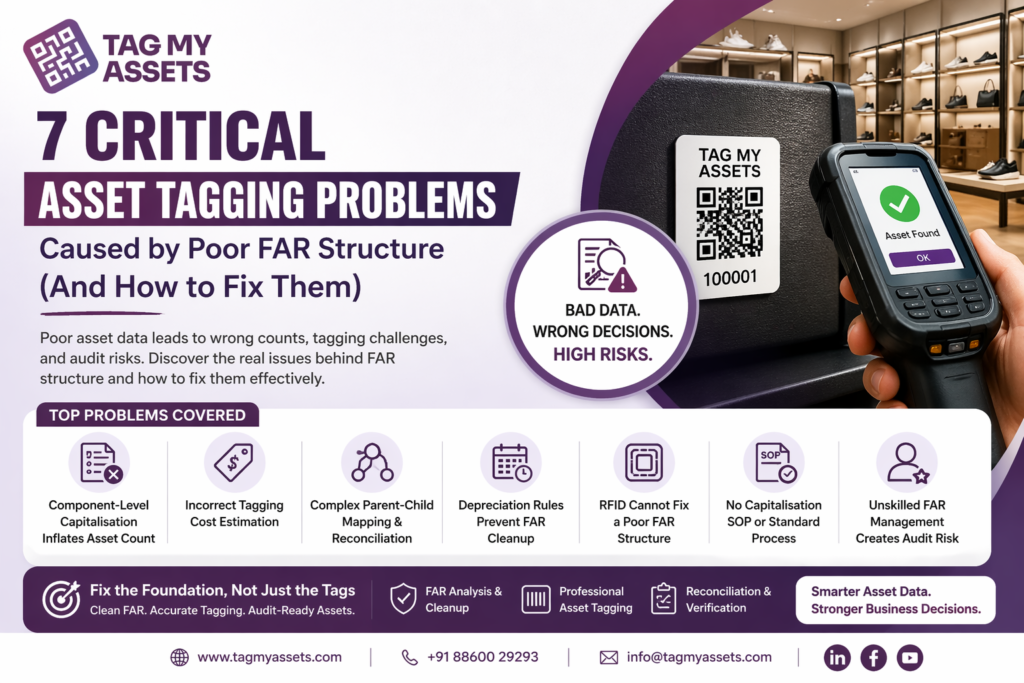
These asset tagging problems are not operational issues—they are structural FAR issues.
⚠️ Problem 1: Wrong Asset Count Due to Component-Level Capitalisation
In many organizations, FAR is structured like this:
- 50 meters pipe
- 10 boards
- 20 fittings
- 5 display fixture units created
👉 Instead of recording the final usable asset, the FAR captures individual components.
🔍 Ground Reality vs FAR
| Physical Reality | FAR Structure |
|---|---|
| 5 assets (display fixture units) | 80+ line items |
💥 Why This Is a Problem
- Asset count becomes artificially inflated
- Tagging scope becomes unclear
- Decision-making becomes misleading
👉 Asset tagging always happens on physical assets—not on raw materials
💸 Problem 2: Incorrect Tagging Cost Estimation
When FAR shows inflated asset counts:
- Tag quantities are overestimated
- Manpower planning becomes inaccurate
- Project timelines become unreliable
📊 Example Scenario
- FAR shows: 10,000 assets
- Actual taggable assets: 3,000
👉 Result:
- Over-budgeting or under-quoting
- Rework during execution
- Client dissatisfaction
🔗 Problem 3: Complex Parent-Child Mapping During Tagging
During asset tagging:
- Physical tagging is done on usable assets (parent level)
- FAR exists at component level (child items)
👉 This creates a mapping challenge:
- One tag → multiple FAR entries
- Manual mapping sheets required
- High chances of errors
❌ Outcome
- FAR remains cluttered
- Reports become difficult to interpret
- Audit trails become weak
📉 Problem 4: Depreciation Constraints Prevent FAR Cleanup
Even when companies want to fix FAR structure, they face a major roadblock:
👉 Depreciation is calculated based on individual capitalisation dates
Example:
- Display fixture unit created in 2022
- Additional components added in 2023
If merged:
- Depreciation logic gets disturbed
🚫 Result:
- Parent-child consolidation is avoided
- FAR remains fragmented
- Asset clarity is lost
📡 Problem 5: RFID Tagging Cannot Fix a Poor FAR
Many organizations invest in RFID asset tagging expecting it to solve all problems.
But:
- RFID improves tracking efficiency
- It does NOT correct data structure issues
❌ Even After RFID Implementation:
- Asset hierarchy remains unclear
- Reporting inconsistencies continue
- FAR remains difficult to understand
👉 Technology cannot fix poor data design.
🧠 Problem 6: Lack of Capitalisation SOP (Standard Operating Procedure)
The root cause of all these issues lies at the beginning:
👉 Asset capitalisation stage
Common gaps include:
- No clear definition of “asset unit”
- No distinction between asset vs component
- No alignment between finance and operations
- No structured approval process
⚠️ Problem 7: Treating FAR Management as a Low-Skill Activity
One of the biggest misconceptions:
“Anyone can manage the Fixed Asset Register”
In reality:
❌ FAR is not just data entry
✅ It is a critical financial control system
Poor FAR management leads to:
- Audit risks
- Incorrect depreciation
- Asset misstatements
- Operational inefficiencies
✅ How to Fix These Asset Tagging Problems (Practical Approach)
1. Define the “Taggable Asset Unit”
Before capitalisation, decide:
- What is the final usable asset?
- What will be physically tagged?
👉 Example:
- Display fixture unit = 1 asset
- Pipes, boards = components
2. Implement a Controlled Parent-Child Structure
- Parent asset → Taggable
- Child items → Informational
Ensure:
- Tagging is done at parent level
- Reporting is simplified
3. Align Finance, Operations, and Audit Teams
All stakeholders must agree on:
- Asset grouping logic
- Capitalisation approach
- Tagging methodology
4. Create a Strong Capitalisation SOP
A robust SOP should define:
- Asset classification rules
- Treatment of additions and extensions
- Depreciation alignment
- Tagging readiness criteria
5. Conduct FAR Cleanup Before Tagging
Before starting any asset tagging project:
- Analyse FAR structure
- Identify inconsistencies
- Standardise asset naming
- Define mapping logic
👉 This step alone can reduce project complexity by 40–60%
🏢 How TagMyAssets Ensures Successful Asset Tagging
At TagMyAssets, we go beyond basic tagging services.
We:
- Analyse FAR before project execution
- Identify parent-child inconsistencies
- Define taggable asset units
- Build structured mapping logic
- Support FAR reconciliation and cleanup
👉 This ensures:
- Accurate asset tagging
- Clean and usable FAR
- Audit-ready reporting
- Long-term asset control
📊 Final Conclusion: Fix the Foundation, Not Just the Tags
If your FAR structure is incorrect:
- Asset tagging will become complicated
- RFID will not solve core issues
- Audits will remain challenging
👉 The real solution is:
Fix asset structuring at the time of capitalisation—not after tagging begins, Solving these asset tagging problems requires fixing FAR at the source.
Good Reads
👉 For comprehensive asset lifecycle control, explore our
https://tagmyassets.com/fixed-asset-management/
👉 Looking for professional tagging execution? Check our
https://tagmyassets.com/fixed-asset-tagging-services/
👉 Need physical verification and reconciliation? Visit
https://tagmyassets.com/inventory-verification-services/
ICAI – Guidance Note on Fixed Assets
MCA – Companies Act Depreciation Rules
❓ FAQ Section (Add Schema)
Q1. What are the biggest asset tagging problems in companies?
The biggest problems include incorrect FAR structure, component-level capitalisation, mapping challenges, and lack of standard asset definitions.
Q2. Can RFID solve asset management problems?
RFID improves tracking efficiency but cannot fix poor FAR structure or incorrect asset hierarchy.
Q3. Why is FAR cleanup important before asset tagging?
Without FAR cleanup, tagging becomes complex, mapping errors increase, and reporting becomes unreliable.
Q4. What is parent-child asset structure?
It is a system where a main asset (parent) contains multiple components (child items), but tagging is done at the parent level.