
Introduction: The Invisible Problem Most Companies Ignore
Asset loss is a common but often unnoticed problem. Most organisations don’t realise assets are missing until an audit or financial review forces a comparison with reality — because until then, nobody is actually looking.
This is what we call asset loss in companies — hidden asset leakage that builds quietly for years until an audit, merger, or financial review exposes it. In large organisations with multiple locations, departments, or legal entities, it’s more common than most people expect.
This article covers what hidden asset leakage actually is, a real case, why companies fail to detect it, and how to prevent it.
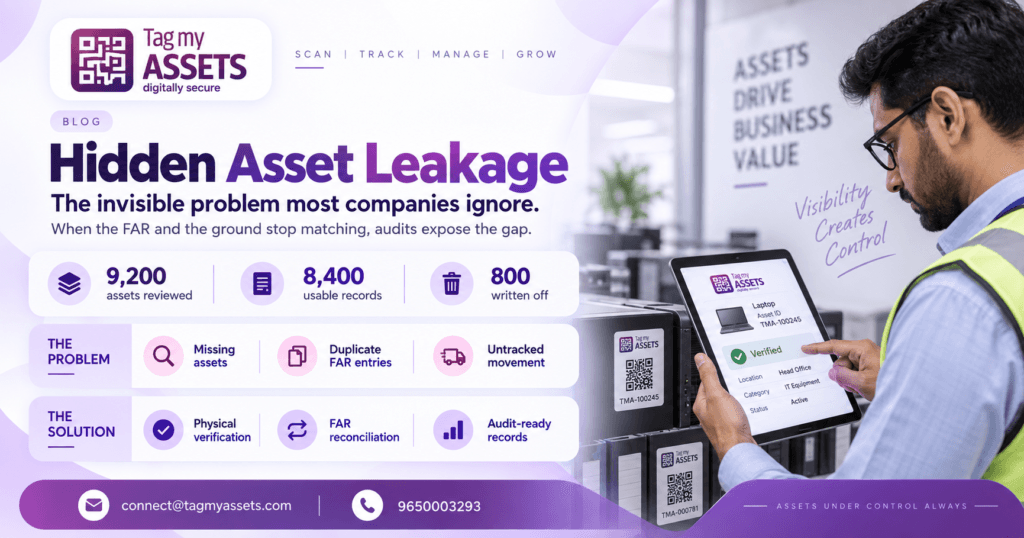
Hidden Leakage Explained
Hidden asset leakage means assets recorded in the Fixed Asset Register that aren’t physically available, or assets that exist physically but were never properly recorded. Either way, the books and the ground stop matching — and regular physical verification is the only reliable way to catch the mismatch before it affects financial reporting.
A Real Case: Where Did the Assets Go?
On a multi-location manufacturing engagement across three plants and a corporate office, the FAR carried roughly 9,200 assets. Physical verification and reconciliation cleaned that register to 8,400 usable records, with around 800 written off as no longer physically present — assets the company had no internal record of losing until the verification exercise found the gap.
The client had no system flagging this beforehand. The reconciled register was subsequently used as the asset master for the client’s SAP migration.
What We Found
- Multiple duplicate entries in the FAR
- Assets shifted between departments without the records being updated
- Assets scrapped but still carried in the register
- Items never tagged or tracked in the first place
Where Leakage Actually Happens
Duplicate asset entries. The same asset recorded more than once, usually from poor data entry or no naming standard — inflating the asset count.
Incorrect asset mapping. An asset physically exists but is mapped to the wrong entry in the FAR — especially common across multi-location companies and shared offices.
Untracked asset movement. Assets move between departments, locations, or entities, but the records never catch up.
Non-tagged assets. Without a tag, an asset has no unique identity and no way to be tracked — effectively invisible to the system.
Scrapped assets still in the FAR. Disposed or replaced equipment still shown in the books, creating a false asset value.
Why Companies Don’t Realise This Is Happening
Four things tend to combine: no asset tagging system, so manual tracking produces errors and missing records; poor FAR maintenance with inconsistent formats and no standardisation; no periodic physical verification, so nothing ever gets checked against reality; and over-reliance on spreadsheets, which record data but don’t actually track assets.
Financial Impact of Hidden Asset Leakage
Overstated asset value, since the books show more assets than physically exist. Incorrect depreciation, calculated against assets that no longer exist. Audit risk, when auditors flag missing assets and unreliable records. And real operational cost — duplicate purchases and inefficient use of assets nobody knew they already owned.
How to Detect Hidden Asset Leakage
- Physical asset verification — compare the FAR against what’s actually on site to identify gaps directly.
- FAR reconciliation — clean out duplicate and incorrect entries.
- Asset classification — sort into taggable, countable, and non-auditable categories.
- Data standardisation — unify asset names and categories so records can actually be compared.
How to Prevent Asset Leakage
- Implement asset tagging — QR codes or RFID tags, so every asset has a unique identity.
- Use digital tracking tools — scanning, location tracking, and photo capture instead of paper records.
- Track asset movement — maintain a log of transfers and location changes as they happen.
- Conduct periodic audits — regular verification is what prevents leakage from building up quietly again.
How TagMyAssets Helps
We handle large-scale asset verification and tagging projects across industries — identifying hidden leakage, cleaning and standardising the FAR, implementing QR and RFID tagging, and producing audit-ready records. Our teams have run multi-location projects across plants, offices, and retail stores.
Explore our asset tagging services or learn about our verification process.
Conclusion
Hidden asset leakage isn’t a minor issue — it’s a systemic one. Most companies miss it because it builds slowly and hides inside data nobody is regularly checking. Once identified, though, it directly affects financial accuracy, audit outcomes, and operational efficiency.
The fix is straightforward: tag assets, verify them regularly, and keep the records clean. As per audit practices recommended by the Institute of Chartered Accountants of India, accurate asset records and periodic verification are central to reliable financial reporting, and maintaining correct records also supports compliance with Ministry of Corporate Affairs requirements.
Frequently Asked Questions
What is hidden asset leakage?
Missing or incorrectly recorded assets that go unnoticed because of poor tracking systems and no regular physical verification.
How common is asset leakage?
In our experience running verification projects across large organisations, discrepancies of this kind aren’t rare — though the exact rate varies widely depending on how well the FAR has been maintained and how long it’s been since the last physical check.
How can companies prevent asset loss?
Through asset tagging, regular physical verification, and disciplined FAR management — the three together, not any one alone.
What is the best way to detect missing assets?
Physical verification reconciled directly against the FAR — comparing what’s recorded against what’s actually there.