
Fixed asset audit observations are the findings raised during a fixed asset audit after comparing physical assets, the Fixed Asset Register (FAR), supporting records and accounting treatment. They highlight discrepancies, control weaknesses and documentation gaps that management must investigate and resolve before closing the audit. The most common observations include assets not physically found, unrecorded assets, location mismatches, duplicate FAR entries, untagged assets and disposals never removed from the books. This guide lists 21 observations auditors raise most often in Indian companies — what each one means, the risk it creates, its usual cause and the corrective action that closes it.
Within a fixed asset audit — whether statutory, internal or a management review — observations are the output stage: the findings that emerge once physical verification, register review and documentation testing are complete. This guide is written for the people who raise, receive and close those findings: statutory and internal auditors, CFOs, finance managers, plant and facility heads, and ERP teams responsible for the FAR.
It is based on our field experience across 395+ verification projects, 1500+ locations and 10 lakh+ assets in India. For how to run the verification exercise that surfaces these issues, see our fixed asset verification checklist; for the statutory reporting side, see the CARO 2020 compliance checklist.
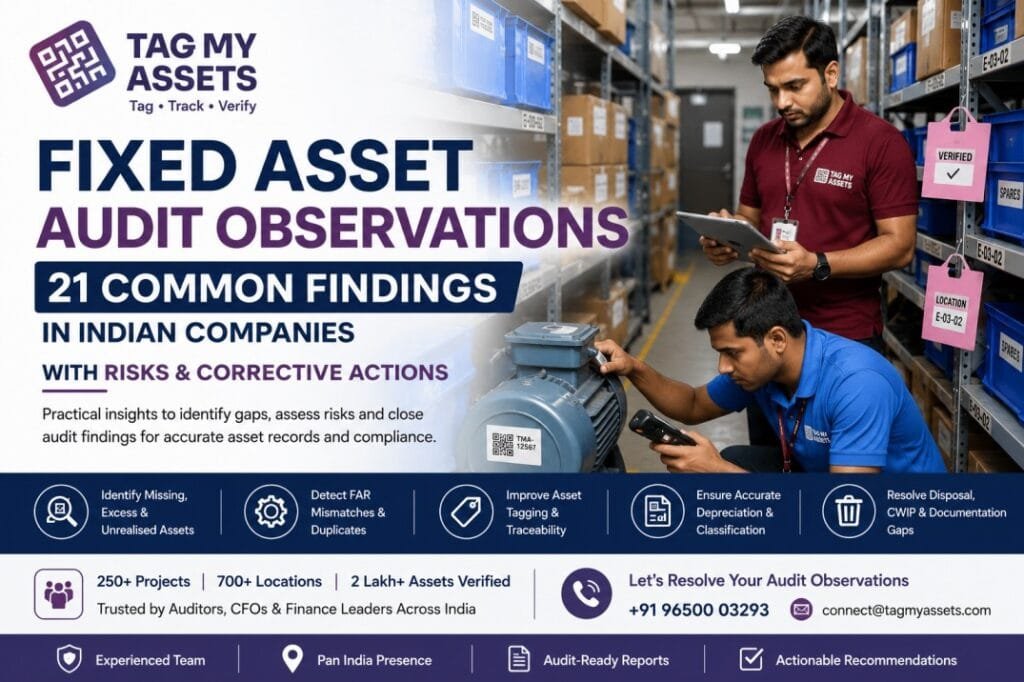
Quick-Reference: Observation, Risk and Immediate Action
| Audit observation | Primary risk | Immediate action |
| Asset in FAR but not physically found | Possible loss, or FAR overstated | Trace movement, repair and disposal records before treating as missing |
| Asset found but not in FAR | Incomplete capitalisation | Verify invoice, ownership and capitalise where appropriate |
| Asset at a different location than recorded | Weak movement controls | Update location and introduce movement records |
| Untagged asset | Cannot be verified repeatably | Assign a unique asset ID and tag |
| Duplicate FAR entry | Gross block overstated | Validate and remove the duplicate with approval |
| Scrapped asset still active in FAR | Excess depreciation and insurance | Complete disposal approval and derecognise |
| Incorrect asset classification | Wrong depreciation rate | Reclassify after review |
| Missing serial numbers on IT assets | Weak traceability, swap risk | Capture make, model and serial number |
How a Fixed Asset Audit Observation Should Be Written
A useful observation is more than a complaint — it gives management something actionable. The standard structure:
- Condition — what was actually found
- Criteria — what record, policy or control should have existed
- Risk or implication — what can go wrong if uncorrected
- Root cause — why the discrepancy arose
- Recommendation — the practical correction required
- Management action plan — who will correct it, and by when
Sample observation wording (illustrative)
“During physical verification, a number of assets appearing in the Fixed Asset Register could not be produced at their recorded locations, and the location teams could not provide approved movement or disposal records for them. The FAR may therefore include assets that are lost, transferred or disposed of, resulting in inaccurate records and weak accountability. Management should trace each asset through custodian confirmations, movement and repair registers and disposal documents, and update the FAR only after approvals and supporting evidence are obtained.”
Short, Excess and Mismatch: The Language of Verification Findings
- Short — asset exists in the FAR but is not physically located
- Excess — asset is physically found but is not mapped to any FAR entry
- Match — physical asset and FAR record are successfully linked
- Location mismatch — asset found, but at a location different from the recorded one
- Description mismatch — the asset appears correct but its description, category or serial details differ from the register
Every observation in this guide is one of these five at its core. Resolving them — shorts investigated, excesses capitalised, mismatches corrected — is the work of FAR reconciliation.
A. Physical Verification Observations
1. Assets recorded in the FAR but not physically found
What is found: Assets listed in the register cannot be produced at their recorded locations.
Risk: The FAR may include lost, transferred or disposed assets that are still being depreciated and insured. Usual cause: Disposal, scrapping or transfer without an accounting entry; or the record was never updated.
Corrective action: Trace each asset through custodian confirmations, movement registers, repair records and disposal documents before concluding it is missing; derecognise only with approvals.
2. Physical assets found but missing from the FAR
What is found: Assets in active use have no corresponding register entry.
Risk: Understated gross block, incomplete capitalisation and untested ownership. Usual cause: Project purchases, donations or inter-unit transfers that were never capitalised.
Corrective action: Verify purchase documentation and ownership, then capitalise with management approval.
3. Assets at locations different from the register
What is found: Assets exist but not where the FAR says they are.
Risk: Verification slows, custodianship is unclear, and departmental costing is distorted. Usual cause: Branch or inter-department transfers and project relocations without record updates.
Corrective action: Correct locations in the FAR and introduce a movement approval record for future transfers.
4. Transfers between departments without movement records
What is found: Assets have clearly moved, but no approved movement trail exists.
Risk: “Not found” conclusions get drawn for assets that were merely shifted, and accountability is lost between departments. Usual cause: No movement register or approval workflow in place.
Corrective action: Introduce a simple transfer form or digital movement log; reconcile pending transfers before the next audit.
5. Assets in locked or inaccessible areas left unverified
What is found: A portion of the asset base was never physically checked — server rooms, vaults, restricted plant zones.
Risk: The verification is incomplete, and the auditor may not be able to rely on it for those assets. Usual cause: Access was not planned in advance of the fieldwork.
Corrective action: Log exclusions with reasons during the exercise, and schedule access — with escorts or shutdown windows — to complete the count.
6. Asset descriptions too generic to identify the asset
What is found: Register lines such as “machinery — various” or “equipment” cannot be matched to any specific physical asset.
Risk: Existence becomes untestable; the same asset may be matched to multiple entries. Usual cause: Bulk capitalisation from invoices without asset-wise detail.
Corrective action: Enrich descriptions with make, model, capacity and location during the next verification, and split grouped lines asset-wise.
7. Quantity mismatches for grouped or countable assets
What is found: The register says 50 chairs; the floor count says 41 — or 63.
Risk: Gross block and insurance values do not reflect reality for entire categories. Usual cause: Single-line capitalisation of bulk purchases with later additions and disposals never adjusted.
Corrective action: Reconcile counts category-wise, adjust with approval, and tag countable assets individually where value justifies it.
B. Asset Identification Observations
8. Assets without unique identification tags
What is found: Assets carry no tag linking them to a register entry.
Risk: Verification is slow and error-prone; the same asset can be counted twice or matched to the wrong entry. Usual cause: Tagging was never done, or new additions bypass the tagging process.
Corrective action: Tag during the verification exercise itself so the count becomes the baseline; route all new additions through tagging.
9. Duplicate, damaged or illegible tags
What is found: Two assets share a tag number, or tags have weathered beyond reading.
Risk: The identification system loses reliability exactly where it is needed. Usual cause: Uncontrolled tag issuance; wrong tag material for the environment (heat, grease, outdoor exposure).
Corrective action: Maintain a central tag-number series, and select tag material by environment — metal or polyimide for plant and kitchen areas, standard labels for offices.
10. Tag numbers that do not match FAR asset codes
What is found: Assets are tagged, but the tag series was never mapped to the register.
Risk: Tagging exists on paper yet delivers none of its verification value. Usual cause: Tagging and FAR maintenance were done as separate projects.
Corrective action: Build and maintain a tag-to-FAR mapping; make the tag number a mandatory FAR field.
11. Make, model and serial numbers not captured
What is found: IT and serialised equipment recorded without identifying details.
Risk: Identical-looking assets cannot be told apart; swap and substitution go undetected. Usual cause: Capture was never part of the capitalisation or verification format.
Corrective action: Capture serials during verification for laptops, servers, instruments and machinery, and store them in the FAR.
12. Parent and child assets incorrectly recorded
What is found: A machine and its major components are recorded inconsistently — sometimes as one line, sometimes as several unlinked ones.
Risk: Component replacements and partial disposals cannot be accounted for correctly. Usual cause: No parent-child convention in the register.
Corrective action: Define a convention (parent asset with linked components), and restructure high-value plant entries during reconciliation.
C. FAR and Accounting Observations
13. Duplicate entries in the Fixed Asset Register
What is found: The same asset appears twice, often with slightly different descriptions or values.
Risk: Gross block and depreciation are overstated. Usual cause: Multiple departments maintaining separate records; ERP migrations; manual Excel FARs merged over time.
Corrective action: Identify duplicates during reconciliation, validate against invoices, and remove with a documented approval.
14. Incorrect asset classification
What is found: Office equipment booked as plant and machinery, IT assets under furniture, and similar misclassifications.
Risk: Wrong useful life and depreciation rate; distorted financial reporting. Usual cause: No standard categorisation policy applied at capitalisation.
Corrective action: Reclassify after review and standardise category definitions across locations.
15. Incorrect capitalisation dates or depreciation start dates
What is found: Assets capitalised on invoice date rather than the date ready for use, or backdated inconsistently.
Risk: Depreciation is misstated from day one. Usual cause: Capitalisation process driven by accounts payable timing rather than asset readiness.
Corrective action: Correct material cases with approval and align the capitalisation policy with the applicable accounting framework.
16. Fully depreciated assets still in use without review
What is found: A large share of the register sits at residual value while remaining in active service.
Risk: Asset base and insurance decisions rest on values that no longer reflect use; useful-life estimates go unreviewed. Usual cause: Useful lives adopted mechanically and never revisited.
Corrective action: Review fully depreciated but in-use assets periodically and document the useful-life assessment.
17. Capital work-in-progress requiring capitalisation review
What is found: Completed and in-use assets still parked in CWIP — or CWIP lines appearing in the FAR as if commissioned.
Risk: Depreciation either never starts or starts on assets not yet ready; project costs lose their trail. Usual cause: No trigger connecting project completion to capitalisation.
Corrective action: Review CWIP ageing each quarter and capitalise on readiness-for-use with proper documentation. See our detailed note on CWIP verification and capitalisation.
Detailed guidance: CWIP verification and capitalisation.
D. Disposal, Documentation and Control Observations
18. Sold, scrapped or obsolete assets continuing in the FAR
What is found: Assets long gone from the premises remain in the books, depreciating and insured.
Risk: Carrying value, depreciation and insurance premiums are all overstated — the classic ghost asset. Usual cause: No disposal workflow connecting physical scrapping to the accounting entry.
Corrective action: Introduce a disposal approval form that triggers derecognition, and clear the backlog during reconciliation.
19. Missing invoices, transfer approvals or disposal documents
What is found: The register exists but its supporting papers cannot be produced.
Risk: Ownership, cost and treatment become unverifiable; audit testing fails on documentation. Usual cause: Records scattered across departments and years, with no asset-wise file.
Corrective action: Build an asset documentation index — invoice, capitalisation approval, movement and disposal papers per asset — starting with high-value items.
20. Assets issued to employees without acknowledgement records
What is found: Laptops, mobiles, tablets, cameras and tools are in employees’ hands, but no signed acknowledgement or custodian record links them to the person.
Risk: Responsibility cannot be established if the asset is lost, damaged or not returned at exit; verification of mobile assets becomes guesswork. Usual cause: Assets issued informally by IT or admin without a custody process connected to the FAR.
Corrective action: Maintain an employee asset acknowledgement linked to the FAR, update it whenever custody changes, and reconcile it at every exit clearance.
21. No periodic verification, reconciliation or audit trail for FAR changes
What is found: The register changes over the years with no record of who changed what, and no verification cycle that would have caught the drift.
Risk: Every other observation in this list compounds silently until a statutory audit, insurance claim or ERP migration exposes it — and the auditor reports on the absence of the control itself. Usual cause: Verification treated as a one-time or audit-eve activity rather than a policy-driven cycle.
Corrective action: Adopt a written verification policy — frequency matched to asset mobility and documented in the fixed asset policy — and maintain an approval trail for every FAR change.
Field Insight: “Not Found” Does Not Automatically Mean Missing
In multi-location verification projects, an asset reported as “not found” is frequently discovered to have been transferred between departments, sent for repair, issued to an employee, stored in a locked area, deployed at a project site or disposed of without a FAR update. Treating every short as a loss overstates the problem and misdirects the response. Each discrepancy needs reconciliation — custodian confirmations, movement and repair records, disposal papers — before a final conclusion is drawn. In our engagements, a substantial share of initial shorts resolve into transfers and documentation gaps rather than genuine losses. Across our assignments spanning 1500+ locations and more than 10 lakh assets, the observations we encounter most frequently are location mismatches, assets without identification tags, duplicate FAR records, assets under repair, and disposals not updated in the register — which is why categories A, B and D above deserve the closest attention.
The life of an observation
Finding → Classification → Investigation → Management Approval → Correction in Books → Closure & Evidence
Tracking Observations to Closure
Observations that are reported but never closed become next year’s repeat findings — and repeat findings attract sharper audit language. A simple tracker keeps ownership visible:
| Observation | Owner | Corrective action | Target |
| Assets not found | Admin / custodians | Trace movement, obtain confirmations, conclude with evidence | Set per exercise |
| Unrecorded assets | Finance | Verify invoices and capitalise with approval | Set per exercise |
| Scrap still in FAR | Finance + operations | Complete disposal approvals and derecognise | Set per exercise |
| Untagged assets | Verification team | Tag and map to FAR | During fieldwork |
How Companies Prevent Recurring Audit Observations
Almost every observation above traces back to the same handful of missing controls: unique identification, movement approvals, a disposal workflow, periodic verification and reconciliation with an audit trail. In practice that means systematic asset tagging (QR, barcode or RFID matched to the environment), physical verification on a policy-driven cycle, and FAR reconciliation that converts findings into corrected books. Companies that run these as routine controls walk into audits with evidence instead of explanations. For how these controls fit into the full asset lifecycle, see our guide to fixed asset management, and for what tagging delivers beyond audit compliance, our note on asset tagging benefits.
Need Help Resolving Fixed Asset Audit Observations?
Our verification reports don’t just identify discrepancies — they provide the evidence and reconciliation needed to help management close audit observations with confidence.
TagMyAssets supports companies across India with physical verification, QR and RFID asset tagging, FAR reconciliation, custodian mapping and audit-ready documentation — 395+ projects, 1500+ locations, 10 lakh+ assetsacross manufacturing, retail, warehousing, laboratories, education and corporate offices. Whether your audit has raised missing assets, unrecorded assets, location mismatches or unreliable FAR data, we help identify root causes and prepare a structured corrective-action trail. See our fixed asset verification services , or write to connect@tagmyassets.com | +91 96500 03293.
Frequently Asked Questions
What are fixed asset audit observations?
They are discrepancies or control weaknesses identified while comparing physical assets with the Fixed Asset Register, supporting documents and accounting treatment — such as missing assets, unrecorded assets, FAR mismatches, duplicate records, untagged assets and disposals never removed from the books.
What should a company do when an asset is not physically found?
Investigate before concluding: check custodian confirmations, movement and repair records, employee issue registers and disposal papers. Many “not found” assets turn out to be transferred or under repair. Only after the trail is exhausted should the asset be treated as a loss and derecognised with approval.
How should a fixed asset audit observation be written?
With six elements: the condition found, the criteria that should have existed, the risk or implication, the root cause, a practical recommendation, and a management action plan naming the owner and target date. An observation without a cause and an owner rarely gets closed.
What is the difference between short and excess assets?
A short is an asset that exists in the FAR but cannot be physically located; an excess is a physical asset with no corresponding FAR entry. Shorts test existence, excesses test completeness — which is why verification must work in both directions.
Is an untagged asset automatically an audit non-compliance?
No law mandates tagging. However, untagged assets make verification unrepeatable and evidence weak, so auditors frequently raise them as a control observation. Tagging during the verification exercise is the standard remediation.
How are disposed assets removed from the FAR?
Through a documented disposal workflow: management approval for the disposal, evidence of sale or scrapping, derecognition of gross block and accumulated depreciation, and recognition of any profit or loss — all retained as the audit trail.
How often should fixed assets be physically verified?
There is no statutory frequency. It should be set by asset mobility and risk — movable assets like IT equipment are commonly covered more frequently than fixed plant — and recorded in the company’s fixed asset policy so the CARO “reasonable intervals” question has a documented answer.
Can QR or RFID tagging eliminate all audit observations?
No single control can. Tagging solves identification, but observations relating to capitalisation, classification, disposal and documentation need their own controls — movement approvals, disposal workflows and periodic reconciliation. Tagging is the foundation that makes the other controls verifiable.