Asset tagging benefits extend far beyond audit compliance. While many organizations begin asset tagging to prepare for audits, the long-term benefits include better visibility, accountability, maintenance planning, and informed decision-making across the organization.
These asset tagging benefits continue well beyond the audit and support better asset governance throughout the period for which assets remain in use.
That is one of the biggest misconceptions we come across during our field assignments.
Every organization owns hundreds or thousands of fixed assets—computers, furniture, machinery, production equipment, laboratory instruments, warehouse assets, and office infrastructure. Yet many businesses cannot confidently answer three simple questions:
- Where is the asset?
- Who is responsible for it?
- Does it actually exist where the records say it does?
If these questions cannot be answered confidently, the challenge goes far beyond audit readiness.
Asset tagging helps organizations build visibility, accountability, and control over their physical assets. While it certainly makes statutory and internal audits easier, its real value extends into daily operations, maintenance planning, financial reporting, and management decision-making.
Asset tagging is about visibility—not just labels
Many people think an asset tag is the end product.
It isn’t.
A QR code, barcode, or RFID tag is simply an identifier. The real value comes from the verified information linked to that tag.
A properly executed asset tagging exercise creates a reliable digital record that helps every department—not just finance—work with accurate information.
When every asset is uniquely identified and physically verified, organizations gain confidence that the information in their records reflects what actually exists on the ground.
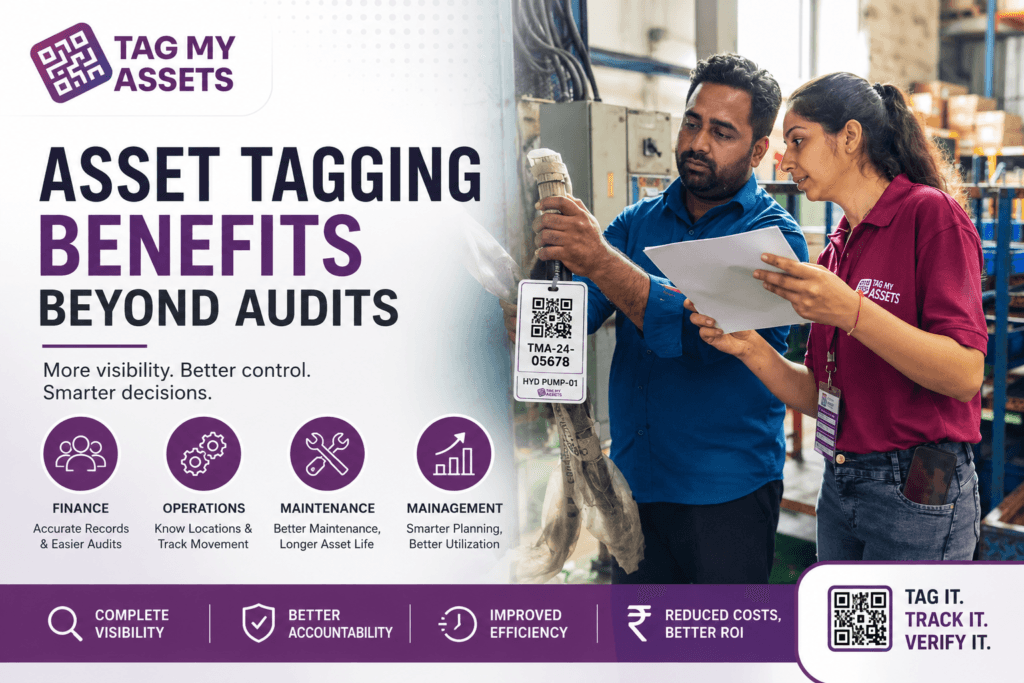
Asset Tagging Benefits Across Finance, Operations and Management
The asset tagging benefits discussed in this article are based on our experience across more than 395 projects and 1,500+ locations
Finance Team
An accurate asset register is the foundation of reliable financial reporting.
Asset tagging helps finance teams:
- Maintain a Fixed Asset Register (FAR) that reflects actual physical assets.
- Simplify sheet-to-floor and floor-to-sheet reconciliation.
- Improve the accuracy of depreciation records.
- Prepare for statutory and internal audits with fewer discrepancies.
- Reduce the time spent investigating shortages, excess assets, and duplicate records.
Operations Team
Operations teams need to know where assets are and who is using them.
Asset tagging helps them:
- Identify the current location of every asset.
- Track asset movement between departments, buildings, plants, or branches.
- Reduce time spent searching for equipment.
- Improve accountability for shared assets.
- Manage inter-location transfers with proper records.
Maintenance Team
Maintenance becomes far more effective when every asset has a unique identity.
Tagged assets allow maintenance teams to:
- Record the physical condition of assets during verification.
- Maintain service and maintenance history.
- Support warranty and service-contract tracking for eligible assets.
- Schedule preventive maintenance.
- Identify frequently failing equipment.
- Extend the useful life of assets through timely servicing.
Management
Senior management benefits from better visibility across the organization.
Verified asset information helps management:
- Avoid duplicate purchases.
- Improve utilization of existing assets.
- Make informed repair-versus-replace decisions.
- Plan capital expenditure based on actual requirements.
- Improve overall asset governance across locations.
Industries that commonly use asset tagging
Although almost every organization owns fixed assets, some industries particularly benefit from structured asset tagging and physical verification.
These include:
- Manufacturing plants
- Corporate offices
- Warehouses and distribution centres
- Retail chains
- Hospitals and healthcare facilities
- Educational institutions
- Hotels and hospitality businesses
- Banks and financial institutions
- Government departments and public sector organizations
- Data centres and IT facilities
Regardless of the industry, the objective remains the same: creating an accurate and reliable record of physical assets.
Asset tagging is not the same as asset tracking
These two terms are often used interchangeably, but they serve different purposes.
Asset tagging is the process of assigning a unique identity to every asset using a QR code, barcode, RFID tag, or metal identification plate.
Asset tracking is the ongoing process of using that identity to know where an asset is, who is responsible for it, and how it moves within the organization.
Without proper asset tagging, effective asset tracking becomes difficult.
The technology is only one part of the solution
Different environments require different identification methods.
Depending on the asset type and operating conditions, organizations may use:
- QR code asset tags
- Barcode labels
- RFID asset tags
- Metal asset tags
- Polyester asset labels
- Tamper-evident asset labels
Selecting the right tag is important, but choosing the right identification technology alone does not ensure success.
The quality of the underlying asset data matters even more.
Accurate data is the real foundation
An asset tag has little value unless it is linked to accurate information.
If the asset description is incorrect, the location is outdated, or duplicate records exist in the register, the tag alone cannot solve the problem.
That is why a professional asset tagging exercise should be accompanied by physical verification and data validation.
A reliable asset database should capture information such as:
- Asset location
- Department
- Custodian
- Physical condition
- Make and model
- Serial number
- Photographs
- Purchase details
- Asset status (In Use, Idle, Under Repair, Scrapped)
This verified information becomes the foundation for reliable reporting, reconciliation, maintenance planning, and management decisions.
What asset tagging enables beyond audits
Many organizations initially undertake asset tagging to support an upcoming audit. Although asset tagging benefits are far beyond it.
However, once accurate asset information is available, the same data supports many other business processes.
Insurance and valuation
Verified asset records, including location, condition, photographs, and identification details, provide a reliable foundation for insurance reviews, valuation exercises, and claim verification. Asset tagging does not determine an asset’s value, but it helps ensure that such exercises are based on accurate physical asset information.
Office and plant relocation
When facilities move, tagged assets make it easier to verify that equipment reaches its intended destination.
Employee custodianship
Laptops, tools, mobile devices, and other assigned assets can be linked to individual employees, improving accountability.
Asset disposal and write-offs
Physical verification may identify assets that have been scrapped, disposed of, transferred, or are no longer traceable. This information helps organizations review their Fixed Asset Register, support disposal or write-off decisions, and maintain more accurate financial records.
Accurate disposal records also support subsequent accounting, compliance, and reporting processes by ensuring that the Fixed Asset Register reflects the actual status of assets.
Mergers, acquisitions, and due diligence
Potential investors, buyers, lenders, and auditors often want to verify what physically exists rather than relying solely on accounting records.
Capital expenditure planning
Understanding the age, condition, utilization, and availability of existing assets helps organizations make better capital expenditure decisions, reduce unnecessary purchases, and improve procurement planning.
Risk management and internal controls
Accurate asset information helps reduce operational and financial risks arising from missing assets, duplicate records, incorrect locations, or incomplete custodianship details. Better visibility also supports stronger internal controls, accountability, and asset governance.
Without asset tagging vs. with asset tagging
| Without Asset Tagging | With Asset Tagging |
|---|---|
| Asset locations are often uncertain | Verified asset locations |
| Manual identification of equipment | Quick identification using unique asset IDs |
| Duplicate asset records | Cleaner and more reliable asset register |
| Difficult reconciliation | Easier FAR reconciliation |
| Limited accountability | Assigned custodian information |
| Incomplete asset information | Verified digital asset records |
| Higher risk during audits | Better audit preparedness |
Compliance is an outcome—not the only objective
A well-maintained asset database naturally supports:
- Statutory audits
- Internal audits
- Fixed Asset Register reconciliation
- Insurance verification
- Financial reporting
- Management reviews
But compliance is only one benefit.
The larger objective is to improve visibility, accountability, operational efficiency, and informed decision-making across the organization.
Frequently Asked Questions
Is asset tagging mandatory?
Asset tagging is not mandatory under every law or regulation. However, many organizations implement it to improve asset control, support physical verification, simplify FAR reconciliation, and strengthen audit readiness. In practice, it has become a widely accepted best practice for organizations managing significant fixed assets.
Also read: Does CARO require asset tagging?
What information should an asset tag contain?
Typically, an asset tag contains a unique asset ID, QR code, barcode, or RFID identifier. The detailed information—including description, location, custodian, make, model, serial number, and photographs—is maintained in the organization’s asset register or asset management system.
Which assets should be tagged?
Most movable and identifiable fixed assets can be tagged, including laptops, furniture, machinery, production equipment, laboratory instruments, office equipment, and warehouse assets. The choice of tag depends on the asset type and operating environment.
QR code, barcode, or RFID—which is better?
There is no single answer. QR codes and barcodes are cost-effective for many organizations, while RFID is suitable where faster identification or bulk scanning is required. The right solution depends on operational requirements, asset type, and budget.
Can asset tagging be carried out without disrupting operations?
Yes. With proper planning, asset tagging and physical verification can usually be performed department-wise or location-wise, minimizing disruption to day-to-day business activities.
How often should physical verification be conducted?
The frequency depends on organizational policies, industry requirements, regulatory expectations (where applicable), and the criticality of the assets. Many organizations perform annual physical verification, while others verify high-value or fast-moving assets more frequently.
Our View at TagMyAssets
Planning an asset tagging initiative starts with accurate information. A structured physical verification exercise helps create a reliable asset register that supports audits, maintenance, insurance, operational control, and better business decisions for years to come.
At TagMyAssets, we have learned one thing from projects across offices, factories, warehouses, retail stores, educational institutions, hospitals, and other business environments:
Organizations rarely regret investing in accurate asset information. They usually wish they had created it earlier.
Whether the objective is audit readiness, operational control, maintenance planning, insurance support, or better capital allocation, every successful asset management initiative begins with one foundation—a physically verified and accurately tagged asset database.
If your organization is planning an asset tagging or physical verification exercise, our field teams work across India covering offices, manufacturing plants, warehouses, educational institutions, hospitals, and retail locations
These asset tagging benefits continue to deliver value long after the audit is completed, helping organizations manage their fixed assets more effectively.