
Why Asset Tagging Audit Evidence Matters During Physical Verification
In many Indian companies, asset tagging is still treated as a labeling activity instead of an audit-control mechanism.
That approach usually creates problems during statutory audit, internal audit, insurance verification, FAR reconciliation, and physical verification exercises.
On paper, companies may show:
- complete FAR records
- location mapping
- capitalization details
- asset ownership records
But during actual audit verification, practical problems start appearing:
- assets shifted without updates
- duplicate asset records
- ghost assets still appearing in FAR
- untagged movable assets
- faded labels
- missing location mapping
- mismatched descriptions
- unidentified machinery components
- manual Excel-based tracking without evidence trail
This is where proper asset tagging becomes important not merely for identification, but for creating reliable audit evidence.
A structured asset tagging audit evidence system helps companies create reliable verification records during statutory audit and internal audit processes.
In actual large-scale verification projects across retail stores, factories, warehouses, hospitals, offices, educational institutions, and multi-location businesses, auditors usually rely heavily on whether assets can be:
- physically identified
- uniquely traced
- linked with FAR
- verified location-wise
- supported with proper audit documentation
A structured QR code or RFID-based asset tagging system creates that traceability.
And practically speaking, traceability is what converts asset data into audit evidence.
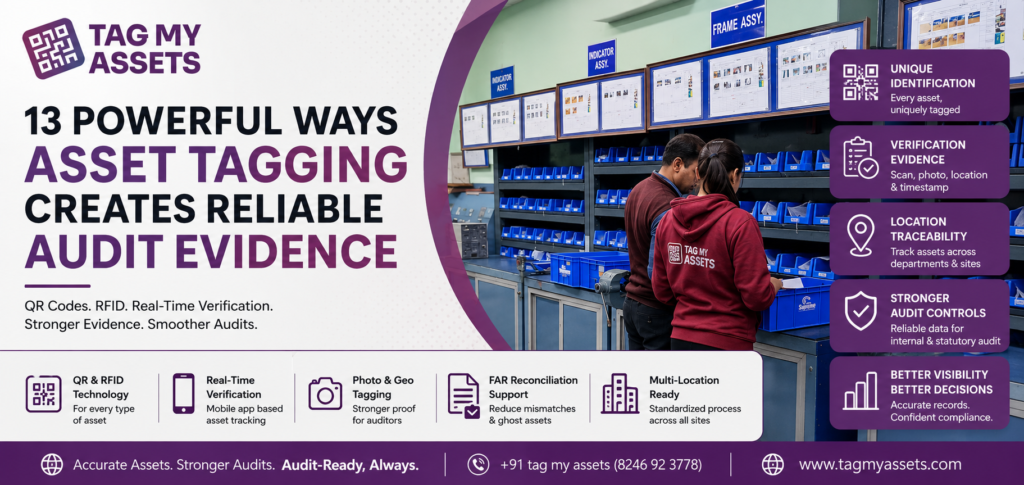
What Is Asset Tagging Audit Evidence?
Asset tagging audit evidence refers to the documentation and traceability created when physical assets are linked with:
- unique identification numbers
- QR codes
- RFID tags
- FAR records
- geo-tagged verification
- image-based verification
- location mapping
- scan history
- movement records
- verification timestamps
This evidence helps auditors validate:
- asset existence
- ownership
- location
- movement
- verification status
- reconciliation accuracy
Without structured tagging systems, companies often struggle to provide reliable physical verification support during audit.
Why Auditors Need Strong Asset Evidence
Auditors generally do not rely only on FAR data.
They expect companies to demonstrate:
- physical existence
- identification capability
- traceability
- reconciliation support
- control over asset movement
This becomes more critical in:
- multi-location companies
- retail chains
- manufacturing plants
- logistics businesses
- infrastructure-heavy industries
Especially where assets move frequently.
1. Asset Tagging Creates Unique Asset Identity
One of the biggest practical problems during physical verification is identifying similar-looking assets.
Example:
| Asset Type | Common Practical Problem |
|---|---|
| Office Chairs | No unique identification |
| POS Systems | Similar models across stores |
| Warehouse Racks | Difficult manual counting |
| Laptops | Frequent employee transfers |
| Machinery Components | Parent-child confusion |
Without tagging, verification teams often depend on:
- serial numbers
- handwritten stickers
- department assumptions
- Excel references
which are unreliable during large audits.
QR and RFID tags create unique identification for each asset.
That uniqueness becomes the foundation of audit evidence.
2. QR Codes Improve Audit Traceability
QR-based tagging systems are highly effective for creating visual and traceable audit evidence.
Typical verification flow:
| Step | Practical Process |
|---|---|
| Asset Scan | QR code scanned through mobile app |
| Asset Mapping | FAR linked with physical asset |
| Image Capture | Asset photo captured |
| Location Capture | Department/store/floor updated |
| Timestamp Logging | Verification date/time stored |
This creates an audit trail which can later support:
- statutory audit
- internal audit
- insurance verification
- asset reconciliation
Many organizations now use QR and RFID technologies to strengthen asset tagging audit evidence across multiple business locations.
3. RFID Improves Bulk Audit Verification Speed
RFID becomes highly useful in environments where manual scanning is difficult.
Particularly in:
- warehouses
- retail stores
- distribution centers
- manufacturing units
For example:
Retail display racks often require anti-metal RFID tags because normal paper RFID labels fail on metallic surfaces.
During large retail verification projects, RFID helps reduce manual counting effort significantly where:
- multiple fixtures exist
- asset movement is frequent
- stores operate continuously
However, RFID implementation requires practical understanding.
RFID Audit Evidence Challenges Companies Face
| Challenge | Practical Impact |
|---|---|
| Wrong tag type | Read failures |
| Metallic surfaces | Signal interference |
| Poor adhesive quality | Tag peeling |
| Wrong tag placement | Low scanning accuracy |
| Aesthetic concerns | Store rejection |
This is why execution quality matters more than just using RFID technology.
4. Asset Tagging Helps Detect Ghost Assets
Ghost assets are one of the most common issues discovered during physical verification.
These are assets:
- appearing in FAR
- but physically unavailable
Common reasons:
- disposal not updated
- transferred assets
- duplicate capitalization
- scrapped assets still active
- ERP cleanup not performed
Without structured asset tagging, identifying ghost assets becomes extremely difficult.
5. Asset Tagging Improves FAR Validation
One of the biggest audit problems is mismatch between:
- FAR records
AND - physical asset availability
This becomes more complicated in companies where:
- assets move frequently
- departments change
- branches transfer equipment
- capitalization is component-wise
A proper asset tagging audit evidence system helps link:
- FAR line item
- physical asset
- verification status
- location details
- image proof
This simplifies reconciliation significantly.
6. Parent-Child Asset Structures Create Major Audit Complexity
This issue is extremely common in manufacturing companies.
For example:
A production machine may contain:
- drives
- motors
- panels
- attached systems
- supporting components
But FAR may show them separately because capitalization happened over multiple years.
Without parent-child tagging logic:
- counts inflate
- matching becomes confusing
- verification time increases
- audit evidence weakens
This is one of the biggest practical reconciliation bottlenecks during factory audits.
7. Multi-Location Businesses Need Stronger Audit Evidence
Companies operating across:
- retail stores
- regional offices
- warehouses
- hospitals
- educational campuses
usually face major traceability challenges.
Common issues:
- asset transfers without approvals
- branch-level asset shifting
- duplicate procurement assumptions
- inconsistent tagging standards
In practical projects, location mismatch rates can initially reach:
- 5–15% in older organizations
before reconciliation cleanup.
8. Mobile Verification Apps Improve Audit Documentation
Manual Excel verification creates major evidence gaps.
Common problems:
- duplicate entries
- delayed reconciliation
- missing timestamps
- no image evidence
- difficult consolidation
Mobile verification systems improve audit evidence quality through:
| Feature | Audit Benefit |
|---|---|
| QR/RFID Scanning | Unique identification |
| Geo-tagging | Location validation |
| Timestamp Capture | Verification proof |
| Image Upload | Visual evidence |
| Central Database | Easier reconciliation |
| Store-wise Reporting | Better audit traceability |
9. Asset Tagging Supports Internal Financial Controls
Strong asset tagging systems improve:
- accountability
- movement tracking
- asset ownership validation
- disposal controls
- verification consistency
Auditors generally consider these indicators of stronger internal controls.
10. Asset Tagging Reduces Verification Dependency on Individuals
In many organizations, asset knowledge stays with:
- admin staff
- plant supervisors
- store managers
- maintenance teams
When employees change, asset tracking weakens badly.
Structured tagging systems reduce dependency on individual memory.
11. Wrong Tag Placement Weakens Audit Evidence
This is a very practical field-level issue.
Poor placement creates:
- scanning difficulty
- damaged tags
- maintenance removal
- aesthetic objections
- low visibility
For example:
Retail stores often reject poorly pasted tags on customer-facing fixtures because appearance matters operationally.
12.Tagging Productivity Depends on Asset Type
Companies often underestimate physical verification effort.
Practical productivity ranges usually vary significantly.
| Industry Type | Approx Practical Capacity |
|---|---|
| Office furniture | 100–150 assets/day/person |
| Laptops and IT equipment | 100–120 assets/day/person |
| Plant and machinery | 80-100 assets/day/person |
These differences directly affect:
- audit timelines
- manpower planning
- reconciliation speed
13. Asset Tagging Creates Long-Term Audit Readiness
The biggest advantage of structured asset tagging is not just annual verification.
It is long-term audit readiness.
Companies with mature tagging systems generally experience:
- faster audits
- lower mismatch rates
- improved reconciliation
- stronger traceability
- easier location tracking
- reduced ghost assets
over time.
Common Mistakes Companies Make While Creating Audit Evidence
Starting Tagging Before FAR Cleanup
Creates:
- duplicate mapping
- incorrect asset linking
- reconciliation delays
Weak asset tagging audit evidence often results in FAR mismatch issues and reconciliation delays during physical verification.
Using Wrong RFID Tags
Especially on:
- metallic racks
- machinery
- warehouse fixtures
Ignoring Non-Taggable Asset Classification
Not all assets should be tagged.
Companies must classify:
- taggable
- countable
- non-auditable
properly.
Delaying Reconciliation Until Project End
This creates large mismatch accumulation.
Real-time reconciliation is far more effective.
QR Code vs RFID for Audit Evidence
| Factor | QR Code | RFID |
|---|---|---|
| Cost | Lower | Higher |
| Audit Visibility | Excellent | Moderate |
| Bulk Verification | Limited | Strong |
| Infrastructure Need | Low | Higher |
| Retail Rack Verification | Moderate | Excellent |
| Manual Dependency | Higher | Lower |
| Read Accuracy | High | Depends on environment |
Frequently Asked Questions (FAQs)
Why is asset tagging important during audit?
Because it creates traceable audit evidence linking physical assets with FAR records and verification history.
What type of audit evidence does QR tagging create?
QR systems generally create:
- scan history
- timestamps
- image evidence
- location mapping
- verification logs
Is RFID better than QR for audit verification?
It depends on operational requirements.
RFID works better for:
- bulk asset environments
- warehouses
- retail fixtures
- large-scale movement tracking
QR is often more economical for standard office environments.
Why do auditors ask for physical verification evidence?
To validate:
- asset existence
- ownership
- FAR accuracy
- movement control
- internal financial controls
What are ghost assets?
Assets appearing in FAR but physically unavailable during verification.
Conclusion
Asset tagging is no longer just an identification exercise.
For modern Indian businesses, it has become an important mechanism for creating reliable audit evidence during:
- statutory audits
- internal audits
- physical verification
- FAR reconciliation
- insurance assessments
- compliance reviews
Companies relying purely on manual tracking systems often struggle with:
- traceability gaps
- ghost assets
- reconciliation delays
- duplicate records
- poor audit documentation
On the other hand, structured QR and RFID-based tagging systems create stronger audit evidence through:
- unique identification
- verification history
- location mapping
- image-based validation
- movement traceability
The real value of asset tagging lies not in the label itself, but in the audit trail and operational control it creates over time.
For organizations managing assets across multiple locations, factories, warehouses, stores, hospitals, or offices, practical implementation quality matters far more than simply pasting tags.
A properly executed asset tagging system should improve long-term asset governance, audit readiness, and verification reliability across the organization.
A strong asset tagging audit evidence framework improves audit readiness, traceability, and asset control visibility over time.
Good Reads
- Fixed Asset Verification Services
- RFID Asset Tagging Services
- FAR Reconciliation Services
- Asset Tagging Services in India
- Inventory Verification Services
- Physical Verification Audit Blogs