
Physical verification of fixed assets is one of the most important activities during internal audits. Companies with inaccurate asset records, missing assets, or weak verification systems often face compliance risks, audit observations, and operational inefficiencies.
An effective internal audit checklist for physical verification of fixed assets helps organizations:
- validate asset existence,
- improve FAR accuracy,
- identify discrepancies,
- strengthen internal controls,
- and improve audit readiness.
This process becomes even more important for companies operating across:
- factories,
- warehouses,
- retail stores,
- hospitals,
- branch offices,
- and multiple operational locations.
In this guide, we explain the most important internal audit checklist points companies should follow during physical verification of fixed assets.
Why Physical Verification Is Important During Internal Audit
Internal auditors evaluate whether:
- assets physically exist,
- records are accurate,
- controls are effective,
- and asset movement is properly monitored.
Weak verification systems may lead to:
- missing assets,
- FAR mismatch,
- duplicate records,
- ghost assets,
- and incorrect financial reporting.
Periodic physical verification helps companies improve compliance and reduce audit risk significantly.
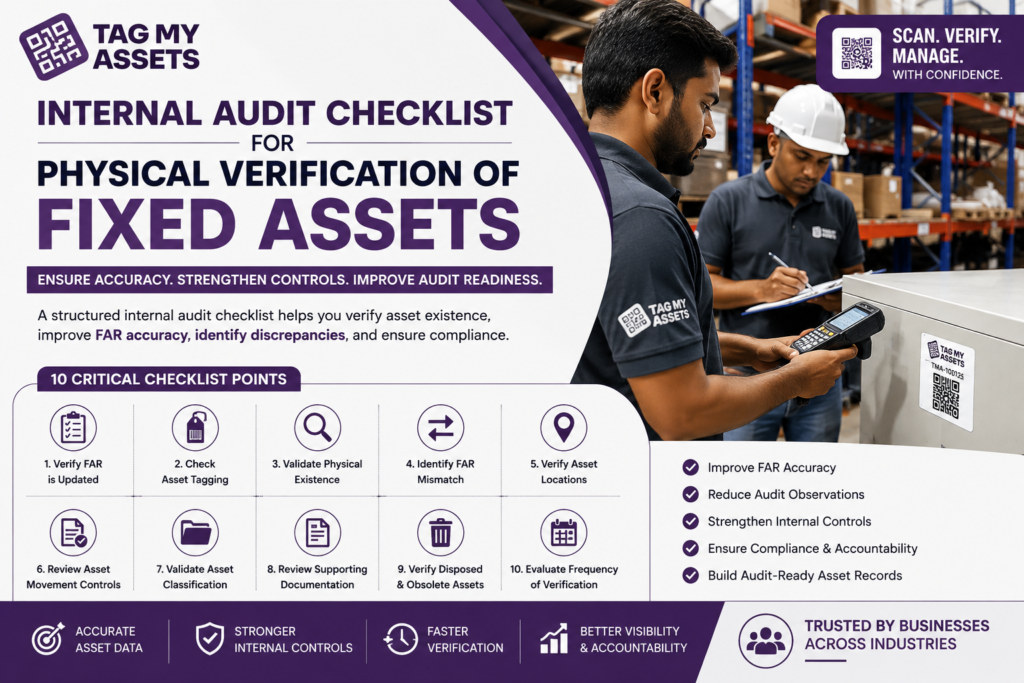
1. Verify Whether Fixed Asset Register (FAR) Is Updated
The first point in any internal audit checklist for physical verification of fixed assets is reviewing the FAR.
Auditors should check whether:
- new assets are added properly,
- disposed assets are removed,
- capitalization records are accurate,
- and locations are updated.
Outdated FAR records create major verification problems during audits.
2. Check Asset Tagging Status
Every asset should ideally carry a:
- barcode,
- QR code,
- RFID tag,
- or unique identification number.
Untagged assets are difficult to trace during physical verification and often create audit observations.
Internal auditors should verify:
- tag availability,
- tag readability,
- and uniqueness of asset codes.
3. Validate Physical Existence of Assets
The core objective of physical verification is confirming whether assets physically exist.
Auditors should:
- physically inspect assets,
- confirm asset condition,
- validate asset location,
- and match assets with FAR records.
This is one of the most important internal audit checklist points for physical verification of fixed assets.
4. Identify FAR Mismatch and Discrepancies
Internal auditors should identify:
- missing assets,
- excess assets,
- duplicate records,
- and incorrect locations.
Discrepancies between physical assets and FAR records indicate weak internal controls and poor asset management practices.
Proper FAR reconciliation helps companies resolve these issues efficiently.
5. Verify Asset Location Mapping
Companies with multiple branches or operational sites often struggle with asset location accuracy.
Internal auditors should verify whether:
- assets are available at recorded locations,
- transfers are documented,
- and movement approvals exist.
Incorrect asset location mapping is a common audit observation.
6. Review Asset Movement Controls
Movable assets such as:
- laptops,
- tools,
- portable equipment,
- and handheld devices
require stronger tracking systems.
Internal auditors should review:
- asset issue records,
- employee allocation records,
- gate pass controls,
- and transfer approvals.
This helps strengthen Internal Financial Controls (IFC).
7. Validate Asset Classification
Incorrect asset classification impacts:
- depreciation,
- reporting,
- taxation,
- and compliance.
Auditors should confirm whether:
- furniture,
- IT equipment,
- machinery,
- vehicles,
- and operational equipment
are correctly categorized in the FAR.
8. Review Supporting Documentation
An important internal audit checklist point for physical verification of fixed assets is reviewing supporting records.
Auditors should verify:
- invoices,
- capitalization approvals,
- disposal records,
- transfer documentation,
- and verification reports.
Improper documentation weakens audit readiness.
9. Verify Disposed and Obsolete Assets
Companies often continue carrying:
- scrapped assets,
- sold assets,
- or obsolete equipment
in the FAR.
Internal auditors should ensure:
- disposed assets are removed from records,
- approvals exist,
- and disposal documentation is maintained properly.
10. Evaluate Frequency of Physical Verification
Companies should conduct physical verification periodically instead of only during statutory audits.
Internal auditors should assess whether verification frequency is reasonable based on:
- asset volume,
- asset value,
- operational risk,
- and business nature.
High-value and movable assets may require more frequent verification.
Common Internal Audit Observations During Asset Verification
Internal auditors frequently identify:
- untagged assets,
- missing assets,
- duplicate entries,
- outdated FAR records,
- incorrect locations,
- and weak movement controls.
Most of these issues can be reduced through:
- periodic verification,
- asset tagging,
- and centralized FAR management.
How Asset Tagging Improves Internal Audit Efficiency
Asset tagging significantly improves:
- asset traceability,
- verification speed,
- audit accuracy,
- and internal controls.
Barcode and RFID-based asset tagging systems help auditors:
- identify assets quickly,
- reduce manual errors,
- and simplify FAR reconciliation.
This improves overall audit readiness.
Best Practices for Physical Verification of Fixed Assets
Companies should follow these best practices:
- maintain updated FAR records,
- implement asset tagging,
- conduct periodic verification,
- reconcile discrepancies regularly,
- maintain digital verification reports,
- and strengthen movement controls.
Technology-driven verification systems improve operational visibility and compliance significantly.
Industries Where Internal Asset Verification Is Critical
Internal audit checklist processes are especially important for:
- manufacturing companies,
- retail chains,
- warehouses,
- hospitals,
- educational institutions,
- hotels,
- logistics companies,
- and infrastructure businesses.
Organizations with large asset bases require stronger verification systems and controls.
Frequently Asked Questions (FAQs)
What is an internal audit checklist for physical verification of fixed assets?
An internal audit checklist for physical verification of fixed assets helps auditors verify asset existence, FAR accuracy, asset location, tagging status, and internal controls.
Why is physical verification important during internal audit?
Physical verification helps companies identify missing assets, FAR mismatch, duplicate records, and control weaknesses.
How does asset tagging help during internal audit?
Asset tagging improves asset traceability, verification speed, FAR reconciliation, and audit accuracy.
What are common fixed asset verification audit observations?
Common observations include missing assets, untagged assets, outdated FAR records, duplicate entries, and incorrect asset locations.
Conclusion
An effective internal audit checklist for physical verification of fixed assets helps organizations improve:
- compliance,
- FAR accuracy,
- asset traceability,
- internal controls,
- and audit readiness.
Companies implementing:
- periodic physical verification,
- structured asset tagging,
- FAR reconciliation,
- and digital asset management systems
are better prepared to reduce audit observations and strengthen operational control.
As businesses continue expanding across multiple locations, strong physical verification systems become essential for maintaining transparency, compliance, and asset accountability.
Learn more about our fixed asset verification services for physical verification and audit compliance across multiple business locations.
Internal auditors also review compliance requirements under the Companies Act, 2013 and CARO 2020 reporting framework issued by the Ministry of Corporate Affairs (MCA).