
Many companies assume that once assets are tagged, audit control automatically improves. In practice, that is rarely the case.
Across physical verification and asset tagging projects — factories, warehouses, retail stores, corporate offices, multi-location businesses — the same pattern shows up: poor tagging execution often creates more audit confusion than control. This usually happens because organisations focus on pasting tags, completing counts, and generating reports, without first planning FAR mapping, tag selection, asset classification, and reconciliation logic.
This article covers the most common asset tagging failures we see during actual implementation, what each one does to audit reliability, and how to avoid it.
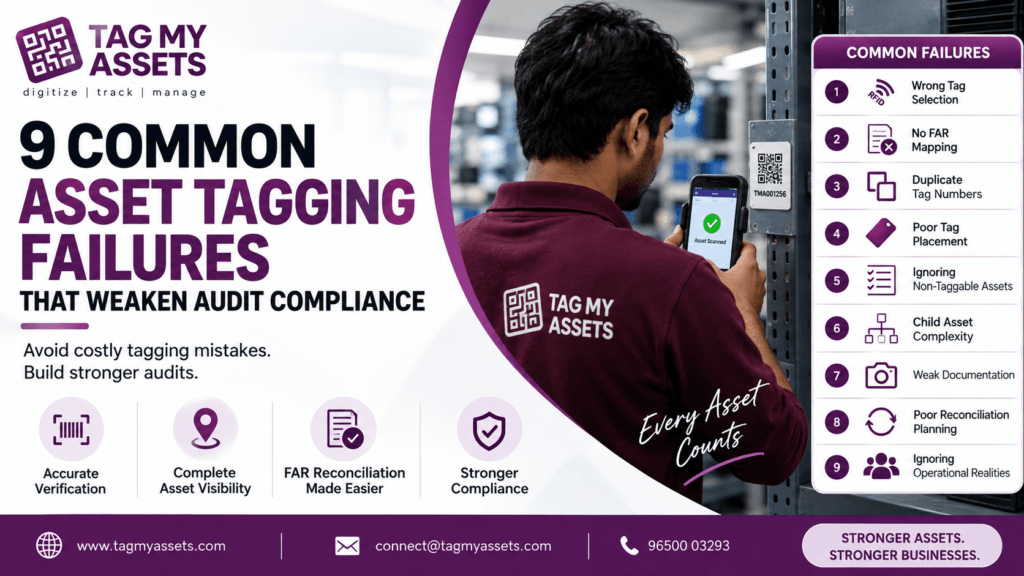
Why Asset Tagging Failures Create Audit Problems
Auditors expect a tagged asset to support unique identification, traceability, FAR linkage, and reconciliation accuracy. When the tagging system itself is unreliable, none of that holds up under statutory audit, internal audit, or insurance verification — regardless of whether the physical asset is actually there.
1. Wrong RFID Tags on Metallic Assets
Standard paper RFID tags on metal racks, steel fixtures, machinery, and warehouse shelving cause signal interference and poor read rates. In retail, display racks are usually metallic and need anti-metal RFID tags or on-metal labels — but projects under cost pressure sometimes use cheaper paper labels instead. They may work initially; read rates and adhesion both degrade over time, and the problem only surfaces during the next verification cycle.
| Factor | QR Code | RFID |
|---|---|---|
| Initial cost | Lower | Higher |
| Bulk scanning | Limited | Fast |
| Metallic surface compatibility | Easier | Needs anti-metal tags |
| Verification speed | Medium | High |
2. Tagging Before FAR Mapping
Starting tag printing and pasting before the FAR has been cleaned and mapped is one of the most common execution mistakes on large projects. Vague descriptions, duplicate records, and assets that have moved without paperwork all turn tagging into guesswork rather than verification.
On a multi-location engagement across five sites (18,500 assets in the FAR), the register had never been cleaned before tagging began. Reconciliation corrected 1,180 FAR records, found 426 assets physically present but never recorded, and found 287 assets recorded in the FAR but not present on site — all discovered only because reconciliation ran alongside tagging rather than after it.
3. Duplicate Asset Tag Numbers
Duplicate tag numbers usually come from manual Excel tracking, decentralised printing, or multiple teams working simultaneously without a shared issuance control. Once two assets carry the same ID, verification history and movement tracking both become unreliable — and the error is expensive to trace back after the fact.
4. Poor Tag Placement
Tags placed under desks, on removable panels, near heat sources, or on curved surfaces cause scanning difficulty, adhesive failure, or peeling. In customer-facing retail environments, poorly placed tags also draw aesthetic objections — store teams sometimes remove them, which defeats the exercise entirely. Placement standards need to be agreed before tagging starts, not adjusted mid-project.
5. Ignoring Non-Taggable Asset Classification
Not every asset should be tagged. Ceiling lights, CCTV cameras, embedded electrical wiring, and short-lifecycle temporary displays are typically impractical or unnecessary to tag individually. Trying to tag everything increases project time and manpower cost without improving audit reliability — classification into taggable, countable, and non-auditable categories should happen before field work begins, not during it.
6. Missing Parent-Child Logic
This is especially common in manufacturing. A single production asset may include a motor, drive, panel, and other components — but the FAR often shows these as separate lines because capitalisation happened component-wise over several years. Without a parent-child relationship recorded, counts inflate and duplicate tagging becomes likely.
An auto-components manufacturing engagement across three plants and a corporate office illustrates this well: the FAR carried roughly 9,200 assets, several representing components that had been capitalised separately from their parent machines. Reconciliation cleaned the register to 8,400 usable records, with around 800 written off as no longer physically present — work completed in nine working days, after which the client used the reconciled register as its asset master for an SAP migration.
For more on this distinction, see our guide to component capitalisation vs physical verification.
7. Weak Verification Documentation
Tags pasted without a photograph, location, timestamp, and verifier name leave no audit trail. Modern audit expectations increasingly expect digital, traceable records rather than a spreadsheet line — mobile-based verification captures this alongside the scan itself, rather than as a separate, easily skipped step.
8. Reconciliation Left Until the End
Delaying reconciliation until tagging is complete lets mismatches accumulate quietly. Reconciliation run continuously during execution — flagging discrepancies as they’re found rather than after the project closes — keeps the mismatch volume manageable and the final report defensible.
9. Unrealistic Productivity Assumptions
Underestimating how long verification actually takes leads to rushed tagging, poor scanning quality, and incomplete documentation. Practical planning figures, by asset type:
| Asset type | Approx. capacity per person per day |
|---|---|
| Office furniture | 100–150 assets |
| Laptops and IT equipment | 100–120 assets |
| Plant and machinery | 80–100 assets |
These figures directly affect manpower planning, timelines, and — ultimately — how much gets rushed near project close.
How to Avoid These Failures
- Clean the FAR before tagging — remove duplicates, freeze active records, identify obsolete assets.
- Classify assets properly — taggable, countable, non-auditable, parent-child.
- Choose the right tag — QR vs RFID, anti-metal tags where the surface requires it.
- Standardise placement — visible, scannable, maintenance-safe, aesthetically acceptable.
- Verify in real time — mobile scanning, photo capture, and reconciliation as one workflow, not three separate steps.
Frequently Asked Questions
Why do asset tagging projects fail?
Most commonly: wrong tag selection, tagging before FAR mapping, weak reconciliation planning, duplicate records, and incorrect placement.
Why are anti-metal RFID tags important?
Standard RFID labels generally don’t read reliably on metallic surfaces because of signal interference.
Can all assets be tagged?
No. Assets should be classified as taggable, countable, or non-auditable based on operational feasibility before tagging begins.
Why do FAR mismatches appear after tagging?
Because tagging often starts before FAR cleanup, reconciliation planning, and asset classification are complete.
See also: Asset Tagging Services in India, Fixed Asset Verification Services, FAR Reconciliation Process. For statutory reference, see the Institute of Chartered Accountants of India and the Ministry of Corporate Affairs.