
How Asset Tagging Closes the Gap Between SAP and the Floor
Asset tagging for SAP fixed assets starts where the ERP stops. SAP may hold lakhs of asset records, but during physical verification the problem is the gap between those records and what is actually on site.
Common situations seen during actual audits:
- Assets available physically but not traceable in SAP
- SAP showing assets at old locations
- Duplicate FAR entries
- Child asset capitalization confusion
- Missing serial numbers
- One SAP asset code representing multiple physical assets
- Assets transferred between branches without documentation
- Ghost assets continuing in depreciation schedules
This is where tagging and physical verification do the work SAP cannot.
Tagging and verification, run alongside SAP rather than inside it, help companies:
- improve FAR accuracy
- reduce audit observations
- simplify physical verification
- improve asset traceability
- streamline branch-wise reconciliation
- reduce manual Excel dependency
However, actual implementation is far more complex than software demos suggest.
In this article, we explain how asset tagging software integrates with SAP in real-world Indian business environments, including practical execution challenges, reconciliation complexities, and implementation realities observed across multi-location projects.
Why SAP Data Alone Is Usually Not Enough
Many companies assume:
“SAP already has all asset data, so physical verification should be easy.”
In practice, this is rarely true.
This gap between ERP records and physical reality is exactly where asset tagging software helps.
What Asset Tagging for SAP Fixed Assets Involves in Practice
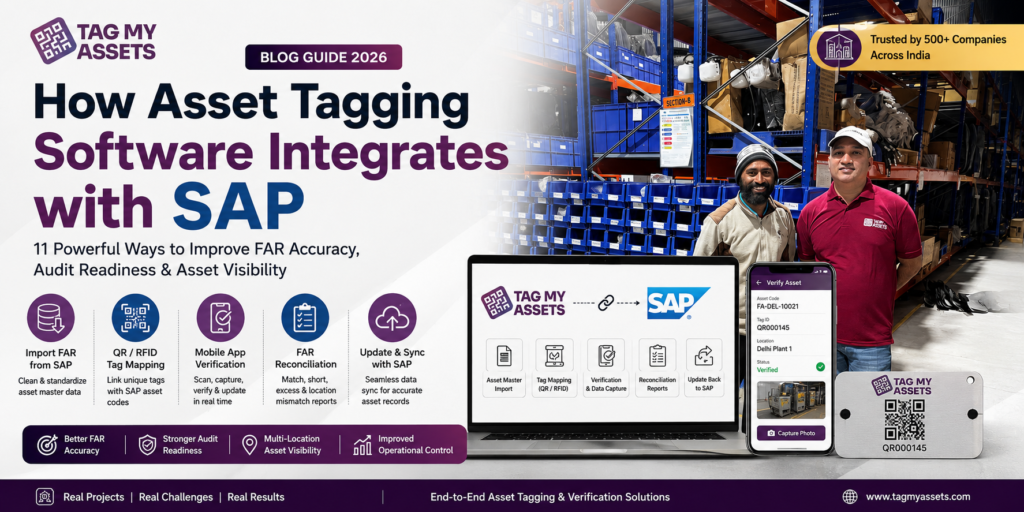
In practical projects, SAP integration usually means:
- Importing FAR data from SAP
- Mapping asset master data
- Linking QR/RFID tag numbers with SAP asset codes
- Capturing physical verification status
- Updating location/user/condition data
- Reconciling shortages/excess assets
- Exporting verified data back into SAP-compatible formats
In most Indian companies, integration is not fully automated initially. The biggest advantage when asset tagging software integrates with SAP is centralized visibility across locations.
The actual workflow often looks like this:
Typical SAP + Asset Verification Workflow
| Step | Practical Activity |
|---|---|
| 1 | FAR exported from SAP |
| 2 | Data cleaned and standardized |
| 3 | Asset categories identified |
| 4 | Taggable vs non-taggable assets classified |
| 5 | QR/RFID tags generated |
| 6 | Mobile app-based verification conducted |
| 7 | Physical observations captured |
| 8 | Match/short/excess reconciliation prepared |
| 9 | Final verified data shared with SAP team |
| 10 | SAP master updated internally |
1. SAP Asset Master Import into Asset Tagging Software
This is the first operational step.
Normally, companies export FAR data from SAP in Excel or CSV format.
Typical SAP fields include:
- Asset Code
- Asset Description
- Quantity
- Cost Center
- Plant
- Location
- Capitalization Date
- WDV
- Gross Block
- Asset Class
However, imported data is usually not clean enough for direct verification.
Common Practical Problems During Import
| Problem | Practical Impact |
|---|---|
| Inconsistent location names | Duplicate locations created |
| Missing serial numbers | Difficult identification |
| Quantity-based asset rows | Verification confusion |
| Generic descriptions | Wrong tagging risk |
| Mixed capitalization logic | Parent-child mismatch |
| Old inactive assets | Audit complications |
This data cleanup phase often takes longer than companies expect.
2. QR Code or RFID Tag Mapping with SAP Asset Codes
Once FAR data is cleaned, unique tag IDs are mapped with SAP asset numbers.
Example:
| SAP Asset Code | Physical Tag |
|---|---|
| FA-DEL-10021 | QR000145 |
| FA-MUM-20044 | RFID-A001256 |
This mapping becomes the foundation for future audits and tracking.
QR vs RFID Integration with SAP
| Factor | QR Code | RFID |
|---|---|---|
| Cost | Lower | Higher |
| Scan Method | Line-of-sight | Bulk scanning possible |
| Suitable For | Offices, furniture, IT assets | Warehouses, retail, manufacturing |
| Mobile App Compatibility | Excellent | Requires RFID hardware |
| Implementation Complexity | Lower | Higher |
| SAP Mapping Difficulty | Easier | Medium |
| Multi-asset scanning | Limited | Strong |
In actual Indian projects, many companies use hybrid models:
- QR for general assets
- RFID for high-movement or large-volume environments
3. Mobile App-Based Physical Verification Linked with SAP
This is where operational efficiency improves significantly.
Field teams scan:
- QR code
or - RFID tag
using mobile applications linked with SAP asset data.
During verification, teams capture:
- asset availability
- condition
- image
- GPS location
- user department
- movement remarks
- floor/section details
This creates much better audit evidence compared to manual Excel-based verification.
One major advantage when asset tagging software works alongside SAP is that field verification data is captured in a structured format from the outset, so the central asset records can be updated from a clean file rather than reassembled from spreadsheets.
Practical Field Reality During SAP-Based Verification
Ground execution is rarely straightforward.
Common Situations Seen During Verification
Manufacturing Plants
- Machines partially dismantled
- Child assets separately capitalized
- Heavy dust/oil affecting tag readability
- Hot surfaces requiring special RFID tags
Retail Stores
- Metallic racks requiring on-metal RFID tags
- Weekend restrictions affecting productivity
- Frequent fixture movement
- Decorative laminates causing tag peeling
Corporate Offices
- IT assets shifted without records
- Employee transfers creating mismatches
- Duplicate monitors/printers difficult to identify
Laboratories
- Equipment movement between departments
- Instrument traceability requirements
- Cleaning routines affecting tag durability
4. FAR Reconciliation Using Asset Tagging Software
This is one of the most important integration benefits.
After physical verification, reconciliation reports are generated.
Typical categories include:
| Status | Meaning |
|---|---|
| Matched | Asset physically verified |
| Short | Asset not found |
| Excess | Found physically but not in FAR |
| Different Location | Found elsewhere |
| Non-Taggable | Count-only assets |
| Pending Verification | Access not available |
| Scrap/Obsolete | No longer operational |
This reconciliation becomes extremely useful for:
- statutory audit
- internal audit
- insurance validation
- asset capitalization review
- impairment review
Reconciled, evidenced records close an audit faster than a spreadsheet count.
5. Parent-Child Asset Mapping Challenges in SAP
This is one of the biggest practical problems in Indian companies.
Example:
A production line may physically appear as:
- 1 machine
But SAP may contain:
- motor
- control panel
- conveyor
- sensors
- structure
- accessories
all capitalized separately.
During physical verification:
- teams see one integrated machine
- SAP shows multiple asset codes
Without proper parent-child mapping logic, reconciliation becomes messy.
This is especially common in:
- manufacturing plants
- process industries
- engineering companies
6. Multi-Location Asset Tracking Through SAP Integration
Large companies often struggle with branch-wise visibility.
Especially in:
- Retail Chains
- Banks & NBFC
- Laboratories
- Depots and Distribution Networks
- logistics businesses
Typical operational problems include:
- Asset transfers without SAP updates
- Location naming inconsistencies
- Duplicate branch codes
- Old store closures
- Regional asset movement
Asset tagging software helps create:
- Centralized visibility
- Location-wise reports
- Store-wise reconciliation
- Branch-wise shortage analysis
What Affects Verification Productivity
Productivity varies considerably by asset type and site conditions. Office environments with accessible desk-level assets run fastest; working plants with machinery, height work or safety protocols run slowest. Retail and warehouse sites sit between the two, and RFID improves throughput substantially where bulk scanning is possible. We size teams and timelines after reviewing your asset mix and site list.
Actual numbers depend on:
- asset complexity
- accessibility
- branch readiness
- FAR quality
- tagging requirements
Common Mistakes Companies Make During SAP Integration
1. Starting Verification Without FAR Cleanup
This creates major reconciliation confusion later.
2. Ignoring Non-Taggable Assets
Assets like:
- CCTV
- electrical fittings
- civil work
often require separate handling.
3. Wrong RFID Tag Selection
Using paper RFID tags on metallic racks leads to scanning failures.
4. No Asset Naming Standardization
Different naming conventions create duplicate reporting issues.
5. Treating SAP Integration as Pure IT Work
Actual success depends equally on:
- audit
- finance
- operations
- physical verification teams
Real-World Observation from Large Multi-Location Projects
One practical challenge repeatedly observed in India:
ERP data is often maintained centrally, but asset movement happens locally.
Example:
- store teams shift fixtures internally
- regional teams relocate equipment
- maintenance teams replace parts
- old assets remain in SAP without disposal entries
Over time:
- FAR accuracy reduces significantly
- audit complexity increases
- physical verification timelines increase
This is why periodic asset verification linked with SAP is becoming increasingly important.
Industries Where SAP + Asset Tagging Integration Creates Maximum Value
| Industry | Major Benefit |
|---|---|
| Manufacturing | Machine traceability |
| Retail Chains | Store-wise visibility |
| Laboratories | Instrument and equipment traceability |
| Warehousing | High-volume tracking |
| IT Companies | Employee asset control |
| Pharma | Compliance documentation |
| Logistics | Distributed asset visibility |
FAQ
Can SAP directly generate QR codes for assets?
SAP can store asset identifiers, but dedicated asset tagging software usually provides better:
- mobile verification
- QR generation
- RFID support
- reconciliation workflows
- image capture
- audit reporting
Is RFID always better than QR code for SAP integration?
No.
RFID is useful for:
- high-volume scanning
- warehouses
- retail environments
- movement tracking
QR codes are often more cost-effective for:
- offices
- fixed assets
- low-movement environments
How long does SAP-based asset verification take?
It depends on:
- asset volume
- FAR quality
- number of locations
- asset complexity
- tagging requirements
For large multi-location companies, projects often run in phases.
Why do SAP and physical assets usually mismatch?
Common reasons include:
- asset movement
- poor disposal controls
- duplicate records
- capitalization errors
- missing tagging systems
- branch-level operational changes
Conclusion
SAP alone cannot ensure fixed asset accuracy.
Without physical verification and proper asset tagging integration:
- FAR mismatches continue growing
- audit observations increase
- asset traceability weakens
- ghost assets remain active
- reconciliation becomes difficult
A properly implemented asset tagging system integrated with SAP helps companies create:
- better visibility
- stronger audit readiness
- accurate FAR records
- location-wise asset control
- improved operational accountability
However, real success depends less on software demos and more on:
- proper FAR preparation
- field execution quality
- tagging strategy
- reconciliation methodology
- operational understanding
That is where practical implementation experience matters most.