
Clause 3(i) of CARO 2020: Fixed Asset Verification, FAR Reconciliation & Ind AS 16 ComplianceCompliance Guide · CARO 2020
Fixed Asset Verification:
FAR Reconciliation, Ind AS 16 & GST Compliance
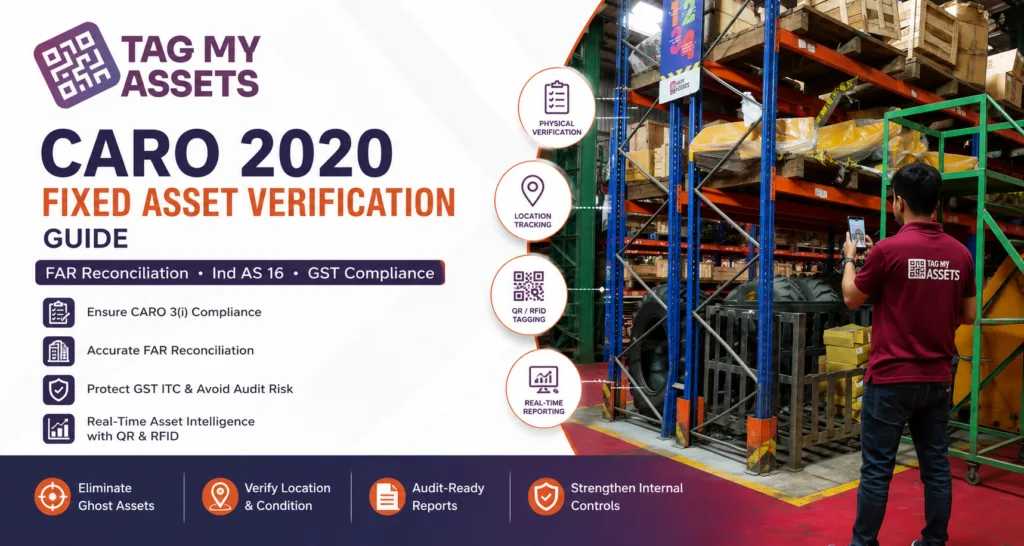
Technology-driven fixed asset verification under Clause 3(i) of CARO 2020 helps organisations improve FAR reconciliation, reduce ghost assets and maintain audit readiness
Table of Contents
- Why CARO 2020 Changed Asset Verification
- Understanding CARO 3(i) Requirements
- What is Fixed Asset Verification?
- How FAR and Physical Verification Connect
- The Case for Continuous Tracking
- Challenges in Manual Verification
- Traditional vs. Technology-Driven Verification
- How Technology Improves CARO 2020 Compliance
- The Technology-Driven Verification Workflow
- Common Findings During Asset Verification
- FAR Reconciliation, Ind AS 16 & GST
- Why Companies Choose TagMyAssets
- CARO 2020 Compliance Checklist
- Benefits Beyond Compliance
- Frequently Asked Questions
Technology-driven CARO 2020 fixed asset verification helps organisations improve FAR reconciliation, reduce ghost assets and maintain audit readiness.
1. Why Clause 3(i) of CARO 2020 Changed Asset Verification Expectations
CARO 2020 fixed asset verification has become a critical compliance requirement for Indian enterprises managing fixed assets across multiple locations.
The issuance of the Companies (Auditor’s Report) Order, 2020 (CARO 2020) by the Ministry of Corporate Affairs (MCA) under Section 143(11) of the Companies Act, 2013 fundamentally elevated governance standards for corporate asset management across India.
Prior to Clause 3(i) of CARO 2020, fixed asset reporting frameworks permitted broad, qualitative assessments. General claims of periodic verification were frequently accepted by statutory auditors without granular supporting evidence. That ambiguity is now gone.
CARO 2020 introduced objective reporting requirements that shifted the burden of proof directly onto company management, transforming asset verification from a simple, passive accounting exercise into a documented internal control process. Auditors conducting a fixed asset audit in India are now explicitly instructed to challenge the verification methodologies used by management, evaluate the precision of record-keeping, and inspect the structural validity of the fixed asset register.
The official statutory mandate is published on the Ministry of Corporate Affairs CARO Order Gazette.
2. Understanding Clause 3(i) of CARO 2020 Requirements
Clause 3(i) of CARO 2020 runs to five sub-clauses. The three that govern records, physical verification and title deeds are set out below. Revaluation is dealt with at Clause 3(i)(d), which requires the auditor to report whether any revaluation of PPE or intangible assets during the year was based on a valuation by a Registered Valuer, and benami proceedings at Clause 3(i)(e). Each imposes distinct obligations on management.
Clause 3(i)(a)
Records of Location & Particulars
Splits into two limbs. Clause 3(i)(a)(A) requires proper records showing full particulars, including quantitative details and the situation (location), of Property, Plant and Equipment. Clause 3(i)(a)(B) requires proper records showing full particulars of intangible assets; there is no situation requirement for intangibles.
Clause 3(i)(b)
Physical Verification Protocols
Obligates management to physically verify PPE at “reasonable intervals.” The widely accepted industry standard is a full verification at least once every three years. Material discrepancies must be identified and adjusted in the books.
Clause 3(i)(c)
Immovable Property Title Deeds
Requires explicit reporting on whether title deeds of all immovable properties are held in the name of the company, or supported by duly executed lease agreements where applicable.
Note on the “reasonable intervals” standard: The three-year benchmark is an interpretive norm widely accepted by statutory auditors — it is not a numerical figure codified in the CARO 2020 statute itself. Auditors assess reasonableness based on company size, asset diversity, and the robustness of internal controls. Documenting your chosen verification cycle and applying it consistently is essential.
3. What is Fixed Asset Verification Under Clause 3(i) of CARO 2020?
🔍 Definition
Fixed asset verification under CARO 2020 is the process of physically validating company assets and reconciling them with the Fixed Asset Register (FAR) to confirm compliance with Clause 3(i), Ind AS 16, and statutory audit requirements. This control process validates the physical existence, condition, and location (“situation”) of property, plant, and equipment — enabling management to account for material discrepancies, identify ghost assets, and accurately support capital disclosures in the financial statements.
This definition covers two inseparable activities: the on-ground physical count and the corresponding financial reconciliation. Neither activity, performed in isolation, satisfies the full intent of CARO 2020. Auditors expect to see both the physical evidence and the ledger adjustment that followed.
4. How FAR and Physical Verification Connect
The Fixed Asset Register (FAR) and the physical verification process form a closed-loop internal financial control system. The FAR represents the financial truth — the values on which depreciation is claimed, taxes are calculated, and balance sheets are drawn. Physical verification represents the material truth — the actual presence, working status, and location of those economic resources.
True fixed asset register reconciliation is the process of cross-referencing these two datasets and resolving every variance. A compliant workflow requires executing two distinct reconciliation methods:
- Sheet-to-Floor Reconciliation: Taking an itemised line entry from the accounting ledger and locating it physically on the operational floor. This confirms the existence of the asset and proves that the company’s stated net block is not artificially inflated by non-existent equipment.
- Floor-to-Sheet Reconciliation: Scanning a physical asset found on the floor and tracing it back to its corresponding ledger entry. This identifies unrecorded assets that may have been purchased or capitalised incorrectly, ensuring complete and accurate financial reporting.
Both directions of reconciliation are necessary. A verification exercise that performs only one direction cannot produce a complete compliance picture.
5. Why Annual Verification Is Not Enough: The Case for Continuous Tracking
Many organisations treat asset tracking as an annual, reactive scramble conducted just before statutory auditors arrive. For complex enterprise operations, this approach carries significant hidden risk.
A static snapshot captures discrepancies only after they have occurred, making it nearly impossible to trace the historical chain of custody — proving when or why an asset went missing. Identifying a discrepancy late in the financial year can also trigger unexpected balance sheet adjustments and surprise audit qualifications.
Transitioning to a continuous, technology-enabled verification model fundamentally reduces corporate risk. When assets are scanned during routine internal movements, maintenance cycles, or quarterly checks, data gaps are resolved in real-time. The enterprise remains perpetually audit-ready, rather than scrambling during closing cycles.
6. Challenges in Manual Verification
Many enterprises still attempt physical asset verification using spreadsheet-driven, clipboard-based processes. This approach introduces compounding operational failures — particularly in distributed or multi-location organisations.
- Spreadsheet drift: A manual asset log becomes outdated almost immediately after it is compiled. The moment an engineer transfers a diagnostic tool between labs or an IT administrator reassigns corporate laptops, the static spreadsheet becomes incorrect. This is not a data quality problem — it is a structural limitation of the medium.
- Human identification errors: Relying on human eyes to read worn, oily, or obscured serial numbers on factory equipment introduces high rates of transcription error. Misread serial numbers lead to flawed records that may persist undetected through multiple audit cycles.
- Absence of a verifiable audit trail: Hand-written checkmarks on a printout do not constitute proof of existence. When statutory auditors request objective evidence of a verification event, manual logs cannot withstand scrutiny. Timestamps, geo-location, and photographic capture are increasingly expected as standard audit evidence.
- Siloed enterprise systems: Physical asset records frequently sit entirely separate from procurement databases and ERP software. This lack of integration causes systematic data desynchronisation across branches, manufacturing units, and regional offices — a problem that worsens with organisational scale.
7. Process Comparison: Traditional vs. Technology-Driven Verification
The following table contrasts the two methodologies across the parameters that matter most to finance and compliance teams.
| Parameter | Traditional Verification | Technology-Driven Verification |
|---|---|---|
| Tracking Ledger | Static Excel spreadsheets | Live, centralised dashboard |
| Field Data Collection | Manual counting on paper clipboards | QR codes / RFID automated scans |
| Verification Cycle | Annual or triennial reactive drills | Continuous / real-time tracking |
| Reconciliation Speed | Delayed — weeks of manual review | Instant algorithmic data matching |
| Audit Evidence | Subjective — handwritten logs | Objective — timestamp & geo-location verified |
| Ghost Asset Detection | Discovered only at year-end | Flagged automatically in real-time |
| Multi-Location Coverage | Resource-intensive, prone to gaps | Unified view across all sites and GSTINs |
8. How Technology Improves Clause 3(i) of CARO 2020 Compliance
The practical compliance improvements technology delivers include:
By adopting technology-driven asset tagging and verification systems through professional fixed asset tagging services, organisations shift from estimating asset statuses to capturing indisputable digital telemetry.Instant generation of itemised PDF and Excel validation reports — the kind of objective evidence that satisfies increasingly rigorous statutory auditors.
- Instant identification and categorisation of ghost assets before they enter audit proceedings.
- Real-time location mapping that satisfies the CARO “situation” requirement for every asset in the register.
- Server-validated timestamps and GPS coordinates providing documented evidence of the verification event.
- One-click generation of Clause 3(i)-compliant evidence exports in both PDF and Excel formats for auditor submission.
For deeper technical implementation protocols, the ICAI Guidance Note on CARO 2020 issued by the Institute of Chartered Accountants of India provides authoritative implementation guidance.
9. Technology-Driven Verification Workflow
A technology-driven verification exercise replaces manual workflows with an end-to-end digital lifecycle that links every physical asset directly to the central ledger.
1 Data Ingestion & Ledger Structuring
The company’s existing FAR is imported from its ERP platform into the asset management system. The software structures legacy data into clean, trackable records categorised by asset class, location tier, and cost centre — resolving inconsistencies before field work begins.
2 Universal Digital Tagging
Every physical asset receives a unique digital identity. High-density QR codes or barcodes are applied to office equipment and IT assets. Passive RFID tags are deployed in high-density environments such as server rooms and warehouse racks, where simultaneous batch scanning without line-of-sight is required.
3 Mobile Field Verification
Field staff equipped with smartphones or dedicated RFID readers scan assets room by room, floor by floor, or plant by plant. Each scan automatically captures asset presence, physical condition, and precise geo-location without requiring manual data entry.
4 Automated Exception Analysis
The platform instantly cross-references field data with the central accounting register. Automated matching algorithms categorise every asset into distinct compliance buckets — Matched, Misplaced, Missing, or Unrecorded — and surface anomalies in a live dashboard without manual spreadsheet manipulation.
5 Ledger Synchronisation & Archiving
Once discrepancies are reviewed and authorised by designated managers, the system updates asset positions, triggers necessary ledger transfers, and archives an audit-ready compliance record with a complete digital chain of custody
10. Common Findings During CARO 2020 Asset Verification
When organisations rely on manual workflows, statutory asset audits frequently uncover a recurring set of accounting and physical control failures. Understanding these categories helps finance teams prioritise their remediation efforts.
👻Ghost Assets
Equipment remains in the ledger but cannot be located anywhere within the enterprise. This directly overstates net block values and creates a high risk of audit qualification and depreciation disallowance under Section 32 of the Income Tax Act.
📍Wrong Location Mapping
Assets are physically present but found at a different plant, state, or facility than registered in the FAR. This creates an internal control weakness under the CARO 3(i)(a)(A) “situation” mandate and complicates multi-GSTIN reporting.
🔄 Duplicate Asset Entries
The same physical asset is recorded twice in the FAR, typically due to procurement or invoicing errors during capitalisation. This leads to overstated asset values and incorrect depreciation calculations.
📅 Missing Disposal Records
Equipment was scrapped or sold years ago but never formally retired from the financial ledger. This violates Section 32 of the Income Tax Act and may result in GST ITC reversal exposure under Rule 44 of the CGST Rules.
⚙ Parent-Child Mismatches
Component parts are counted independently of their primary parent asset assemblies, creating significant data anomalies. A sub-component may appear as a standalone asset in the register while its parent assembly is listed separately, distorting gross block figures.
🔒Unrecorded Assets
Physical assets found on the floor during scanning have no corresponding ledger entry — often acquired through petty cash purchases or misclassified as revenue expenditure. These omissions understate capital assets and may affect depreciation and ITC entitlements.
11. The Role of FAR Reconciliation, Ind AS 16 & GST
The impact of modernizing fixed asset tracking extends well beyond satisfying a CARO review. It directly secures an organisation’s position across the broader Indian tax and financial accounting landscape.
1. Ind AS 16 (Property, Plant, and Equipment) Alignment
Under Ind AS 16, an enterprise must accurately determine the carrying amount of its PPE, reflect depreciation changes, and recognise impairment losses when they arise. A technology-driven verification workflow provides clear visibility into the actual physical condition of each asset. When a manufacturing machine is flagged during a mobile scan as broken or obsolete, finance teams can immediately trigger an impairment review or adjust the asset’s remaining useful life — keeping financial disclosures accurate, compliant, and reflective of economic reality.
Comprehensive measurement and recognition standards are detailed via the official MCA portal on the Indian Accounting Standard (Ind AS) 16 Framework.
| Ind AS 16 Requirement | Manual Tracking — Risk Exposure | Technology-Driven — Outcome |
|---|---|---|
| Carrying amount accuracy | Ghost assets inflate net block; no mechanism to detect until audit | Real-time reconciliation flags non-existent assets before period close |
| Impairment recognition | Condition data absent; impairment reviews delayed or missed | Condition photographs captured at every scan trigger immediate impairment review |
| Useful life reassessment | Residual life estimates based on paper records, often outdated | Operational condition data enables timely depreciation schedule adjustments |
| Componentisation (para 43–47) | Parent-child mismatches cause incorrect component depreciation rates | Hierarchical asset mapping ensures each component is depreciated correctly |
| Derecognition on disposal | Retired assets remain on books; gains/losses not recognised promptly | Digital disposal workflow triggers automatic derecognition and gain/loss calculation |
2. Income Tax Act — Section 32 Depreciation Protection
To legally claim depreciation allowances under Section 32 of the Income Tax Act, 1961, a company must prove that the asset is both owned and actively used for business operations during the relevant year. During income tax assessment proceedings, an assessing officer can disallow depreciation claims if the company cannot verify the existence or operational usage of an asset. Technology-driven asset verification — with timestamped scan logs and geo-tagged field evidence — protects these deductions by maintaining a clear, verifiable operational record for every asset on the block.
3. Mitigating GST Input Tax Credit (ITC) Reversal Risk
This is a critical area of financial exposure during GST audits. Under Section 17(5)(h) of the CGST Act, 2017, read with Rule 44 of the CGST Rules, any Input Tax Credit claimed on capital goods must be reversed if those goods are subsequently found to be lost, stolen, destroyed, written off, or disposed of without proper documentation.
If a manual corporate inventory cannot account for missing equipment, the organisation faces a compounding exposure: the unresolved variance is multiplied by the original ITC rate claimed, with retroactive interest accruing from the date of the original credit. A documented disposal workflow, captured during verification, mitigates this risk— ensuring that ITC reversals under Rule 44 are calculated accurately and backed by clear physical proof, including timestamped disposal authorisation and condition photographs.
| GST Scenario | Manual Tracking — Risk Exposure | Technology-Driven — Protection |
|---|---|---|
| Asset reported missing at audit | Full ITC reversal + interest from original claim date (Rule 44) | Continuous location tracking proves asset existence; no reversal triggered |
| Asset scrapped without documentation | ITC reversal mandatory; no supporting disposal evidence available | Digital scrap register with authorised disposal chain satisfies Rule 44 requirement |
| Inter-state asset transfer without transfer note | GSTIN mismatch creates ITC eligibility dispute at destination state | Digital transfer note updates location and GSTIN mapping in real-time |
| Asset used for exempt supply (Section 17(2)) | Apportionment under Rules 42/43 miscalculated without usage data | Usage and location logs support accurate exempt-supply ITC apportionment |
| Auditor requests asset ITC history | Manual reconstruction from invoices — incomplete and time-consuming | One-click ITC history report linked to asset scan record and purchase invoice |
GST citation note: Rule 44 governs ITC reversal in special circumstances, including capital goods held in stock on cancellation or exemption. Rule 43 deals with ITC attribution and reversal for capital goods used partly for taxable and partly for exempt supplies. Which provision applies depends on the facts — the asset’s use, the ITC availed, the remaining useful life and the mode of disposal. Both should be reviewed with your tax advisor rather than assumed. The full text of the CGST Rules is available on the Central Board of Indirect Taxes and Customs (CBIC) official portal.
12. Why Companies Choose TagMyAssets for Fixed Asset Verification India
Indian enterprises engage TagMyAssets to run physical asset verification and FAR reconciliation as a field service. Our teams and our verification application are built for the corporate, operational, and legal realities of the Indian regulatory environment.
🌎 PAN India Audit Execution
Manages multi-location verifications seamlessly — from corporate headquarters in financial centres to production facilities in industrial belts and warehouse networks across states.
🏳Unified QR & RFID Tagging
Offers deployment options ranging from high-density secure QR codes to long-range passive RFID tags designed for heavy industrial and hard-to-reach environments.
📱Intuitive Mobile Verification App
Transforms standard field smartphones into secure, data-capturing asset scanners — eliminating the need for expensive specialised hardware investment.
⚙ Automated FAR Reconciliation Engine
Replaces weeks of manual spreadsheet work with an instant matching dashboard highlighting ledger discrepancies, missing items, and location mismatches.
🕐 Multi-GSTIN Asset Management
Aligns asset locations directly with localised tax registrations, simplifying cross-state internal movements and state-level audit reporting across complex entity structures.
📄 Comprehensive Audit-Grade Evidence
Every scan captures server-validated timestamps, precise GPS coordinates, and condition photographs — Every field interaction leaves a timestamped digital record
TagMyAssets brings extensive experience executing large-scale asset verification and reconciliation projects across diverse industries — serving multi-location conglomerates, complex retail chains, heavy manufacturing facilities, laboratories, and modern distribution warehouses. Our teams are equipped for hospital and healthcare environments, including biomedical and diagnostic equipment.
13. Clause 3(i) of CARO 2020 Compliance Checklist: What an Audit-Ready System Must Include
Whether you run verification in-house or engage a field services firm, compliance teams should confirm the following are covered.
- Periodic Verification Scheduling & Interval Tracking — Built-in calendars to schedule, assign, and record physical verification events, providing documented proof of compliance with statutory timeline requirements.
- Discrepancy Logging & Management Workflow — A secure, multi-tier authorisation matrix routing variance approvals through management before any ledger alteration is permitted.
- Immovable Property Title Deed Register — A dedicated document module for storing and tracking title deeds, directly addressing the requirements of Clause 3(i)(c) of CARO 2020.
- Multi-Location & Multi-GSTIN Support — Architecture that isolates and categorises assets by distinct corporate entities and local GSTIN registrations.
- Ind AS 16 Depreciation Schedules — Automated calculation profiles supporting both straight-line and reducing-balance methods in alignment with accounting standards.
- One-Click CARO 3(i) Evidence Export — IInstant generation of itemised PDF and Excel validation reports for direct submission to statutory audit teams.
- QR/RFID Tagging Support — Built-in engine to print, bind, and register physical smart labels to digital asset records.
- Geo-Tagged Verification Evidence — Automatic capture of precise latitude and longitude coordinates during every scanning event.
- Image Capture with Server Timestamp — Server-locked date-and-time stamping of condition photographs within the mobile scan workflow.
- Parent-Child Asset Mapping — Structural hierarchy capability to link modular sub-assets and components to their primary plant equipment or parent assemblies.
- Asset Movement & Transfer Tracking — Digital transfer notes logging changes to physical locations and cost centres with full authorisation chain.
- Disposal & Scrap Register — Retirement module capturing disposal values, authorisation trails, and tax references to support Rule 44 CGST ITC reversal calculations.
- ERP Integration Capability — Open API support to synchronise asset registers with platforms including SAP, Oracle, and Microsoft Dynamics.
- Audit Trail Logs — Comprehensive system logs recording all modifications made to the asset register database, with a full change history supporting internal control attestation.
14. Benefits Beyond Compliance
Organisations that treat physical verification and FAR reconciliation as a continuous process — rather than an annual audit exercise — gain operational and financial advantages that extend well beyond clean audit reports.
Optimised Capital Expenditure
Procurement teams gain complete visibility into actual, on-the-ground asset utilization. Before approving purchase orders for new IT equipment or factory tools, management can identify and redeploy idle or underutilised assets from other branches — avoiding unnecessary capital spending.
Lower Insurance Premiums & Property Taxes
Maintaining non-existent items in active asset registers means overpaying on insurance premiums and local property taxes. Regularly cleaning up the FAR through automated verifications allows enterprises to adjust coverage to reflect actual asset values, reducing operating costs.
Enhanced Operational Efficiency
Field teams spend far less time searching for missing or misplaced tools.. The asset management system provides exact location history, reducing downtime and keeping operations running without disruption. Maintenance scheduling also improves when asset condition data is continuously captured.
Faster Statutory Audit Cycles
When a permanent, digital, geo-tagged compliance record exists for every asset, audit preparation time collapses. Finance teams no longer scramble to produce evidence — it is already organised, exportable, and in the format auditors expect.
For companies that need this done end to end, professional fixed asset reconciliation services cover physical verification, FAR matching, and discrepancy reporting.
15. Frequently Asked Questions
How often should fixed assets be physically verified under CARO 2020?
CARO 2020 requires the auditor to report on whether physical verification has been carried out at “reasonable intervals”— a term that is not numerically defined in the statute itself. However, the widely accepted industry and auditor standard across Indian corporates is a comprehensive verification at least once every three years. Companies that choose a rolling cycle — for example, verifying one-third of assets annually — must clearly document the schedule, apply it consistently, and be able to justify it to the statutory auditor. For high-mobility or high-value assets such as laptops and diagnostic equipment, annual verification is strongly recommended to minimise write-off risk and avoid internal control qualifications.
Does CARO 2020 require physical verification every year?
No. CARO 2020 Clause 3(i)(b) does not prescribe an annual verification mandate for all fixed assets. The legal text uses the phrase “reasonable intervals,” and completing a full cycle once every three years satisfies the broad statutory baseline for general plant and equipment. That said, companies with rolling verification cycles must document the schedule clearly and demonstrate consistent application to the statutory auditor. Annual verification is advisable for high-velocity or high-value mobile assets regardless of the general policy.
What is the difference between FAR reconciliation and physical verification?
Physical verification is the tactical on-the-ground activity: field teams scan or inspect each asset to confirm its physical existence, current location, and working condition. FAR reconciliation is the analytical process that follows: the field data is matched against the financial accounting ledger to identify discrepancies — ghost assets, duplicate entries, unrecorded acquisitions, or wrong location mappings — and the financial books are updated accordingly. Both activities are required for CARO 3(i) compliance; neither alone is sufficient.
Is RFID better than QR codes for fixed asset audits?
The right choice depends on the operational environment. QR codes are cost-effective and ideal for accessible assets such as IT equipment, office furniture, and corporate devices, since they can be scanned using standard smartphones without additional hardware investment. RFID is superior for high-density, industrial, or difficult-to-reach environments — server rooms, manufacturing bays, or high-shelf warehousing — because passive RFID readers can simultaneously capture hundreds of tag reads from a distance without requiring direct line of sight, significantly accelerating audit cycles at scale.
What documents are needed for CARO 2020 asset verification?
A complete and auditor-ready fixed asset verification dossier should include: an updated Fixed Asset Register with full particulars and location details per Clause 3(i)(a)(A); physical verification reports with timestamps, geo-coordinates, and condition photographs; authorised asset transfer logs recording all inter-location or inter-entity movements; disposal and scrapping certificates with supporting approval chains; and title deeds or registered lease agreements for all immovable properties as explicitly required under Clause 3(i)(c).
Can GST Input Tax Credit be impacted by missing fixed assets?
Yes, and the financial exposure can be material. Under Section 17(5)(h) of the CGST Act, 2017, read with Rule 44 of the CGST Rules, any Input Tax Credit previously claimed on capital goods must be reversed if those goods are found to be lost, stolen, destroyed, written off, or disposed of. If a company cannot substantiate the physical existence or properly documented disposal of an asset during a GST audit, the unverified ITC becomes liable for reversal along with applicable interest, which compounds from the date of the original credit claim.
What happens if fixed assets are not physically verified under CARO 2020?
Failure to conduct physical verification at reasonable intervals directly affects the statutory audit report. Under Clause 3(i)(b), the auditor is required to report whether verification was carried out and whether material discrepancies were found. If verification was not performed — or if the methodology is deemed inadequate — the auditor may issue a qualified opinion or an adverse remark in the CARO report, which becomes part of the public financial record. Beyond the audit report, non-verification increases the risk of inflated net block (ghost assets), disallowed depreciation under Section 32 of the Income Tax Act, GST ITC reversal exposure, and internal control weaknesses flagged by the Board’s auditors under the Companies Act, 2013.
Is CARO 2020 still applicable in 2026?
Yes. CARO 2020 is the current audit reporting order and applies to FY 2025-26 audits. There is no new CARO 2026 order — Clause 3(i) requirements on fixed asset records, physical verification, and title deeds continue unchanged.For which companies are covered and which are exempt, see our guide on CARO applicability for FY 2025-26.
Ready to make your fixed assets audit-proof?
Speak with the TagMyAssets team about Clause 3(i) of CARO 2020 compliance, FAR reconciliation, asset tagging, or multi-location verification across your enterprise.Speak with TagMyAssets →