
QR Code and RFID together can help Indian organisations build audit-ready fixed asset management systems without compromising cost, control, or operational efficiency.
When organisations plan a fixed asset tagging initiative, one question almost always comes up:
Should we use QR Codes or RFID?
Finance teams want audit-ready evidence. Operations teams want speed. Management wants better visibility. Procurement wants cost optimisation.
As a result, companies often approach the decision as an either-or choice.
But after executing fixed asset tagging and verification projects across offices, retail chains, hospitals, warehouses, and manufacturing facilities across India, we have learned something important:
The real question is not whether QR Codes are better than RFID.
The real question is how both technologies can work together to create an audit-ready fixed asset management system.
The most effective asset management programmes are not built around technology preferences. They are built around business requirements.
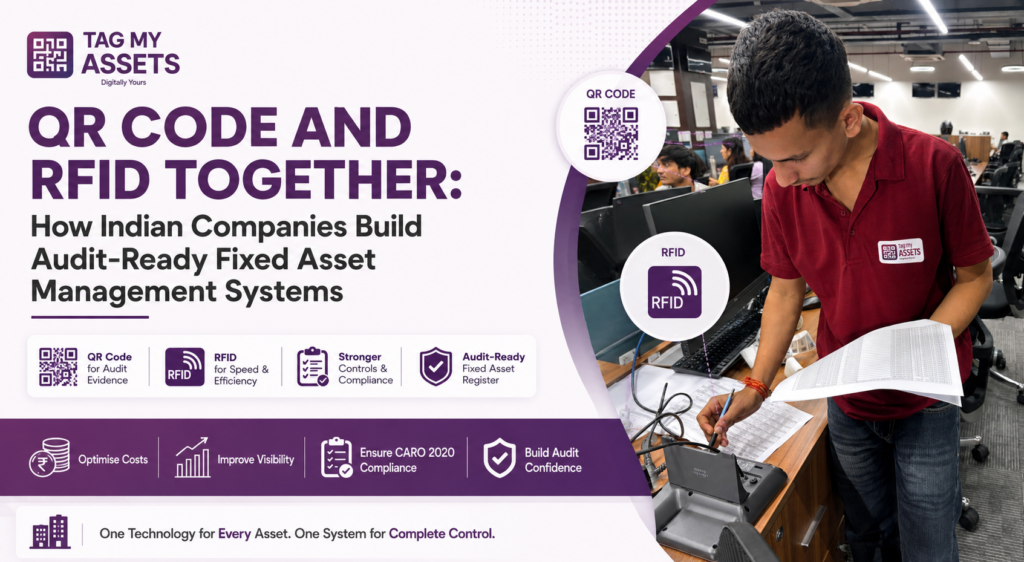
QR Codes and RFID solve different problems. When used strategically, they help organisations improve asset visibility, strengthen internal controls, reduce audit effort, and maintain an accurate Fixed Asset Register (FAR).
Why Audit-Ready Asset Management Matters
Fixed assets often represent one of the largest investments on an organisation’s balance sheet.
Yet many organisations struggle with:
- Fixed Asset Registers that do not match physical assets.
- Duplicate or obsolete asset records.
- Missing assets identified during audits.
- Lack of ownership and accountability.
- Time-consuming verification exercises.
- Difficulty complying with CARO 2020 requirements.
- Limited visibility across multiple locations.
These challenges can result in:
- Audit observations.
- Financial reporting inaccuracies.
- Increased verification costs.
- Weak internal controls.
- Operational inefficiencies.
Technology can help—but only when applied appropriately.
Understanding QR Code Asset Tagging
QR Codes provide each asset with a unique identity.
Using a smartphone or handheld scanner, organisations can access and capture asset information during verification.
A QR-based verification process can record:
- Asset identification.
- Location details.
- Geo-coordinates.
- Asset condition.
- Photographic evidence.
- Verification timestamps.
- User information.
This creates a detailed audit trail.
QR Codes are ideal for:
- Corporate offices.
- Educational institutions.
- Healthcare facilities.
- IT assets.
- Furniture and fixtures.
- Annual physical verification programmes.
- Multi-location organisations.
Understanding RFID Asset Tagging
RFID uses radio frequency signals to identify tagged assets without requiring direct line-of-sight scanning.
Unlike QR Codes, multiple assets can be identified simultaneously.
This significantly improves verification speed.
RFID is particularly valuable when:
- Large volumes of assets exist.
- Verification is conducted frequently.
- Asset movement is high.
- Operational efficiency is critical.
RFID is ideal for:
- Warehouses.
- Retail chains.
- Distribution centres.
- Manufacturing environments.
- High-volume asset populations.
- Frequent verification programmes.
QR Codes and RFID Are Not Competitors
Most organisations assume they must choose one technology.
In reality, they complement each other.
QR Codes Deliver:
✓ Detailed audit evidence
✓ Smartphone accessibility
✓ Lower implementation costs
✓ Ease of deployment
✓ Minimal hardware requirements
✓ Strong support for statutory audits
RFID Delivers:
✓ Faster verification
✓ Bulk asset identification
✓ Reduced manual effort
✓ Operational efficiency
✓ Improved visibility
✓ Better support for high-volume environments
How Indian Companies Use QR Code and RFID Together
QR for Audit Evidence, RFID for Speed
A retail organisation may use RFID to accelerate store verification.
However, QR Codes provide supporting audit evidence through:
- Photographs,
- Geo-tagging,
- Timestamps, and
- Custodian details.
The result is:
Faster operations combined with stronger audit readiness.
RFID for Frequently Moving Assets, QR for Stable Assets
Not every asset requires RFID.
Many organisations adopt a practical approach:
- RFID for frequently moving assets.
- QR Codes for stable assets requiring periodic verification.
This optimises both cost and control.
One FAR, Multiple Technologies
A single Fixed Asset Register can accommodate different identification methods.
For example:
- Office laptops may carry QR Codes.
- Warehouse equipment may use RFID.
- High-value portable equipment may use both.
The finance team continues to maintain one unified Fixed Asset Register.
Supporting CARO 2020 Compliance
CARO 2020 requires the auditor to comment on whether Property, Plant and Equipment have been physically verified by the management
While the Order does not prescribe any specific technology, an effective QR and RFID verification framework can help organisations demonstrate:
- That verification was performed.
- Which assets were verified.
- When verification occurred.
- Who conducted the verification.
- The condition of the assets.
- Their location at the time of verification.
This improves audit preparedness significantly.
Why QR Code and RFID Together Work Better for Fixed Asset Management
For many organisations, the debate is no longer about choosing between QR Codes and RFID. Instead, the focus has shifted to understanding how QR Code and RFID together can create a more practical and audit-ready fixed asset management framework.
QR Codes and RFID address different business requirements. QR Codes excel at creating detailed audit evidence by capturing photographs, geo-tagged locations, timestamps, asset conditions, and custodian details using smartphones. RFID, on the other hand, enables faster verification through bulk identification and reduced manual effort, particularly in environments with large asset populations or frequent asset movement.
When used together, organisations benefit from both control and efficiency.
For example, QR Codes can be used for stable assets such as office furniture, IT equipment, and infrastructure assets where periodic verification and audit evidence are critical. RFID can be deployed for frequently moving assets, high-volume environments, or locations where verification speed directly impacts operational efficiency.
This hybrid approach enables organisations to:
- Strengthen internal controls without overinvesting in technology.
- Improve asset visibility across multiple locations.
- Reduce the time required for physical verification exercises.
- Maintain a single, audit-ready Fixed Asset Register (FAR).
- Support CARO 2020 reporting requirements with stronger evidence.
- Optimise the total cost of ownership by applying the right technology to the right asset category.
Ultimately, the objective is not to implement the most advanced technology everywhere. The objective is to apply the appropriate level of control based on asset value, movement patterns, verification frequency, and audit expectations.
That is why many Indian organisations are increasingly adopting QR Code and RFID together—not as competing technologies, but as complementary tools that help build stronger, more efficient, and audit-ready fixed asset management systems.
Cost Impact: QR, RFID, or Hybrid?
One of the biggest misconceptions in asset tagging projects is that the cheapest tag automatically results in the lowest project cost.
The true cost includes:
- Tag cost.
- Hardware investment.
- Verification manpower.
- Verification frequency.
- Travel and logistics.
- Audit effort.
- Time required to complete verification.
The right decision should be based on the Total Cost of Ownership (TCO).
| Cost Parameter | QR Code | RFID | Hybrid |
|---|---|---|---|
| Tag Investment | Low | Medium to High | Moderate |
| Hardware Requirement | Minimal | Significant | Optimised |
| Verification Speed | Moderate | Very High | High |
| Audit Evidence | Excellent | Moderate | Excellent |
| Annual Verification Cost | Moderate | Lower for large volumes | Balanced |
| Best Suited For | Periodic verification | Frequent verification | Mixed environments |
The objective is not to minimise tag cost. It is to optimise the total cost of maintaining an accurate and audit-ready Fixed Asset Register.
Organisations evaluating QR Code and RFID Together should consider not only tag costs but also verification frequency, asset movement, and audit requirements.
Decision Framework: Choosing the Right Technology
The most practical way to select a technology is to evaluate assets based on value and movement characteristics.
| Asset Category | Examples | Recommended Technology | Why |
|---|---|---|---|
| High-Value, Low-Movement Assets | DG Sets, HVAC Systems, Transformers, Electrical Panels | QR Code | Detailed audit evidence with lower implementation cost |
| High-Value, High-Movement Assets | Medical Equipment, Portable Testing Devices, Construction Equipment | RFID + QR | Faster identification combined with robust audit support |
| High-Volume IT Assets | Laptops, Monitors, Printers, Network Equipment | QR Code | Cost-effective verification with direct Fixed Asset Register linkage and user accountability |
| Low-Value, High-Movement Assets | Tools, Returnable Crates, Trolleys | RFID | Speed and bulk identification where operational efficiency matters |
| Low-Value, Stable Assets | Chairs, Tables, Standard Furniture | QR Code | Cost-proportionate compliance and practical control |
Most Indian organisations operate across mixed environments—a corporate office, a warehouse, and sometimes a manufacturing facility under the same audit scope.
In practice, this framework is applied by asset category and location rather than at a company level. This enables organisations to optimise technology investment while maintaining a single, audit-ready Fixed Asset Register.
The objective is not to apply the same technology to every asset, but to apply the right level of control based on asset value, movement, and audit expectations.
Common Mistakes Companies Make
Choosing Technology Based on Trends
RFID is powerful, but it is not necessary for every environment.
Similarly, QR Codes are highly effective but may not suit high-frequency bulk verification scenarios.
Looking Only at Tag Cost
Technology selection should consider:
- Verification frequency,
- Operational requirements,
- Audit expectations,
- Hardware investment, and
- Labour savings.
Ignoring Future Growth
Asset populations increase over time.
Technology decisions should accommodate future expansion.
Focusing Only on Tagging
Tagging is only the starting point.
Real value comes from:
- Verification,
- Reconciliation,
- Exception reporting,
- Governance, and
- Continuous asset control.
Building an Audit-Ready Fixed Asset Management System
Technology alone does not create control.
An effective framework includes:
✓ Asset tagging
✓ Physical verification
✓ FAR reconciliation
✓ Exception reporting
✓ Geo-tagged evidence
✓ Accountability mechanisms
✓ Periodic review
QR Codes and RFID are simply tools that support these objectives.
Many organisations are now adopting QR Code and RFID Together strategies to balance audit readiness, operational efficiency, and cost optimisation.
As more organisations prioritise stronger controls and operational efficiency, QR Code and RFID Together are emerging as a practical framework for building audit-ready fixed asset management systems.
The Bottom Line
The future of fixed asset management is not QR versus RFID.
It is understanding how both technologies can work together.
QR Codes provide accessible, evidence-based verification.
RFID delivers speed and efficiency where scale demands it.
Combined with structured verification methodologies and FAR reconciliation, they help organisations strengthen internal controls, improve visibility, and maintain audit-ready records.
The objective is not to adopt the latest technology.
The objective is to ensure that your Fixed Asset Register reflects reality.
Because when auditors ask:
“Have these assets been physically verified?”
you should have the confidence—and the evidence—to answer:
Yes.
Frequently Asked Questions
Can QR Codes and RFID be used together?
Yes. Many organisations use QR Codes for audit evidence and RFID for operational efficiency within the same asset management programme.
Is RFID mandatory for fixed asset verification?
No. Many companies successfully conduct fixed asset verification using QR-based systems. RFID becomes valuable where verification speed and frequency justify the investment.
How do QR Codes support statutory audits?
QR-based verification can capture photographs, geo-location, timestamps, and verification records that strengthen the audit trail.
Does CARO 2020 require QR Codes or RFID?
No. CARO 2020 does not prescribe any specific technology. Organisations may choose the approach most suitable for their operations.
Which is more cost-effective: QR or RFID?
QR Codes generally involve lower implementation costs, while RFID offers efficiency benefits in high-volume environments. The right choice depends on business requirements and total cost of ownership.
Can one Fixed Asset Register support both QR and RFID?
Yes. Many organisations maintain a single FAR while using different identification technologies for different asset categories.
Can QR Code and RFID Together improve fixed asset verification?
Yes. Using QR Code and RFID together allows organisations to combine audit evidence with operational efficiency.
Can QR Code and RFID Together improve asset visibility?
Yes. Using QR Code and RFID Together helps organisations improve asset visibility, strengthen accountability, and maintain accurate Fixed Asset Registers across multiple locations.
Need help deciding whether QR Codes, RFID, or a hybrid approach is right for your organisation? Tag My Assets can assess your asset profile, verification requirements, and audit objectives to recommend the most practical and cost-effective solution.