
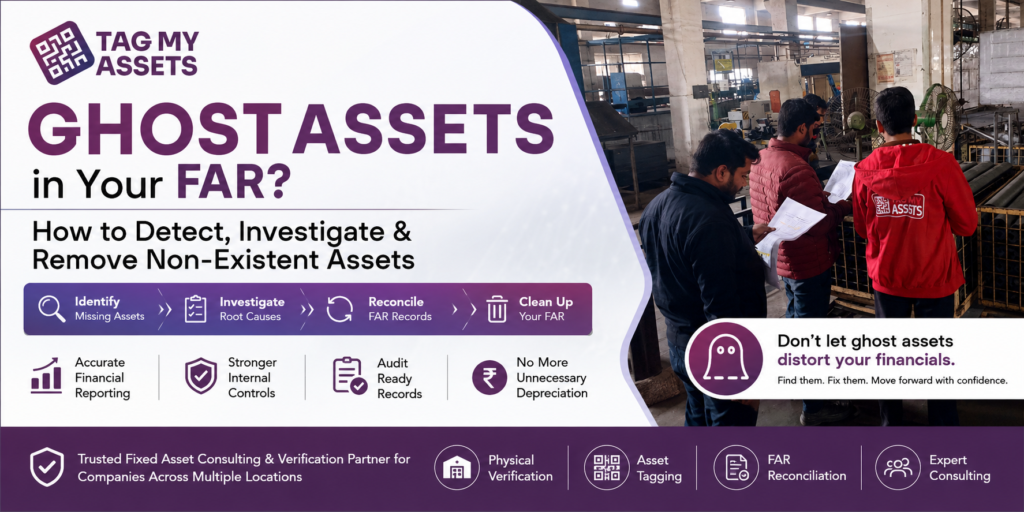
Many organisations assume that the Fixed Asset Register (FAR) accurately reflects the assets they own. However, during physical verification exercises, companies are often surprised to discover that several assets recorded in their books no longer exist.
These missing assets may have been disposed of years ago, transferred to another location without documentation, replaced under service contracts, lost during office relocations, or simply forgotten over time. Yet they continue to remain in accounting records and depreciation schedules.
These non-existent assets are commonly referred to as Ghost Assets.
Ghost assets distort financial reporting, weaken internal controls, create audit risks, and reduce management’s ability to make informed decisions. For organisations operating across multiple locations, the problem often accumulates gradually over several years before finally coming to light during an audit or physical verification exercise.
In our experience, ghost assets are rarely the result of fraud alone. More often, they arise due to inadequate disposal processes, inconsistent record maintenance, the absence of periodic physical verification, and a lack of ownership over fixed asset records.
What Are Ghost Assets?
Ghost assets are assets that appear in the Fixed Asset Register but cannot be physically located or verified.
In simple terms:
If an asset exists in your books but cannot be found physically, it is a ghost asset.
Examples include:
- Computers disposed of without updating the FAR.
- Office furniture discarded during renovations.
- Machinery transferred between plants without documentation.
- Equipment lost during office relocations.
- Assets stolen but never removed from accounting records.
- Devices replaced under AMC contracts without corresponding FAR updates.
Why Do Ghost Assets Occur?
Ghost assets rarely occur because of a single mistake. They usually result from years of inadequate controls and incomplete record maintenance.
1. Lack of Periodic Physical Verification
Many organisations rely entirely on accounting records without conducting regular asset verification exercises.
2. Poor Disposal Processes
Assets are scrapped, sold, or discarded, but disposal entries are never passed.
3. Office Relocations
Assets move between branches or departments without proper documentation.
4. Absence of Asset Tagging
Without QR Code or RFID tags, identifying individual assets becomes difficult.
5. ERP and FAR Mismatches
Manual interventions and data migrations often create inconsistencies.
6. Inadequate Internal Controls
Responsibilities for maintaining fixed asset records are not clearly defined.
Risks Associated with Ghost Assets
Ignoring ghost assets can have significant financial and operational consequences.
Incorrect Depreciation
Companies continue charging depreciation on assets that no longer exist.
Misstated Financial Statements
The carrying value of Property, Plant and Equipment (PPE) may be overstated.
Statutory Audit Observations
Auditors may identify weaknesses in fixed asset controls and seek explanations.
Internal Audit Findings
Repeated exceptions indicate ineffective asset management processes.
Higher Insurance Costs
Insurance coverage may include assets that no longer exist.
Poor Management Decisions
Capital expenditure planning and replacement decisions become unreliable when based on inaccurate records.
What CARO 2020 Requires on Ghost Assets
Ghost assets are not only a bookkeeping issue. They sit directly against two reporting requirements under CARO 2020.
Clause 3(i)(a)(A) requires the auditor to report whether the company is maintaining proper records showing full particulars, including quantitative details and situation, of Property, Plant and Equipment. An asset that remains in the register but cannot be located means the recorded situation no longer holds.
Clause 3(i)(b) requires reporting on whether PPE has been physically verified by management at reasonable intervals, whether the intervals are reasonable, and whether any material discrepancies were noticed and properly dealt with in the books of account.
Ghost assets found during verification are discrepancies of this kind. Identifying them is only the first half; how they are dealt with in the books is what the clause asks about.
For the auditor, SA 500 governs audit evidence and SA 330 governs responses to assessed risks. Where fixed asset records are relied upon, physical verification of PPE is one of the procedures through which evidence about existence is obtained.
A register carrying ghost assets therefore affects both the company’s record-keeping position under clause 3(i)(a)(A) and the discrepancy reporting under clause 3(i)(b).
Red Flags That May Indicate Ghost Assets
Certain warning signs often suggest that ghost assets may exist within the organisation.
Watch out for these indicators:
- The FAR has not been physically verified for more than two years.
- Assets cannot be traced to specific locations.
- Multiple assets have vague descriptions such as “Furniture” or “Equipment.”
- Disposal registers are incomplete or unavailable.
- Inter-branch asset transfers are poorly documented.
- ERP records differ from departmental records.
- Audit reports repeatedly highlight fixed asset observations.
- Departments claim assets exist, but nobody knows their exact location.
If one or more of these situations applies to your organisation, a FAR review may be warranted.
How to Identify Ghost Assets
Detecting ghost assets requires more than reviewing spreadsheets. The approach we use combines physical verification with FAR reconciliation.
Step 1: Obtain the Latest FAR
Review the complete Fixed Asset Register, including:
- Asset descriptions
- Asset codes
- Quantities
- Locations
- Departments
- Capitalisation dates
- Original costs
- Net book values
Step 2: Conduct Physical Verification
Perform a sheet-to-floor verification exercise by physically locating assets listed in the FAR. This is the direction that surfaces ghost assets.
Record:
- Found assets
- Missing assets
- Excess assets
- Asset conditions
- Actual locations
Step 3: Perform Floor-to-Sheet Validation
Identify assets present physically but absent from the FAR.
This exercise helps detect both ghost assets and unrecorded assets.
Step 4: Reconcile Differences
Classify exceptions into categories such as:
- Match
- Short
- Excess
- Transfer pending
- Disposal pending investigation
Step 5: Investigate Missing Assets
Before concluding that an asset is a ghost asset, determine whether it has:
- Been transferred.
- Been disposed of.
- Been capitalised under another code.
- Been replaced.
- Been incorrectly described.
Step 6: Obtain Management Approval
Discuss findings with department heads and management before finalising recommendations.
What a Reconciliation Actually Looks Like
On a verification engagement for an agricultural machinery manufacturer, the fixed asset register carried 19,134 assets. Physical verification located 10,112 of them.
The gap was not 9,022 ghost assets. That distinction is the entire point of Step 5. The exceptions had to be worked through individually — assets transferred between locations without documentation, assets capitalised under one code and tagged under another, assets replaced under service contracts where the original entry was never reversed, and assets described so vaguely in the register that they could not be matched to anything on the floor even when the item was standing in front of the team.
Only the residue that survives that investigation is a genuine ghost asset. The variance quantified on that engagement, after reconciliation, exceeded Rs 10.5 lakh.
The lesson for anyone reading a first-cut verification report: a large short quantity is not a ghost asset count. It is a reconciliation workload. Treating it as a write-off list at that stage is how organisations end up removing assets that exist.
How to Remove Ghost Assets from FAR
Once investigations are complete, organisations should formally clean up their records.
Typical actions include:
Pass Disposal Entries
Remove assets confirmed as disposed of.
Write Off Missing Assets
Assets that cannot be located after investigation may require write-off approvals.
Update Transfer Records
Correct the locations of assets that have been moved internally.
Eliminate Duplicate Entries
Remove duplicate asset records and coding errors.
Strengthen Policies
Improve procedures to prevent future accumulation of ghost assets.
Role of Asset Tagging in Preventing Ghost Assets
Asset tagging reduces the conditions in which ghost assets accumulate.
QR Code and RFID tags help organisations:
- Assign unique identities to assets.
- Track movement across locations.
- Simplify physical verification.
- Reduce reliance on asset descriptions.
- Improve FAR accuracy.
- Detect missing assets quickly.
When combined with periodic verification, asset tagging improves visibility and control over fixed assets.
Best Practices to Prevent Ghost Assets
Organisations can minimise ghost assets by adopting the following practices.
Conduct Annual Physical Verification
Verify fixed assets at least once every year.
Implement Asset Tagging
Use QR Code or RFID-based identification systems.
Establish Disposal Procedures
Ensure accounting entries accompany disposals.
Maintain Transfer Documentation
Document movement between branches and departments.
Standardise Asset Descriptions
Adopt consistent naming conventions across locations.
Perform Regular FAR Reconciliations
Address discrepancies proactively instead of waiting for audits.
Strengthen Internal Controls
Clearly define ownership and accountability for maintaining asset records.
How Fixed Asset Consulting Services Help
Many organisations lack the time and resources to investigate years of accumulated discrepancies.
Fixed asset consultants can assist by:
- Reviewing the Fixed Asset Register.
- Conducting physical verification exercises.
- Identifying ghost assets.
- Reconciling differences.
- Supporting disposal reviews.
- Standardising asset records.
- Assisting management during statutory and internal audits.
An independent review often uncovers issues that remain unnoticed during routine operations.
Conclusion
Ghost assets are a recurring finding in fixed asset verification.
They silently inflate asset values, distort depreciation, weaken internal controls, and increase audit risks.
The good news is that ghost assets can be identified and eliminated through a structured approach involving physical verification, FAR reconciliation, investigation, and record clean-up.
Organisations that periodically review their fixed assets not only improve compliance but also gain confidence that their financial records accurately reflect the assets they actually own.
If your organisation has not conducted a fixed asset verification exercise in recent years, now may be the right time to assess whether ghost assets are hiding within your Fixed Asset Register.
Frequently Asked Questions
What are ghost assets?
Ghost assets are assets recorded in the Fixed Asset Register that cannot be physically located during verification.
How are ghost assets identified?
Ghost assets are typically identified through physical verification and FAR reconciliation exercises.
Why are ghost assets a problem?
They result in incorrect depreciation, misstated financial statements, audit observations, and weak internal controls.
Can ghost assets be removed from the FAR?
Yes. After investigation and management approval, disposal entries, write-offs, or record updates can be passed.
How can companies prevent ghost assets?
Periodic verification, asset tagging, disposal controls,and regular FAR reviews reduce the risk of ghost assets.
How We Can HelpAt TagMyAssets, we help organisations improve the accuracy of their Fixed Asset Registers through physical verification, asset tagging, FAR reconciliation, and fixed asset consulting services. Whether you operate from a single office or across multiple locations, our structured approach helps identify discrepancies, strengthen internal controls, and build confidence in fixed asset reporting.
Good Reads
Fixed Asset Consulting Services
7 Powerful Reasons Companies Need Fixed Asset Consulting Before a Statutory Audit
Why Asset Management Software Fails Without Physical Verification and FAR Reconciliation