
Environmental exposure and fixed asset useful life are closely linked, yet many companies continue to apply standard useful lives without considering operating conditions such as coastal salinity, corrosive atmospheres, outdoor exposure, mining environments and extreme temperatures.
Can two identical machines have the same useful life if one operates in an air-conditioned control room and the other is exposed to coastal salinity, rain, dust and extreme temperatures?
Schedule II of the Companies Act 2013 allows a company to adopt a useful life different from the prescribed one, where the difference is supported by technical advice and the justification is disclosed. Yet in practice, most companies continue to apply standard useful lives regardless of operating environment.
This raises a question worth examining carefully — not as a compliance challenge, but as a matter of sound financial reporting and responsible asset management.
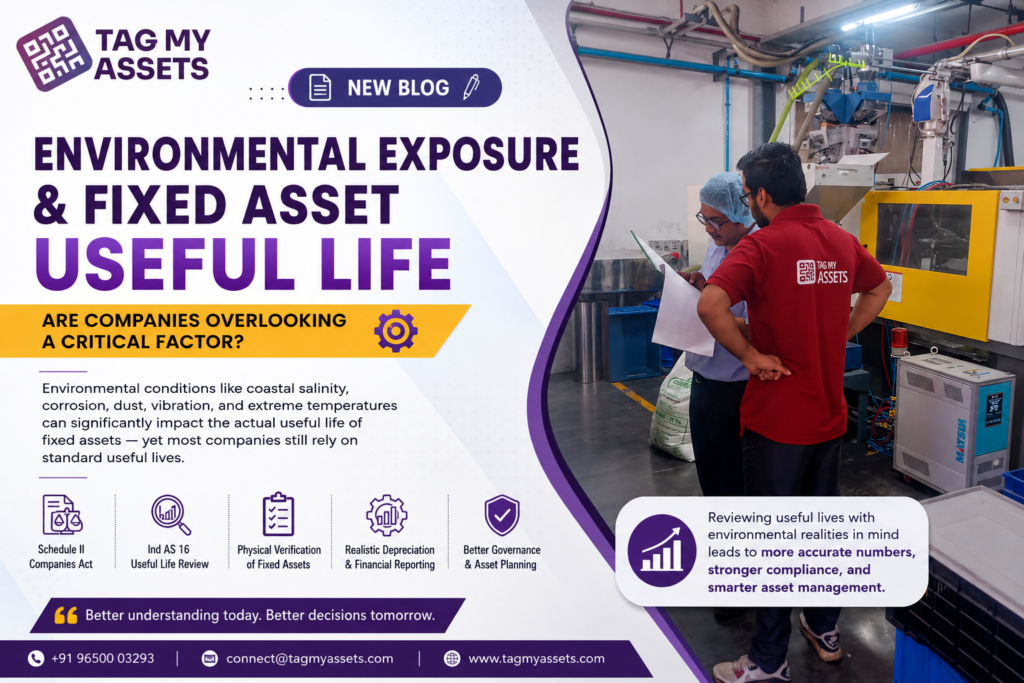
Environmental Exposure & Fixed Asset Useful Life: What Companies Need to Know
Environmental conditions such as coastal salinity, corrosive industrial atmospheres, outdoor exposure, mining dust, vibration and extreme temperatures can significantly affect the actual useful life of fixed assets.
While Schedule II of the Companies Act provides standard useful lives, companies may adopt different useful lives based on technical advice, with the justification disclosed in the financial statements.
The key question is whether organisations are consistently evaluating these environmental factors while determining asset useful lives.
A Scenario That Makes the Issue Concrete
Consider this example.
A steel electrical panel is installed inside an air-conditioned control room at a manufacturing facility. An identical panel — same make, same model, same purchase date — is installed 500 metres from the sea at a coastal port facility.
Twenty years later, one may still be fully operational. The other may have required complete replacement — or multiple rounds of expensive maintenance — long before that.
Yet both may have been depreciated using exactly the same useful life assumptions under Schedule II.
The comparison is illustrative, but engineers and plant heads see the pattern regularly. The question is whether accounting and audit practice reflects it adequately.
What Schedule II Currently Provides
Schedule II of the Companies Act 2013 prescribes useful lives for asset categories including buildings, plant and machinery, computers, vehicles and other fixed assets.
Its shift-based provision is well understood:
Where an asset is used for double shift, depreciation increases by 50% for that period. For triple shift, it is calculated at 100% for that period.
This recognises that usage intensity accelerates wear and tear.
Less commonly applied — but equally valid — is the provision that allows companies to use a useful life different from the prescribed standard, provided:
- The different useful life is supported by technical advice.
- The justification for it is disclosed in the financial statements.
This flexibility already exists. The question is how consistently it is being applied to assets operating in demanding environmental conditions.
Disclaimer: This article does not suggest that environmental exposure automatically warrants a different useful life. Any deviation from Schedule II must be supported by appropriate technical assessment and disclosures as required under the Companies Act 2013. The intent here is to encourage a more conscious and documented consideration of environmental factors where they are genuinely material.
The Environmental Conditions That Matter
The following are not edge cases. They represent the daily operating reality for a significant proportion of Indian industry.
Coastal and Marine Environments
Assets near the sea — ports, coastal warehouses, offshore facilities and coastal industrial zones — are exposed to salt-laden air that accelerates corrosion of metal components, electrical systems and structural elements.
A useful life that may be reasonable for an inland facility could be materially overstated for the same asset in a coastal environment.
Chemical and Industrial Atmospheres
Fertiliser plants, dye manufacturers, acid processing units and petrochemical facilities expose assets to corrosive fumes continuously.
Paint, insulation, seals and structural components often degrade faster than standard useful life assumptions anticipate.
Outdoor Installation
Transformers, pumps, compressors, generators and storage tanks installed in open yards face:
- UV radiation
- Rain ingress
- Thermal cycling
- Dust accumulation
Each of these factors contributes to accelerated material fatigue.
Mining and Heavy Industry
Assets in mining operations — crushers, conveyors, drilling equipment and processing machinery — face continuous vibration, abrasive contact and dust penetration.
Their economic life under these conditions is often significantly different from standard prescribed lives.
Extreme Temperature Zones
From Himalayan infrastructure projects to industrial facilities operating in the heat of Rajasthan and Gujarat, temperature extremes accelerate failures in:
- Lubricants
- Gaskets
- Seals
- Electronic components
- Insulation systems
The Downstream Impact on Financial Reporting
This is not merely an engineering issue. It has direct implications for financial reporting and governance.
For CFOs
When useful lives are not reviewed in light of environmental conditions, carrying values drift away from the actual condition of the assets. This can distort:
- Return on Assets (RoA)
- Net worth
- Capital efficiency metrics
The gap between book value and realisable value often becomes apparent during impairment reviews, insurance assessments or asset disposals.
For Statutory Auditors
Under CARO 2020, clause 3(i)(b), the auditor reports on whether Property, Plant and Equipment have been physically verified by management at reasonable intervals and whether material discrepancies found have been properly dealt with in the books.
The focus often remains on physical existence and records, while the effect of environmental conditions on useful life may receive less attention — even when assets are visibly deteriorating faster than standard assumptions imply.
For Ind AS Preparers
Ind AS 16 requires useful lives and residual values to be reviewed at least at each financial year-end.
This makes environmental exposure relevant not only from a Companies Act perspective but also from an IFRS-aligned financial reporting perspective.
For listed entities and large organisations, the adequacy of useful life assessments is increasingly under scrutiny.
For Asset Managers and Engineers
Maintenance planning, capital budgeting, insurance valuations and replacement strategies all depend on a realistic understanding of asset condition and remaining useful life.
When assumptions do not reflect operating environment, planning decisions may be based on incomplete information.
What a More Disciplined Approach Looks Like
A more rigorous approach does not require a change in law. It requires more deliberate use of the flexibility that already exists.
1. Environmental Factors as Disclosed Policy Assumptions
Companies operating assets in high-risk environments should consider disclosing the environmental factors considered while determining useful lives for major asset categories. This improves transparency and auditability.
2. Periodic Technical Assessments for High-Risk Assets
For assets in:
- Coastal locations
- Chemical plants
- Mining operations
- Heavy industrial environments
a periodic independent technical assessment, at intervals suited to how quickly the assets deteriorate, can provide a defensible basis for revising useful lives where appropriate.
3. Physical Verification That Captures Condition, Not Just Existence
A physical asset verification exercise that records only existence and location misses a critical dimension — asset condition.
Condition assessment, environmental classification and photographic documentation should be standard components of any serious asset verification programme. Useful life assessment without an understanding of actual asset condition is often little more than an assumption.
4. Board-Level Awareness
Many Boards are unaware that Schedule II already permits different useful lives with proper technical justification.
Finance leadership should ensure that this flexibility is consciously evaluated for asset-intensive businesses operating in challenging environments.
Closing Thoughts
Schedule II introduced shift-based depreciation because the law recognised that usage intensity affects asset life.
Environmental intensity is equally real — and the flexibility to reflect it already exists within the same framework.
For organisations operating in coastal, mining, chemical, infrastructure, oil & gas, power and heavy manufacturing environments, this question is particularly relevant.
Are we reviewing useful lives often enough — or simply accepting standard assumptions?
The answer has implications not only for depreciation but also for governance, financial reporting quality, asset management and long-term capital planning.
We would be interested to hear perspectives from CFOs, statutory auditors, chartered accountants, valuers, engineers, plant heads and asset managers.
Frequently Asked Questions (FAQs)
Does Schedule II allow different useful lives for fixed assets?
Yes. A company may adopt a useful life different from that prescribed under Schedule II where it is supported by technical advice and the justification is disclosed in the financial statements.
Can environmental exposure reduce asset useful life?
Environmental factors such as corrosion, salinity, UV exposure, vibration, dust and extreme temperatures may reduce the actual useful life of assets depending on operating conditions.
Is physical verification relevant for useful life assessment?
Yes. Physical verification helps assess asset condition, deterioration, operating environment and maintenance status, which can support useful life reviews.
Does Ind AS 16 require useful life review?
Yes. Ind AS 16 requires management to review useful lives and residual values at least at each financial year-end and revise estimates where appropriate.
About TagMyAssets
TagMyAssets provides fixed asset verification, asset tagging, RFID asset tracking and FAR reconciliation services across India.
Our field teams help organisations build Fixed Asset Registers that reflect the actual condition, location and status of their assets.
Phone: +91 96500 03293
Email: connect@tagmyassets.com
Website: tagmyassets.com