
Introduction
Every asset tagging project begins with the same question: which tagging technology should we use?
There is no single correct answer. QR codes, barcodes, RFID tags and metal nameplates each perform well in some environments and poorly in others. The right choice depends on where the assets are located, how many there are, how they will be verified, and what the tags must survive.
This guide is based on field experience from 395+ fixed asset projects across 1500+ locations in India, covering more than 10 lakh + assets in manufacturing plants, hospitals, offices, warehouses, educational campuses and retail chains.
Rather than recommending one technology for everything, it explains how each option behaves in real conditions — so the selection matches the environment instead of the sales brochure.
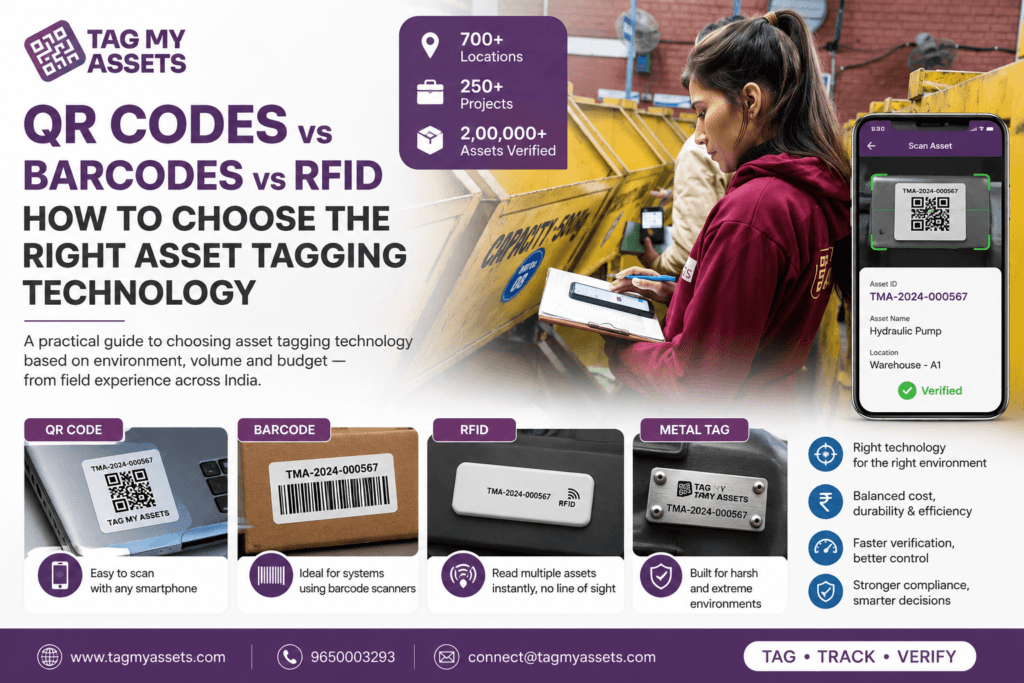
What Is Asset Tagging Technology?
Asset tagging technology refers to the physical label or tag applied to a fixed asset that links it to its record in the Fixed Asset Register (FAR). The tag carries a unique asset ID — printed as a QR code, barcode, RFID chip or engraved number — so the asset can be identified quickly during physical verification, transfers, audits and disposal.
The tag itself does not manage the asset. It provides the identity that connects the physical asset to the accounting record. The quality of that connection determines how smoothly every later process runs.
The Four Main Options
QR Code Labels
QR codes are the most widely used option for office and IT environments.
How they work: A printed QR code contains the asset ID. Any smartphone camera can scan it — no dedicated scanner hardware is required.
Where they perform well:
- Office furniture and fixtures
- Laptops, desktops, printers and IT peripherals
- Indoor assets in clean, temperature-controlled environments
- Organisations that want verification teams to work with mobile phones
Limitations:
- Adhesive labels degrade in heat, grease, moisture and outdoor exposure
- Each asset must be scanned individually, with line of sight
- Label wear over time can make codes unreadable if low-quality material is used
Cost band: Among the lowest-cost options for indoor assets.
Barcode Labels
Barcodes remain a practical, proven option — particularly where the organisation already operates barcode scanners.
How they work: A linear barcode encodes the asset ID, read by a handheld barcode scanner.
Where they perform well:
- Warehouses and stores departments with existing scanner infrastructure
- Organisations whose ERP or inventory workflows are already barcode-based
- High-volume, low-value asset categories where per-tag cost matters
Limitations:
- Requires scanner hardware (though many modern phone apps read barcodes too)
- Same environmental limits as any adhesive label
- Holds less data than a QR code, though for asset tagging the ID is usually all that is needed
A note on “barcodes are obsolete”: They are not. Where scanning infrastructure exists and the environment is indoor, barcodes remain a perfectly sound choice. Replacing a working barcode system purely for the sake of newer technology rarely survives a cost-benefit review.
RFID Tags
RFID allows multiple assets to be identified quickly without direct line of sight.
How they work: Each tag contains a small chip and antenna. A handheld or fixed RFID reader detects tags within range — dozens of assets can be read in a single pass.
Where they perform well:
- Large warehouses and distribution centres
- Manufacturing facilities with high asset counts
- Hospitals and educational campuses where assets move frequently
- Environments where verification speed is the priority
Limitations:
- Higher per-tag and reader hardware cost than QR or barcode
- Metal surfaces and liquids interfere with standard tags; on-metal RFID tags cost more
- RFID improves reading speed, but it still depends on an accurate Fixed Asset Register and disciplined processes — technology alone does not fix poor asset governance
Passive vs active: Most fixed asset projects use passive RFID (no battery, lower cost, shorter range). Active RFID (battery-powered, longer range) is generally reserved for specialised tracking use cases and carries a significantly higher per-tag cost.
For current price bands, see our detailed guide: RFID Tagging Cost in India.
Metal Asset Tags
For harsh environments, printed labels are the wrong tool. Metal tags are engraved or etched with the asset ID, sometimes alongside a QR code.
Where they perform well:
- Plant and machinery
- Kitchen and food-service equipment exposed to grease and heat
- Outdoor installations and electrical infrastructure
- High-temperature or chemical-exposure areas
Materials and marking methods:
- Anodised aluminium is the most common choice — light, corrosion-resistant and cost-effective for most plant environments
- Stainless steel suits chemical exposure, coastal or outdoor installations, and food-service areas subject to aggressive cleaning
- Laser engraving produces a durable mark suitable for most industrial conditions
- Chemical etching cuts deeper into the metal and holds up in the harshest environments — high heat, abrasion and chemical contact
- Many metal tags now combine an engraved asset ID with an engraved QR code, so the tag remains phone-scannable while surviving conditions no printed label can
Fixing method matters as much as the tag: Standard adhesive fails under grease, heat and repeated cleaning — a pattern we see repeatedly on kitchen and food-service equipment, where labels applied with ordinary 3M-type adhesive detach within months. Mechanical fixing — rivets or screws — or high-temperature epoxy generally provides far greater durability on cooking equipment and machinery. The fixing decision should be made per asset category at the planning stage, not left to the field team on the day.
Limitations:
- Higher unit cost and slower application than labels
- Engraved-only tags (without QR) must be read and typed manually
Side-by-Side Comparison
| Factor | QR Code | Barcode | RFID | Metal Tag |
| Reader needed | Smartphone | Scanner or phone app | RFID reader | Eyes / phone (if QR engraved) |
| Line of sight | Required | Required | Not required | Required |
| Bulk reading | No | No | Yes | No |
| Harsh environments | Poor | Poor | Moderate (on-metal tags) | Strong |
| Relative cost per tag | Low | Low | Higher | Higher |
| Best suited for | Offices, IT assets | Existing scanner setups | High volumes, warehouses | Plant, outdoor, kitchens |
How to Decide: Four Questions
1. What will the tag have to survive?
Indoor, air-conditioned office → QR or barcode labels. Grease, heat, moisture, outdoor exposure → metal tags with mechanical fixing. This single question eliminates most wrong choices.
2. How many assets, and how often are they verified?
A few hundred office assets verified annually → individual scanning is fine. Tens of thousands of assets, or frequent cycle counts → RFID’s bulk reading starts justifying its cost.
3. What infrastructure already exists?
Existing barcode scanners and workflows are an asset, not a liability. Building on them is often cheaper than replacing them.
4. What does the budget support per asset?
Tag cost is only part of the picture — application labour, reader hardware and replacement rates all matter. A cheaper tag that fails in two years costs more than a durable tag applied once.
Most multi-site organisations end up with a mixed approach: QR labels for offices, metal tags for the plant floor, and RFID where volumes justify it. Forcing one technology across every environment is the most common selection mistake we encounter in the field.
Typical Technology Choices by Industry
Based on the environments we encounter across sectors, these combinations tend to work well as a starting point:
| Industry | Commonly Suitable Tagging |
| Corporate offices | QR code labels |
| Hospitals | QR labels + RFID for movable equipment |
| Manufacturing plants | Metal tags (engraved QR) + RFID for high-volume areas |
| Hotels & food service | Metal tags for kitchens; QR for rooms and offices |
| Schools & colleges | QR code labels |
| Warehouses & logistics | RFID |
| Oil & gas / chemical | Stainless steel etched tags |
| Retail chains | QR labels; RFID where store counts are large |
These are starting points, not rules — the final selection should always follow a site-level review of conditions, volumes and existing infrastructure.
Quick Decision Matrix
| If your situation is… | A sound starting choice is… |
| Under ~2,000 office/IT assets | QR code labels |
| Existing barcode scanners and workflows | Barcode labels |
| Large warehouse, high asset counts | RFID |
| Plant machinery | Metal tags (engraved QR) |
| Kitchen or high-temperature equipment | Metal tags, mechanically fixed |
| Outdoor or coastal installations | Stainless steel etched tags |
| Assets that move between locations often | RFID |
| Tightest per-tag budget | QR code labels |
Common Selection Mistakes We See During Verification
Across verification assignments, the same technology mistakes appear repeatedly:
- Adhesive labels applied to kitchen and plant equipment, unreadable within months
- RFID purchased for a site whose Fixed Asset Register was too inaccurate to benefit from faster reading
- Barcode systems abandoned mid-way, leaving assets with two competing ID schemes
- Tags applied without a structured numbering convention, creating duplicate IDs across branches
- Tags placed where they cannot be reached or seen during verification
Each of these is preventable at the selection and planning stage — which is why technology choice should be part of the tagging project design, not an afterthought.
Where Tagging Fits in the Bigger Picture
Tagging provides the identity; it does not by itself keep records accurate. A complete fixed asset control cycle also requires periodic physical verification of assets and FAR reconciliation so that the Fixed Asset Register continues to reflect reality. For organisations that want this carried out end-to-end, our fixed asset verification services cover tagging, verification and reconciliation as one exercise.
For companies covered under CARO 2020, maintaining proper records of Property, Plant and Equipment and demonstrating physical verification at reasonable intervals forms part of the statutory audit process — see our guide on CARO 2020 fixed asset verification requirements.
Frequently Asked Questions
Which is better for asset tagging: QR code or barcode?
For most new projects, QR codes are preferred because any smartphone can scan them and they tolerate partial damage better. Barcodes remain a sound choice where scanner infrastructure and barcode-based workflows already exist.
Is RFID worth the cost for asset tagging?
RFID is generally worth considering when asset volumes are high, assets move frequently, or verification speed is a priority — typically warehouses, plants, hospitals and campuses. For a few hundred office assets, QR codes usually deliver similar accuracy at lower cost.
Can one organisation use multiple tagging technologies?
Yes, and most multi-site organisations should. A common structure is QR labels for office and IT assets, metal tags for plant and outdoor equipment, and RFID in high-volume locations — all sharing one numbering convention linked to the same Fixed Asset Register.
What asset tags work on kitchen or high-temperature equipment?
Metal tags with mechanical fixing (rivets or screws) or high-temperature epoxy. Standard adhesive labels generally fail under grease, heat and repeated cleaning.
Does asset tagging require special software?
No. Tagging links each physical asset to its record in the Fixed Asset Register. The register may be maintained in an ERP, asset management software or a structured spreadsheet — the tag works with any of them, provided the asset ID convention is consistent.
Choosing With Confidence
There is no universally best asset tagging technology. The right choice depends on your environment, verification frequency, asset volumes and budget — and most multi-site organisations end up using a combination of QR, RFID and metal tags rather than a single option. What matters is that the selection is made deliberately at the planning stage, with one consistent numbering convention connecting every tag back to the Fixed Asset Register.
If you are planning a tagging project and want an environment-based recommendation, our field teams can help you assess the options against your actual sites and asset mix. Explore our fixed asset tagging services or contact us to discuss your requirement.