
RFID tag costs in India range from ₹10–₹200 per passive tag and ₹500–₹3,000 per active tag, depending on tag type, quantity and surface. TagMyAssets supplies RFID tags — usually as part of a tagging and verification project, and on their own where a company only needs the tags. A complete RFID asset tagging project — tagging, physical verification and FAR reconciliation delivered together — typically runs ₹80 to ₹350 per asset.
If you are planning RFID-based asset tracking, the first question your finance or procurement team will ask is: “How much will it cost?”
The honest answer: the tag price is the smallest part of it. Based on our experience conducting physical asset verification, tagging, and FAR reconciliation projects across 1500+ locations in India, total project cost depends far more on your asset mix, site conditions, and scope than on the tag itself. This guide breaks down every cost component so you can budget accurately — and decide whether RFID is even the right technology for your assets.
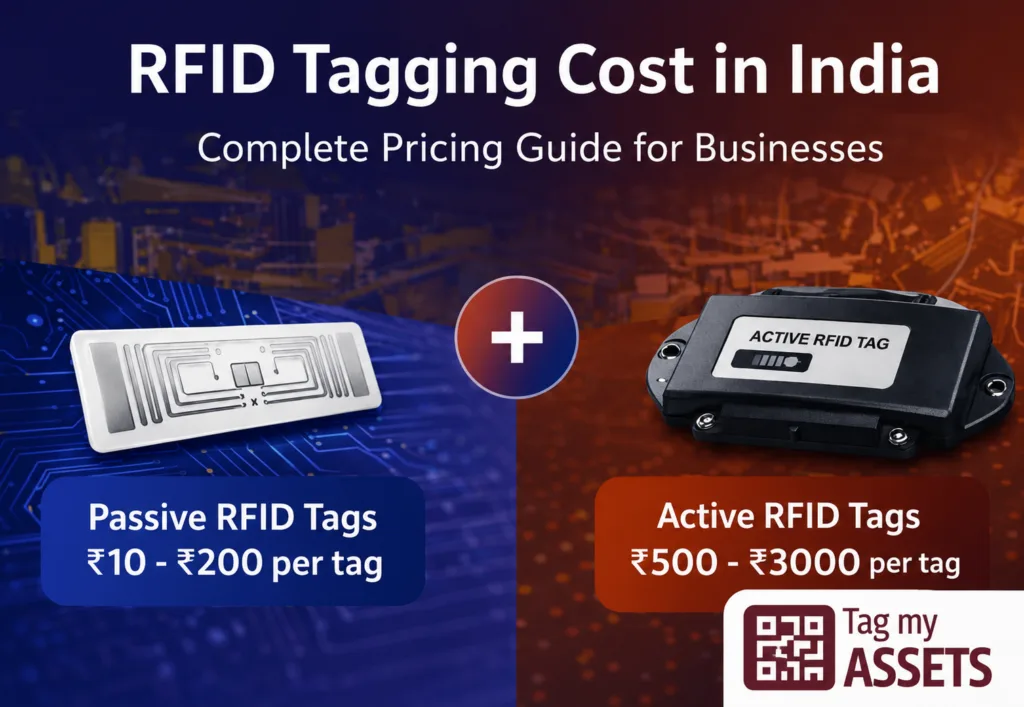
RFID Tagging Cost in India: At a Glance
| Component | Type | Cost (India) |
| RFID tags | Passive (standard and specialised) | ₹10 – ₹200 per tag |
| RFID tags | Active (battery-powered, real-time) | ₹500 – ₹3,000 per tag |
| Complete project (tags + tagging + verification + FAR reconciliation) | Per-asset basis | ₹80 – ₹350 per asset |
| RFID readers | Handheld / fixed | Depends on reader type and count — scoped per project |
| Data capture and reconciliation | Service scope | Included within per-asset project pricing where selected |
Reader hardware is sized to your project during scoping — for a standard audit-focused project, a small number of handheld readers is usually sufficient, and most audit-driven projects in India do not require fixed portal readers at all.
Quick RFID Project Cost Estimator
These figures are indicative planning estimates based on our published pricing bands. Actual project cost depends on asset type, tag technology, locations, and project scope.
Apply the per-asset project band (₹80–₹350) to your asset count:
| Your Project | Indicative Range* |
| 500 office assets, single location | ₹40,000 – ₹1.75 lakh |
| 2,000 assets, 2–3 locations | ₹1.6 lakh – ₹7 lakh |
| 5,000 plant assets | ₹4 lakh – ₹17.5 lakh |
| 20,000+ assets, multi-city rollout | Custom estimate |
| Multi-branch rollout (banks, retail chains) | Custom estimate based on branch count |
*Derived directly from the ₹80–₹350 per-asset band. Per-asset cost typically reduces with volume — larger projects land lower in the band, smaller projects higher. A short asset survey narrows this to a firm quote.
Illustrative Planning Scenarios
These are hypothetical scenarios to help you place your own project — actual quotes depend on your specific asset register and site conditions.
Scenario 1 — Corporate office. Around 3,500 IT and furniture assets across 4 city offices, standard passive labels throughout. Typically lands in the lower-to-mid portion of the per-asset band, since standard labels and indoor conditions keep tag and execution costs down. Takeaway: for office environments, standard passive labels usually offer the best balance of cost and scan efficiency.
Scenario 2 — Manufacturing plant. Around 18,000 assets dominated by heavy machinery requiring on-metal tags. Typically lands in the upper portion of the passive band — specialised tags and working-plant conditions add cost per asset. Takeaway: spending more on the correct on-metal tag upfront often avoids read failures and replacement costs later.
Scenario 3 — Hospital. Medical equipment with a mix of passive tags for fixed assets and active tags for mobile devices that move between departments. Priced as a custom combination of both bands. Takeaway: limiting active tags to genuinely mobile equipment keeps the overall project close to passive-band economics.
What Actually Drives Your RFID Project Cost
Five factors decide where a project lands within the standard bands:
1. Tag technology mix. A project that is 90% standard labels and 10% on-metal tags costs very differently from the reverse. The asset survey stage exists to get this mix right before procurement.
2. Asset volume. Per-asset costs typically reduce with volume. A 500-asset office project and a 20,000-asset plant project sit at different points in the band.
3. Location spread. A single-site project concentrates effort; a multi-city rollout adds travel, coordination, and scheduling. This affects per-asset project cost more than tag cost.
4.Scope of data work. The ₹80–₹350 band covers tagging, physical verification and FAR reconciliation delivered together. Tagging on its own is a narrower scope and costs less — manpower plus the tag.
5. Site conditions. Working plants with safety protocols, height work, or restricted access windows take longer per asset than open office floors.
How Long Does RFID Tagging Take?
In our field experience across India, a trained tagging executive typically tags 100–150 assets per man-day, depending on asset accessibility and site conditions. Office environments with desk-level IT assets sit at the higher end; working plants with machinery, height work, or safety protocols sit lower.
The rate is driven by the asset, not the site. Assets an auditor can find and identify unaided — furniture, fixtures, fittings — run at the top of the range. Assets needing serial numbers, model or configuration captured run slower. Assets that cannot be identified without the machine operator or the maintenance team run slowest of all, because the pace is set by their availability rather than the tagging team’s. A retail store and a warehouse are not separate rates; they are whatever mix of these three their asset base contains.
This gives you a simple planning formula: a 5,000-asset plant is roughly 35–50 man-days of tagging effort — which a multi-member team completes in a few weeks, not months. Timeline, like cost, is driven more by site conditions and asset spread than by asset count alone.
For multi-location projects, tag logistics are a minor but real line item — couriering pre-printed tags to each site typically costs around ₹100 per location, and is worth confirming as included when comparing vendor quotations.
Common Factors That Increase RFID Project Cost
When comparing quotations, check whether these are included in scope — differences here explain most gaps between quotes:
- Site survey and asset classification — physically identifying and classifying assets by type, surface, and location before tagging begins. Skipping this leads to wrong tag selection and rework.
- Data cleansing — fixing incomplete or inconsistent asset descriptions in the existing register
- Duplicate asset records — identifying and resolving assets that appear multiple times in the FAR
- FAR reconciliation — matching physical findings back to the books; RFID tagging without FAR reconciliation delivers incomplete results for audit purposes
- Re-tagging due to tag failure — in harsh environments (paint booths, high heat, chemical exposure), wrong tag selection causes failure within months; using standard passive tags on metal assets is the most common cause of rework in Indian RFID projects
- Asset numbering scheme design — creating or rationalising the coding structure if none exists
- Multi-location travel and logistics — for pan-India projects, travel and accommodation for the tagging team add to total cost and are rarely included in initial vendor quotes; always ask for a fully loaded cost, not just a per-tag rate
- Staff coordination, off-hours working, and shutdown windows — operational facilities may need weekend work or scheduling around production
A quotation that looks lower may simply exclude several of these from its scope.
How Project Cost Can Be Kept Down
In our experience, the largest savings come from planning decisions made before procurement, not from negotiating tag prices:
- Survey before buying tags. An asset survey establishes the true mix of standard vs on-metal vs rugged tags, so you don’t over-purchase specialised tags for assets that don’t need them.
- Use specialised tags only where required. Mixing standard labels for office assets with on-metal tags only for machinery keeps the blended tag cost near the lower end of the band.
- Identify non-taggable assets early. Items like pallets, bins, and crates often don’t justify individual tags — classifying them out before procurement reduces both tag and manpower cost.
- Use QR codes for low-value assets. A hybrid approach — RFID for high-value or high-movement assets, QR for the rest — is often the most cost-effective solution.
- Reuse existing asset IDs where the numbering is sound. Retaining a workable coding scheme avoids re-numbering effort across the register.
- Deploy location-wise. Sequencing multi-site work geographically reduces travel and mobilisation costs.
- Combine tagging with verification in one visit. If FAR reconciliation is on your roadmap anyway, doing both in a single site mobilisation costs less than two separate engagements.
Worth knowing: Office RFID projects typically use standard passive tags throughout. Only a subset of assets — usually machinery, outdoor equipment, or metal-mounted items — requires specialised on-metal or rugged variants. An initial asset survey identifies that mix before procurement, so you avoid paying specialised-tag prices for assets that don’t need them.
RFID vs QR Code vs Barcode: Cost and Fit Comparison
| Parameter | Barcode | QR Code | Passive RFID (₹10–₹200/tag) | Active RFID (₹500–₹3,000/tag) |
| Relative cost | ₹ | ₹ | ₹₹ | ₹ |
| Scan method | One-by-one, line of sight | One-by-one, mobile scan | Bulk scanning, no line of sight | Continuous automatic monitoring |
| Reader hardware | Basic scanner | None (smartphone) | RFID reader required | Gateway infrastructure required |
| Durability | Low | Medium | High | High (battery-dependent life) |
| Best suited for | Low-value inventory, tight budgets | Standard fixed asset audits, mobile-app verification | Enterprise asset bases, bulk audit scanning | Real-time location of high-value mobile equipment |
Which Technology Do You Need? A Quick Decision Flow
- Need only periodic verification for audit or FAR accuracy? → Passive RFID (or QR at lower cost if scan speed is not critical)
- Need live location of moving equipment? → Active RFID for those specific assets
- Tagging metal machinery or equipment? → On-metal RFID tags
- Assets in outdoor, dusty, or harsh environments? → Rugged encapsulated tags
Most projects combine these: passive tags for the majority, with on-metal, rugged, or active tags only for the subset of assets that need them.
When RFID May Not Be Worth It
RFID is not automatically the right answer. It may not be suitable when:
- Asset value is low relative to the tagging cost
- The number of assets is small enough for manual or mobile-based scanning
- Physical verification happens only once a year
- Budget constraints are strict
In these cases, QR code asset tagging often provides the same audit outcome — statutory audit readiness, CARO compliance, one-time physical verification — at a fraction of the cost. The bulk-scanning advantage of RFID matters most when asset volumes and verification frequency are high. The right technology depends on your operational and audit requirements, not on choosing the newest option.
RFID Tagging Cost by Industry
The asset mix and operating environment in your industry determine which tag technology fits — and that drives where your project lands within the bands:
| Industry | Common Assets | Suitable Tag Type | Cost Positioning | Key Cost Driver |
| Manufacturing & Heavy Engineering | Machinery, dies, tools, material handling | On-metal and rugged passive tags | Mid to upper passive band | Metal-mount tags and durability needs |
| Pharma & Healthcare | Lab equipment, medical devices, cold-chain | Chemical-resistant passive; active for mobile devices | Mid to upper band; custom where active is mixed in | Specialised materials, regulatory documentation |
| IT / ITES & Corporate | Laptops, servers, furniture | Standard passive labels; tamper-evident for high-value IT | Lower end of passive band | Volume and multi-office coverage |
| Warehousing & Logistics | Racking, forklifts, pallets | Rugged passive; active for moving equipment | Passive band for fixed assets; active band where live tracking is needed | Real-time tracking requirement |
| BFSI | IT infrastructure, branch fixtures | Standard and tamper-evident passive | Lower to mid passive band per tag | Branch count and geographic spread |
| Education & Institutions | Lab, library, IT assets | Standard passive; durable tags for labs | Lower end of passive band | Campus size and categorisation effort |
Planning a specific rollout? – Manufacturing plant → ask for an on-metal RFID estimate with a machinery-mix survey – Hospital or pharma facility → ask for a medical equipment tagging estimate covering both passive and active needs – Corporate office or IT company → ask for an IT asset tagging estimate by location count – Bank or retail chain → ask for a branch-rollout estimate by branch count and city list
How TagMyAssets Approaches RFID Cost Estimation
We do not give blanket quotes. Our cost estimation process follows these steps:
Step 1 — FAR analysis. We review your Fixed Asset Register to identify asset count, type, and location spread.
Step 2 — Asset classification. We separate assets into RFID-suitable, QR-suitable, and non-taggable categories. In many projects, a meaningful share of FAR entries turns out not to need RFID at all — which directly reduces your cost.
Step 3 — Tag selection. Based on asset surface, environment, and use case, we recommend the right tag type — standard passive, on-metal, rugged, or active.
Step 4 — Reader and data planning. We size the reader count based on asset volume and scanning frequency requirements.
Step 5 — Honest cost estimate. Only after this analysis do we provide a project cost — broken down by component, not a single lump sum. So that you do not overspend on RFID where QR or a hybrid solution would serve equally well.
RFID is a powerful technology — but it is not the right choice for every company or every asset type. Our recommendation is based on your specific asset profile, not on selling the most expensive solution. If you have high-value assets, fast-moving inventory, or genuinely need bulk scanning without line of sight, RFID delivers strong value. If you have standard office or plant assets that need audit-ready tagging at low cost, QR-based tagging is often the smarter choice.
Before You Request Quotations: A Procurement Checklist
Vendors can only quote accurately with the right inputs. Have these ready and every quotation you receive becomes comparable:
- Asset count — even an approximate figure from your FAR
- Number of locations — and their cities
- Metal vs non-metal asset split — a rough percentage is enough
- Indoor vs outdoor assets — affects tag durability requirements
- Scope — tagging only, or tagging with physical verification?
- Reconciliation — do you need findings matched back to the FAR?
- System integration — should tag data flow into your ERP or asset register format?
- Existing asset register quality — is your FAR clean, incomplete, or unavailable? Register quality often affects effort as much as asset count.
Quotations built on these eight inputs can be compared like-for-like. Quotations without them tend to carry assumptions that surface later as cost variations.
Need RFID Tags, or a Full Tagging Estimate?
We supply RFID tags and carry out the tagging and verification. Share the following and we will recommend the right tag type and come back with a budgetary estimate — whether you need tags only or the full exercise:
- Approximate asset count
- Number of locations
- Your industry
- Metal / non-metal asset mix
Whether the right answer is QR, passive RFID, or active RFID, the recommendation will be based on your operational and audit requirements, not the newest technology.
👉 Get a free FAR-based RFID cost assessment → Contact TagMyAssets
Good Reads
- For understanding RFID technology, read RFID asset tagging in India
- For tag comparison, visit passive vs active RFID tags
- For industrial applications, read RFID tags for metal assets
- For implementation support, explore asset tagging services in India
- For industry insights, refer to RFID Journal
Frequently Asked Questions: RFID Tagging Cost in India
What is the average cost of RFID tagging for 1,000 assets in India?
Applying the standard per-asset project band of ₹80–₹350, a 1,000-asset project typically falls between ₹80,000 and ₹3.5 lakh, including tags, physical tagging, and verification scope. Where you land in that range depends on tag technology mix, site conditions, and location spread. The band assumes tagging, physical verification and FAR reconciliation together.
How do I estimate my RFID tagging project cost?
Multiply your asset count by the per-asset project band of ₹80–₹350. A 5,000-asset project, for example, gives a planning range of ₹4 lakh to ₹17.5 lakh. Your position within the band depends on tag technology mix, location spread, and scope.
Is RFID cheaper than QR code tagging?
No. QR code tagging costs less per tag and needs no reader hardware — a smartphone is sufficient. For many Indian fixed asset projects driven by audit compliance, QR code delivers the required outcome at lower cost. RFID is recommended when bulk scanning speed or non-line-of-sight reading is genuinely required.
What type of RFID tag should I use for fixed assets in India?
For office assets and IT equipment: standard passive tags. For metal machinery and industrial assets: on-metal passive tags. For high-value moving assets needing real-time location: active RFID tags (₹500–₹3,000 per tag). All passive variants fall within the ₹10–₹200 band, with specialised tags at the upper end.
Can RFID cost be reduced without compromising quality?
Yes. The most effective approach is classifying your FAR before the project begins — identifying which assets genuinely need RFID, which can use QR codes, and which are non-taggable. A hybrid approach (RFID for high-value assets, QR for the rest) typically brings total cost down meaningfully while preserving audit readiness.
How much does one RFID tag cost in India?
Passive RFID tags cost ₹10–₹200 per tag depending on type and quantity, with standard labels at the lower end and specialised on-metal or rugged variants at the upper end. Active RFID tags cost ₹500–₹3,000 per tag. Prices typically reduce at higher volumes.
What is the total cost of an RFID asset tagging project?
A complete project — tags, physical tagging, data capture, physical verification and FAR reconciliation delivered together — typically costs ₹80–₹350 per asset, depending on asset count, locations, and tag type. Tagging alone, without verification and reconciliation, is a narrower scope and is quoted separately. Larger multi-location projects generally achieve lower per-asset rates.
What costs are commonly missed in RFID project budgets?
Site survey and classification, data cleansing, duplicate record resolution, FAR reconciliation, re-tagging from wrong tag selection, multi-location travel, and off-hours working are frequently excluded from initial quotations and appear later as variations.
How long does an RFID tagging project take?
A trained executive typically tags 100–150 assets per man-day. A 1,000-asset single-site project is usually completed within a week by a small team, while multi-location rollouts are sequenced city-wise. Site conditions — working plants, restricted access windows, height work — affect timelines more than asset count.