
Asset verification software confirms whether recorded assets physically exist, where they are, and what condition they are in. Fixed asset management software (FAMS) maintains the records — depreciation, cost centres, transfers, and disposals. The two solve different problems, and a reliable Fixed Asset Register typically needs both working together.
If your company uses a properly configured fixed-asset module in SAP, Oracle, Microsoft Dynamics, Tally, or another ERP, much of the accounting and record-management requirement may already be covered. What the ERP cannot do is walk through your factory, scan an asset tag, photograph the machine, and tell you whether asset number FA-04412 in the register is actually standing on the shop floor. That gap — between what the books say and what the floor shows — is where asset tagging and physical verification come in.
This article explains the difference between the two categories, why owning an ERP does not mean your assets are verified, and how the two work together in practice.
For the full verification process — scope, methods, frequency and what a verification report contains — see our complete guide to fixed asset verification.
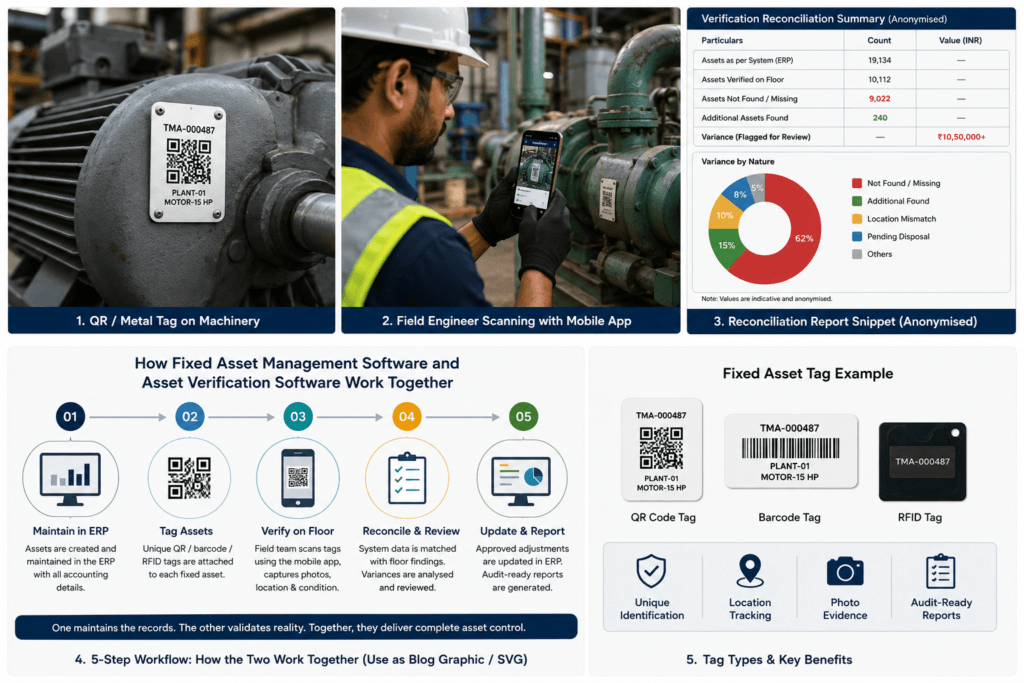
What Fixed Asset Management Software Does
Fixed asset management software answers one question: what should exist?
It is the system of record for your assets. In most Indian companies, this role is played by the fixed asset module of an existing ERP rather than a standalone product:
- SAP (Asset Accounting module)
- Oracle Fusion / EBS Fixed Assets
- Microsoft Dynamics 365
- Tally Prime (fixed asset ledgers)
- Dedicated FAMS products
Whatever the platform, the core functions are similar. The software maintains the asset master, capitalisation dates and values, depreciation as per Companies Act and Income Tax rules, cost centre and location codes, inter-unit transfers, revaluations, impairments, and disposals. It feeds the fixed asset schedule in your financial statements and supports depreciation workings during statutory audit.
This is finance-team territory. The data lives at a desk, and it is only as accurate as the last entry someone made.
What Asset Verification & Tagging Software Does
Asset verification software — sometimes searched for as physical verification software or fixed asset audit software — answers the other question: what actually exists?
This category covers the tools used during physical verification of fixed assets:
- QR code and barcode asset tags applied to each asset
- RFID tags for high-volume or hard-to-reach environments
- A mobile verification app used by field teams to scan tags, capture photographs, record location and condition, and geo-tag assets
- Reconciliation reports that match floor findings against the asset register
The output is not an accounting entry. It is evidence: this asset was seen, at this location, on this date, in this condition, with this photograph. This evidence supports the auditor’s assessment under CARO 2020, which requires reporting on whether property, plant and equipment have been physically verified by management according to a regular programme, and whether material discrepancies have been properly dealt with in the books.
This is audit-and-operations territory. The data is created on the shop floor, not at a desk.
The Difference at a Glance
| Fixed Asset Management Software | Asset Verification & Tagging Software |
| Maintains asset records | Confirms physical existence |
| Calculates depreciation | Scans QR / barcode / RFID tags |
| Handles capitalisation and disposal accounting | Captures photos, condition, and geo-location |
| Answers “what should exist?” | Answers “what actually exists?” |
| Used continuously by the finance team | Used periodically by audit and field teams |
| Lives in the ERP | Lives on a mobile device at the asset location |
| Output: asset register and depreciation schedule | Output: verification evidence and reconciliation report |
Neither replaces the other. The register without verification is unproven; verification without a register has nothing to reconcile against.
“But We Already Have SAP”
This is the most common response we hear when physical verification comes up — and it reflects a genuine confusion between the two categories.
Having a properly maintained SAP fixed-asset module means your asset records may be systematically organised. It does not mean anyone has confirmed those records against reality. Between two verification cycles, a lot happens on the ground that never reaches the ERP:
- Assets are moved between floors, plants, or branches without a transfer entry
- Equipment is scrapped informally and the record stays live in the books (“ghost assets”)
- Assets purchased at site level exist physically but were never capitalised
- Items are cannibalised for spares while the parent asset remains on the register
- Descriptions in the register are too vague to match to a physical item at all
The result is a Fixed Asset Register that is internally consistent — depreciation runs, schedules tie out — but externally unverified. The question your auditor will ask is not “does your ERP calculate depreciation properly?” It is “when were these assets last physically verified, and what discrepancies were found?”
What Verification Actually Finds
From one FAR reconciliation engagement (details anonymised): the client’s system register carried 19,134 assets. Physical verification confirmed 10,112 of them on the ground, and the reconciliation exercise surfaced gross book-value variances exceeding ₹10.5 lakh that were flagged for management review and appropriate accounting action.
The ERP had been running for years and continued calculating depreciation on the recorded asset population — even though some of those assets could not be traced during verification. That is the gap between the two software categories in one example: the FAMS was doing its job, and the register still did not reflect physical reality until a verification exercise tested it.
(For the full methodology behind an exercise like this, see our FAR reconciliation services page.)
How the Two Work Together
In a well-run asset governance cycle, the flow looks like this:
- The ERP holds the register. The finance team extracts the asset listing — asset codes, descriptions, locations, gross block, WDV.
- Assets are tagged. Each asset gets a durable QR, barcode, or RFID tag carrying a unique ID that links the physical item to its register entry. Tag material and fixing method depend on the environment — a polyimide label on office IT equipment, a metal tag with mechanical fixing on plant machinery.
- Field teams verify. Using a mobile verification app, teams scan each tag, capture a photograph, record location and condition, and geo-tag the asset. Untagged items found on the floor are logged as potential additions.
- Findings are reconciled. The verification data is matched against the ERP extract. Missing assets, untraced assets, location mismatches, and unrecorded additions are classified and documented.
- The ERP is updated. Adjustments approved by management — write-offs, transfers, capitalisations — flow back into the FAMS, so the register reflects reality again.
The ERP is the destination; tagging and verification are the evidence pipeline that keeps it honest. Companies that skip steps 2–4 are running step 5 on assumptions.
Where TagMyAssets Fits
TagMyAssets does not replace SAP, Oracle, or any fixed asset management software — and we would advise against any vendor who claims their verification tool can. Our role is the field execution layer that your ERP cannot provide:
- Physical asset tagging with QR, barcode, or RFID, matched to your existing asset codes
- On-ground physical verification using our mobile verification workflow — scan, photograph, geo-tag, condition capture
- FAR reconciliation that maps floor findings to your register, item by item
- Structured, audit-ready reports that support statutory-audit review and CARO 2020 reporting
The verification application is also available on subscription for organisations that want to continue in-house after the first exercise. You can upload your asset list, generate and print QR labels for new assets as they are acquired, and run your own later verification cycles. It is not a replacement for your ERP’s fixed asset module — it is the tagging and verification layer, kept in your hands between engagements.
Across 395+ projects, 1500+ locations, and 10 lakh+ assets tagged, the pattern has been consistent: companies with sophisticated ERPs are not exempt from register-versus-reality gaps. They simply have better-formatted records of assets no one has seen recently.
Which Does Your Company Need?
Broadly, both — but the balance between asset verification software and FAMS differs by situation.
| Your situation | What you actually need |
| ERP/SAP in place, assets never independently verified | Tagging + physical verification + FAR reconciliation |
| Asset register maintained in Excel | Tagging + verification to build a reliable register first |
| New plant or office being set up | Tagging at capitalisation, so verification is scan-based from day one |
| Statutory audit approaching, CARO 2020 reporting due | Physical verification with audit-ready evidence and reconciliation |
| Multi-location company with branch networks | Independent verification across locations + consolidated reconciliation |
| Internal team already tags and verifies | Independent verification for control strength and multi-site coverage |
If you have an ERP with a fixed asset module: your FAMS need is largely covered. What you likely need is the verification side — tagging, periodic physical verification, and reconciliation. This is the most common scenario among mid-size and large Indian companies searching for asset verification software in India: the records system exists, the evidence layer does not.
If you have no structured asset register at all: you need both, but in sequence. A verification and tagging exercise is often the fastest way to build the register in the first place — you cannot record what you have not counted.
If you already tag and verify internally: the question becomes independence and coverage. Internal teams verifying their own custody of assets is a weaker control than independent verification, and multi-location coverage is where internal exercises usually stall.
Whether records are maintained in SAP or in a spreadsheet, companies within the scope of CARO 2020 need an appropriate physical-verification process and must address material discrepancies identified during verification. Even where CARO 2020 is not applicable, periodic verification remains an important asset-control practice.
Common Misconceptions
“We have SAP, so our assets are verified.” SAP verifies that your entries are consistent, not that your assets exist. Physical existence can only be established by someone standing in front of the asset.
“QR tags automatically update the ERP.” Asset verification software identifies assets; it does not post accounting entries. Verification findings still go through a reconciliation and approval process before the register is updated — and that control step is deliberate, not a limitation.
“Asset tagging is only for inventory.” Inventory and fixed assets are different populations with different controls. Tagging fixed assets serves verification, custody, and audit reporting — not stock counting.
“Physical verification is only needed at audit time.” Under CARO 2020, the auditor reports on whether management has physically verified assets according to a regular programme — not a one-off, audit-week scramble. Companies that verify on a planned cycle walk into audits with evidence already in hand.
Industry Snapshots
The software categories stay the same across sectors; the verification challenge changes:
- Manufacturing: heavy machinery, harsh environments, tags that must survive heat, grease, and vibration; high ghost-asset risk from informal scrapping.
- Hotels: thousands of low-value, high-mobility assets (furniture, kitchen equipment, room assets) spread across floors and outlets.
- Hospitals: medical equipment with regulatory traceability needs; assets that move between wards daily.
- Banks & NBFCs: branch networks where the same asset categories repeat across hundreds of locations; concurrent audit expectations.
- Corporate offices: IT assets with high churn; laptops and peripherals that follow employees, not cost centres.
- Warehouses & retail: racking, MHE, and fit-outs where the line between fixed asset and inventory blurs.
- Educational institutions: grant-funded assets requiring utilisation evidence; multi-campus registers.
In every case the ERP entry looks identical. The tag material, verification method, and reconciliation complexity do not.
The Bottom Line
Strong asset governance does not come from choosing between an ERP and verification — it comes from using each for the job it was built to do. The ERP maintains the books; tagging and verification test them against reality; reconciliation closes the gap. A register that runs depreciation on assets nobody can find is not asset management. It is well-formatted uncertainty.
If your fixed asset records live in SAP, Oracle, Dynamics, or Tally and have not been independently verified against the floor, that verification layer — asset verification software and field execution, not another ERP purchase — is usually the missing piece. Talk to us about physical verification and FAR reconciliation for your locations.
Frequently Asked Questions
What is the difference between fixed asset management software and asset verification software?
Fixed asset management software maintains asset records — capitalisation, depreciation, transfers, and disposals — and answers what should exist. Asset verification software supports physical verification through tag scanning, photo capture, and geo-tagging, and answers what actually exists. Most companies need the first for accounting and the second for audit evidence and register accuracy.
We already use SAP. Do we still need asset tagging and verification?
In most cases, yes. SAP maintains your asset records but cannot confirm physical existence. For companies within the scope of CARO 2020, the auditor reports on whether management has physically verified property, plant and equipment according to a regular programme and dealt with material discrepancies. Tagging and verification provide the evidence and the reconciliation that keep your SAP register aligned with reality.
Is asset tagging software the same as asset tracking software?
They overlap but are not identical. Asset tracking software typically monitors asset movement on an ongoing basis, often for IT or logistics use. Asset tagging in the verification context means applying durable QR, barcode, or RFID identifiers so each physical asset can be matched to its register entry during periodic verification and reconciliation.
What does asset verification software capture during a physical verification?
A typical mobile verification workflow captures the scanned tag ID, a photograph of the asset, its physical location (often geo-tagged), condition, and user or department. Assets found on the floor without tags are logged separately as potential unrecorded additions for the reconciliation stage.
Can physical verification be done without tagging the assets first?
It can, but it is slower and harder to repeat. Without unique tags, each verification cycle restarts the matching problem — vague register descriptions must be manually mapped to physical items every time. Tagging converts verification from a one-off matching exercise into a repeatable scan-based process. .
Do we need special scanners?
No. The verification workflow runs on standard Android and iOS phones. Field teams scan tags, capture photographs, and record location and condition using the mobile app — no handheld hardware purchase is required.
How long does a verification engagement take?
Typically 2–8 weeks, depending on asset volume and the number of
locations covered. Multi-location engagements are usually sequenced
site by site rather than run in parallel.